

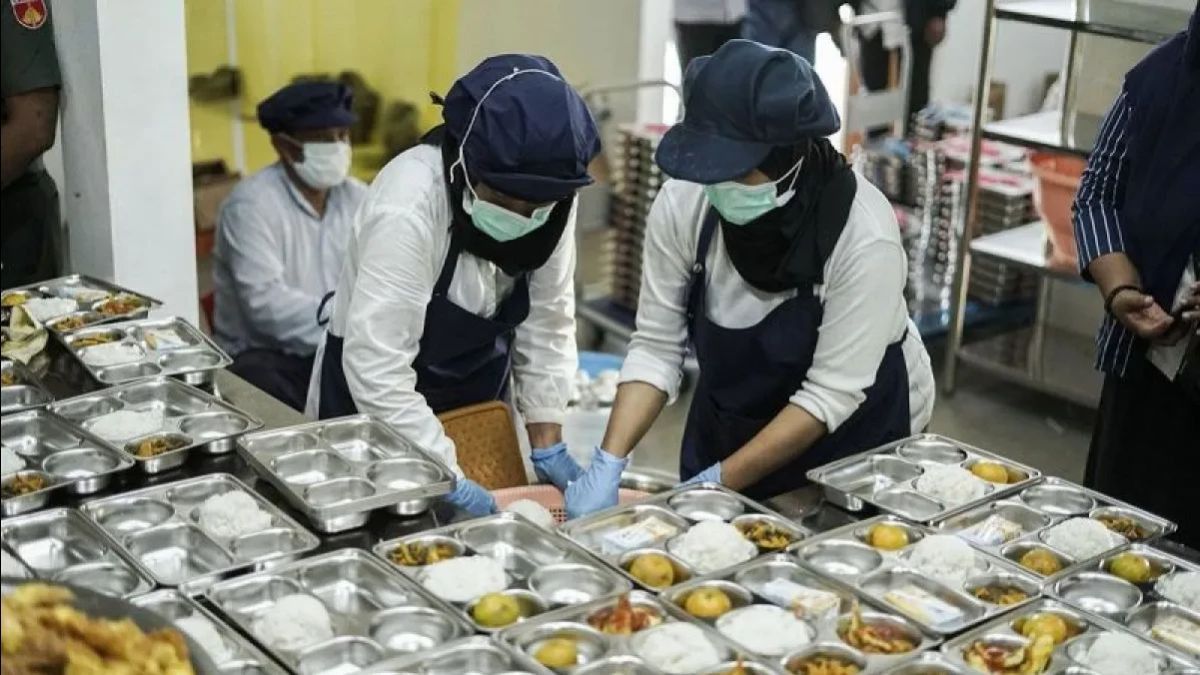


SAMARINDA - The National Nutrition Agency (BGN) is evaluating the implementation of the Free Nutritious Meal (MBG) Program in East Kalimantan (Kaltim) to ensure the eligibility of facilities, especially related to 38 Nutrition Fulfillment Service Units (SPPG) that do not have Waste Water Treatment Facilities (Ipal).
"Strengthening the supervision system is the key to the success of this program, especially to ensure the quality of infrastructure facilities and compliance with operational standards for the best nutrition services for the community," said Director of Regional Monitoring and Supervision III BGN Rudi Setiawan, quoted by Antara, Sunday, April 26.
The evaluation is deliberately carried out continuously with the regional coordinators, foundations, and management partners, so that all nutrition kitchens run on target.
He said that in total, 196 SPPGs had been formed in the Kaltim region. Of this number, he said, as many as 176 SPPGs had served the community gradually to meet the nutrition of school-age children, from elementary school to secondary education.
However, he continued, the absence of IPAL disposal facilities in dozens of processing kitchens is still a concern for the government to be immediately improved in order to maintain the sustainability of the surrounding environment.
"This national program has proven to have a positive impact," he said, because it not only relieves the economic burden of parents of students, but also manages to open thousands of new jobs.
His party continues to ensure the smooth running of the MBG Program, which also encourages local economic circulation by involving Small and Medium Enterprises (SMEs) and empowering the Red and White Cooperative in various districts.
The Head of the Kaltim Jaya Health Office (Dinkes) Mualimin also ensured that his staff closely monitored every stage of the operation of the nutrition facility through a cross-sectoral integrated task force.
"Every facility is required to pass a thorough initial inspection before the local government issues a legality document in the form of a Certificate of Hygiene Sanitation (SLHS)," he said.
As a mitigation, he continued, at the initial operational stage, each unit is limited to a maximum of 500 portions for feasibility testing before its capacity is increased to serve thousands of MBG recipients.
This restriction is applied with caution because the facility produces food for schoolchildren who are classified as high-risk groups for contamination.
"The joint supervisory team is not even hesitant to temporarily stop the kitchen's operation automatically, if it finds a prominent incident such as the entry of foreign objects into food," said Jaya.
Head of BGN Regional East Kalimantan Binti Maulina Putri emphasized that her party requires all partners to comply with standard guidelines and implement a daily internal reporting system in stages.
The English, Chinese, Japanese, Arabic, and French versions are automatically generated by the AI. So there may still be inaccuracies in translating, please always see Indonesian as our main language. (system supported by DigitalSiber.id)
Most Popular Tags
#Prabowo Subianto #donald trump #2026 World Cup #Febrie Adriansyah #8791Popular


