
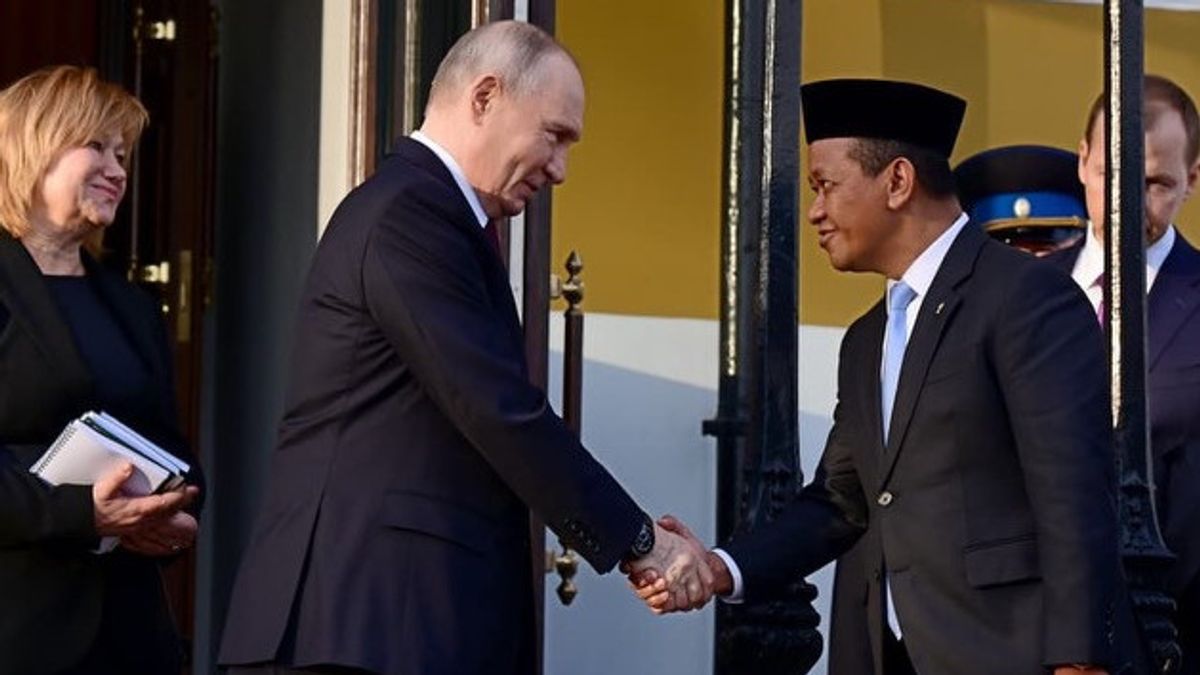


JAKARTA - Energy experts and researchers assess the Indonesian Government's move to establish energy supply cooperation with Russia as a tactical decision that should be appreciated.
The agreement reached through a meeting between Energy and Mineral Resources Minister (ESDM) Bahlil Lahadalia and Russian Energy Minister Sergey Tsivilev includes crude oil supplies, LPG, and the development of storage facilities.
Researcher of the Center for Energy and Mineral Resources Studies from the Sepuluh Nopember Institute of Technology (ITS), Ridho Hantoro, assessed that additional supplies from Russia were a reasonable tactical step in the context of national energy diversification. According to him, this policy can expand supply options while reducing the risk of import concentration, which has been one of Indonesia's vulnerabilities.
"Additional supplies from Russia are a reasonable tactical step to expand supply options and reduce the risk of import concentration," he said when contacted, Friday, April 17.
Ridho also gave a positive assessment of the storage development plan which is part of the cooperation. According to him, strengthening the storage infrastructure is actually a more fundamental step than simply increasing the volume of supply.
"The construction of storage is a more fundamental strategic step, because it strengthens the resilience of the system, not just adding volume of purchases for a moment," said Ridho.
Although he appreciates the government's steps, Ridho reminds that the success of this policy should not stop at diplomatic achievements. He emphasized the importance of technical indicators in implementation, ranging from competitive supply prices, the suitability of crude types with domestic refineries, to the effectiveness of LPG in reducing imports.
"The success of this policy will not be measured by its diplomatic headlines, but by very concrete things, whether the supply price is more competitive, whether the crude is suitable for refineries, whether LPG really reduces import pressure, whether storage is in the right logistics location, and whether the stock can really be accessed quickly during a crisis," he said.
Ridho also placed this cooperation in a broader context as part of the national energy transition and resilience strategy. He reminded that additional supplies from abroad will not solve the fundamental problem if it is not accompanied by strengthening the domestic energy sector.
"This should be seen as part of the energy transition and resilience strategy, not as an end goal. Indonesia still needs to parallel strengthen domestic lifting, refinery upgrading, fuel consumption efficiency, LPG substitution, bioenergy, and acceleration of electrification. Without it, additional supplies will only improve symptoms, not the root of the vulnerability," he said.
In line with Ridho, lecturer and public policy researcher at the State University of Surabaya (Unesa), Ahmad Nizar Hilmi also appreciated the government's move. He assessed that this cooperation is not only of a technocratic dimension, but is also part of the global energy-political economic dynamics that influence domestic policy directions.
"In the perspective of policy, cooperation in energy supply with Russia needs to be read not only as a technocratic solution to increase stocks, but also as part of the global energy-political economic dynamics that shape domestic policy choices," he said.
On the other hand, he assessed that the government's move remained relevant as a stabilization policy amid global pressure. Energy, he said, is a political commodity that is very sensitive to economic turmoil.
"Keeping supply and prices under control means dampening the potential for social pressure due to inflation and economic turmoil. Therefore, this policy is pragmatic in the short term, but risks becoming 'dependence management' if it is not accompanied by other, more fundamental, improvement agendas," he concluded.
The English, Chinese, Japanese, Arabic, and French versions are automatically generated by the AI. So there may still be inaccuracies in translating, please always see Indonesian as our main language. (system supported by DigitalSiber.id)
Most Popular Tags
#Prabowo Subianto #donald trump #Febrie Adriansyah #8791 #giias 2026Popular


