



PASURUAN - The hope of bringing light to the remote areas of North Kalimantan (Kaltara) continues to be pursued by the Provincial Government (Pemprov) Kaltara, which pays serious attention to the basic needs of the community in the 3T area (Left Behind, Leading, and Outermost), especially access to electricity which until now has not been even.
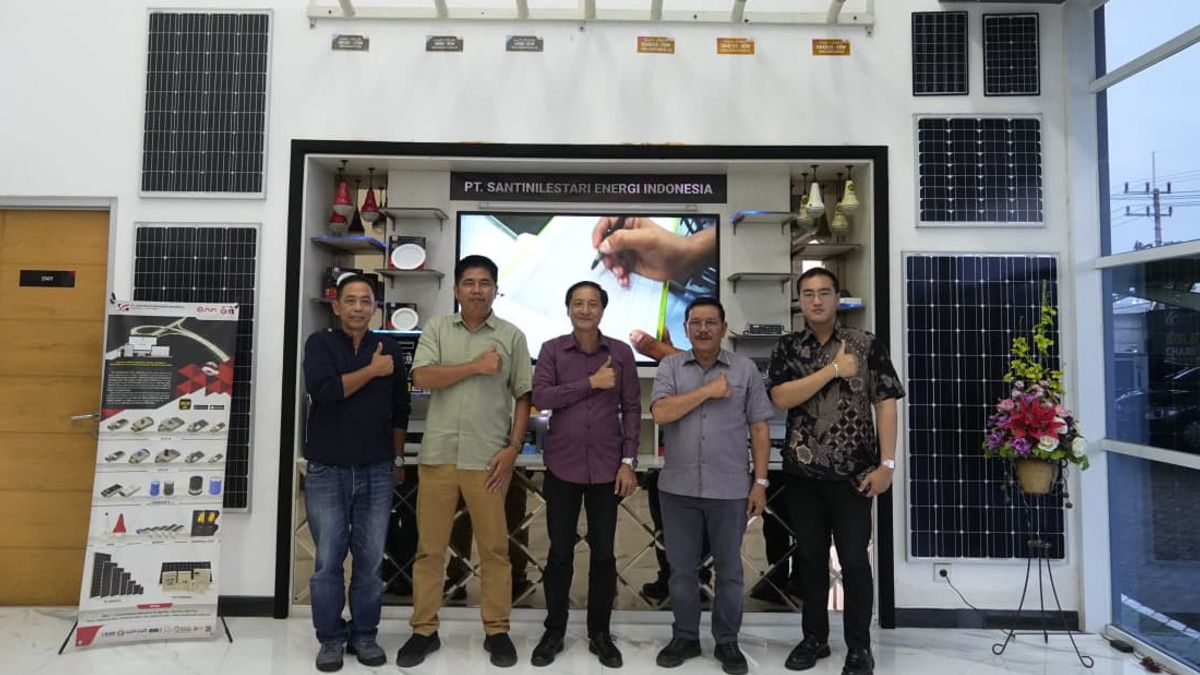
The Deputy Governor (wagub) of Kaltara, Ingkong Ala, directly visited the PT Santinilestari Energi Indonesia factory in Pasuruan, last weekend.
This visit is not just a work agenda, but part of the effort to find real solutions for people in the interior and border areas who still live without electricity.
At the location, Ingkong was greeted by the Director of PT Santinilestari Energi Indonesia, Sandy Hartono, and also received a detailed explanation of renewable energy technology, especially solar power plants which are considered suitable for use in remote areas such as Kaltara.
For Ingkong, electricity is not only about lighting, but also an entrance to progress.
"Basic services such as electricity have an important role for people in the interior. This concerns education, health, to the economy of the people," he said.
Ingkong did not deny that the geographical conditions of Kaltara, which is dominated by forests, rivers, and border areas, are a major challenge in infrastructure development.
"Difficult access makes conventional electricity distribution not always possible," said Ingkong.
"Therefore, the North Kalimantan Provincial Government has started to look at alternative energy. And we continue to look for solutions outside of conventional services, one of which is through the use of solar energy. This is more flexible to reach remote areas," he continued.
Ingkong Ala also witnessed the production process of solar panels, energy storage batteries, to the electricity distribution installation system. This technology is expected to be an answer for villages that have not been touched by electricity. Data from the North Kalimantan Provincial Government notes that there are still around 73 to 123 villages that have not been electrified.
"Most of them are in border areas such as Nunukan and Malinau Regencies. Areas that have been Indonesia's leading face have not fully enjoyed the light," he explained.
He emphasized that with gradual efforts, the government targets 10 to 20 villages to be electrified every year.
"This effort is part of the commitment to bring justice to the development of electricity energy to the outermost point," he said.
Behind this visit, Ingkong has a simple hope that when the lights start to turn on in the border villages, the lives of the residents will slowly change, children can study at night, health services are more optimal, and the wheels of the economy begin to move.
The English, Chinese, Japanese, Arabic, and French versions are automatically generated by the AI. So there may still be inaccuracies in translating, please always see Indonesian as our main language. (system supported by DigitalSiber.id)


