

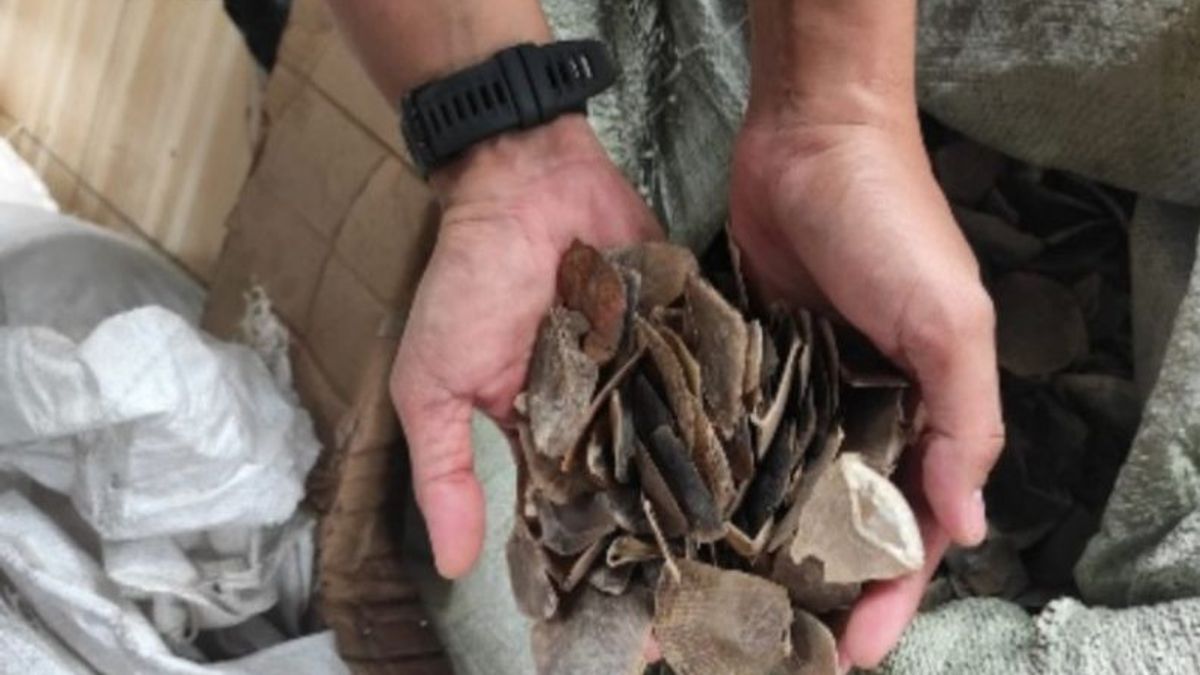


JAKARTA - The Ministry of Forestry (Kemenhut) detained a Vietnamese citizen with the initials LVP related to smuggling 26 boxes of pangolin scales (Manis javanica) with a total weight of 796.34 kilograms from a foreign ship flying the Vietnamese flag in the Merak Port area, Banten.
Director General of Law Enforcement (Gakkum) of the Ministry of Finance, Dwi Januanto Nugroho, explained that the disclosure of nearly 800 kilograms of pangolin scales from the foreign ship showed a serious threat to Indonesia's biological wealth.
"When the body parts of protected animals are traded on a large scale, the country faces not just ordinary violations, but crimes that undermine the value of wildlife, undermine conservation efforts, and test Indonesia's firmness in maintaining its life's wealth," said the Director General of Gakkum as quoted by ANTARA, Monday, April 13.
Therefore, law enforcement must be built not only to stop one shipment, but to narrow down the entire space that allows illegal wildlife trade to continue to move.
He said the case was also the basis for strengthening the prevention system nationally. Wildlife protection is not enough to be guarded in its habitat, but must also be maintained on every path that has the potential to be used for illegal circulation.
In the future, more integrated supervision and more precise responses will continue to be strengthened so that the scope of illegal wildlife trade will be narrowed.
In a similar statement, the Head of the Forestry Gakkum Office for Java, Bali, and Nusa Tenggara, Kemenhut, Aswin Bangun, explained that the matter began with the delivery of the ship and its cargo by the Banten Naval Base (Lanal) to the Forestry Gakkum.
The ship used was the cargo ship MV Hoi An 8, which was known to carry an official cargo of steel coils weighing around 2,735 tons and was manned by 13 Vietnamese citizens. In the middle of the legal cargo, officers found illegal cargo in the form of pangolin scales which were suspected of being smuggled.
Based on the results of the preliminary investigation, this case is suspected of leading to an organized and cross-border wildlife trafficking pattern.
The scale of evidence, the use of foreign vessels, and the alleged modus operandi at sea indicate that this case cannot be viewed as ordinary smuggling, but rather leads to an international-scale illegal wildlife trade pattern that is being further investigated by investigators.
Investigators are also tracing the origin of the pangolin scales and the distribution channels used in the smuggling attempt. One of the suspected modus operandi that is being investigated is the transshipment from ship to ship (STS) in the middle of the sea, as well as the possible use of the method of floating goods at certain coordinates, a pattern often used to obscure the origin of the cargo and distribution channels.
Conservationally, the evidence of 796.34 kilograms of pangolin scales cannot be seen as mere seizure figures. Such a weight reflects the alleged killing of protected animals on a very serious scale.
He highlighted that the Javanese pangolin is a protected animal with a critically endangered status, so the case must be read not only as smuggling illegal goods, but also as a real threat to the sustainability of protected animals and the balance of the ecosystem.
"Therefore, we are not only focusing on the suspects who have been detained, but also continue to trace the patterns, paths, and structures of circulation used in this case," he said.
The English, Chinese, Japanese, Arabic, and French versions are automatically generated by the AI. So there may still be inaccuracies in translating, please always see Indonesian as our main language. (system supported by DigitalSiber.id)
Most Popular Tags
#Prabowo Subianto #donald trump #2026 World Cup #Febrie Adriansyah #8791Popular


