

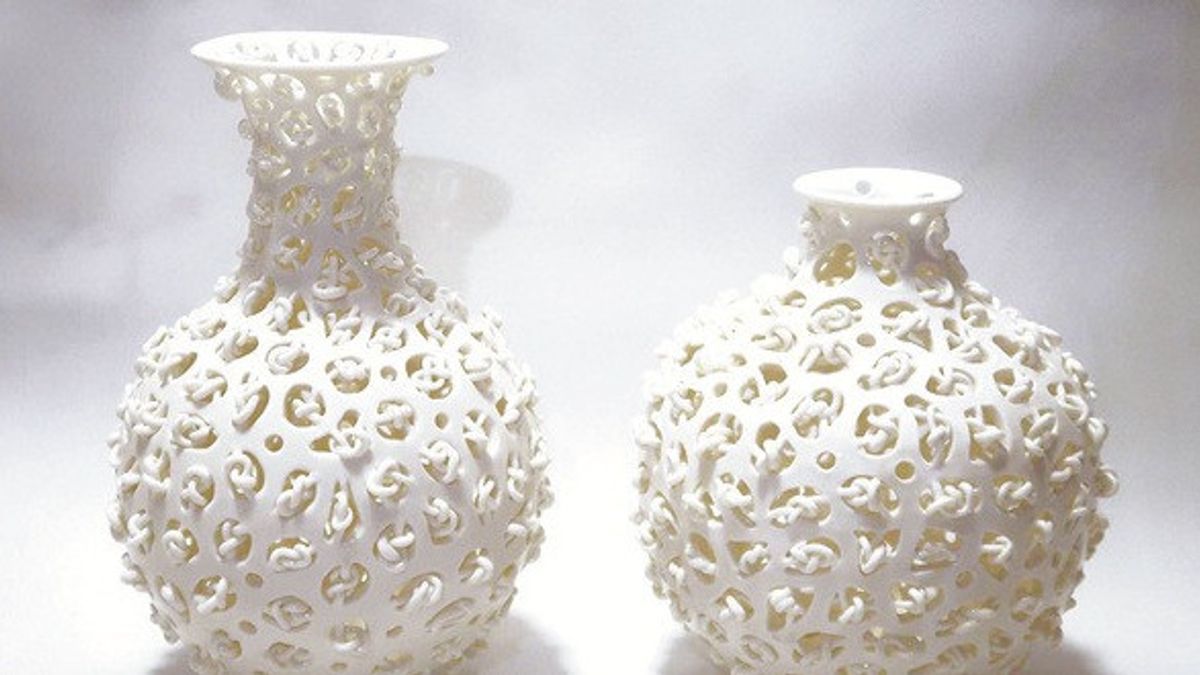


Dehua porcelain, a typical white Chinese ceramic known in the West as Blanc de Chine, has once again attracted attention through the works of young artists who combine traditional techniques with a contemporary approach.
According to a report by China Daily quoted on Monday, April 6, the ceramic tradition from Dehua, Fujian Province, has been around for more than 3,700 years and has long been known for its distinctive white color and high level of technical precision.
One of the prominent works is Princess Yushu by ceramic maestro Lian Deli. The work exhibited at the Guangdong Art Museum is known for its intricate details, including translucent robes and hair carvings as thin as 0.2 millimeters. Lian said the work is the thinnest Dehua porcelain ever made and took almost seven years and hundreds of failed firings to complete.
The level of technical difficulty of Dehua is also described by the porcelain artist Zhou Yao. According to him, from one firing of a kiln containing about 20 objects, sometimes only one succeeds. Each stage, from formation, firing, drying, to firing, requires very high accuracy.
Amid the turmoil, a new generation of Dehua artisans began to present different shapes. Lai Xirong, for example, is known for his work that incorporates porcelain knots into vessels. His work includes the Knot sculpture, a knotted coffee cup, to the "instant noodles" of porcelain. Lai said the Chinese knot has the meaning of luck and wants to bring it closer to everyday life.
Another artist, Zhang Heirui, blends traditional Dehua techniques with global cultural elements. One of his works, Lunar Ice Cream Cone, is in the shape of a moon ice cream cone complete with a Jade Rabbit. Another work, Black and White in Shakespeare's Eyes, explores William Shakespeare and the social-political tensions of the Renaissance era.
Zhang's approach has generated praise as well as criticism. However, two of his works have received international recognition. Lunar Ice Cream Cone was collected by Tate Modern in the UK, while Black and White in Shakespeare's Eyes was added to the collection of the Centre Pompidou in France.
Dehua porcelain itself has been known in Europe since the 17th and 18th centuries through the Maritime Silk Road. Now, a new interpretation by the younger generation is bringing the tradition back to the global public's attention. (Source: China Daily)
The English, Chinese, Japanese, Arabic, and French versions are automatically generated by the AI. So there may still be inaccuracies in translating, please always see Indonesian as our main language. (system supported by DigitalSiber.id)
Most Popular Tags
#Prabowo Subianto #donald trump #2026 World Cup #venezuela #konflik timur tengahPopular


