
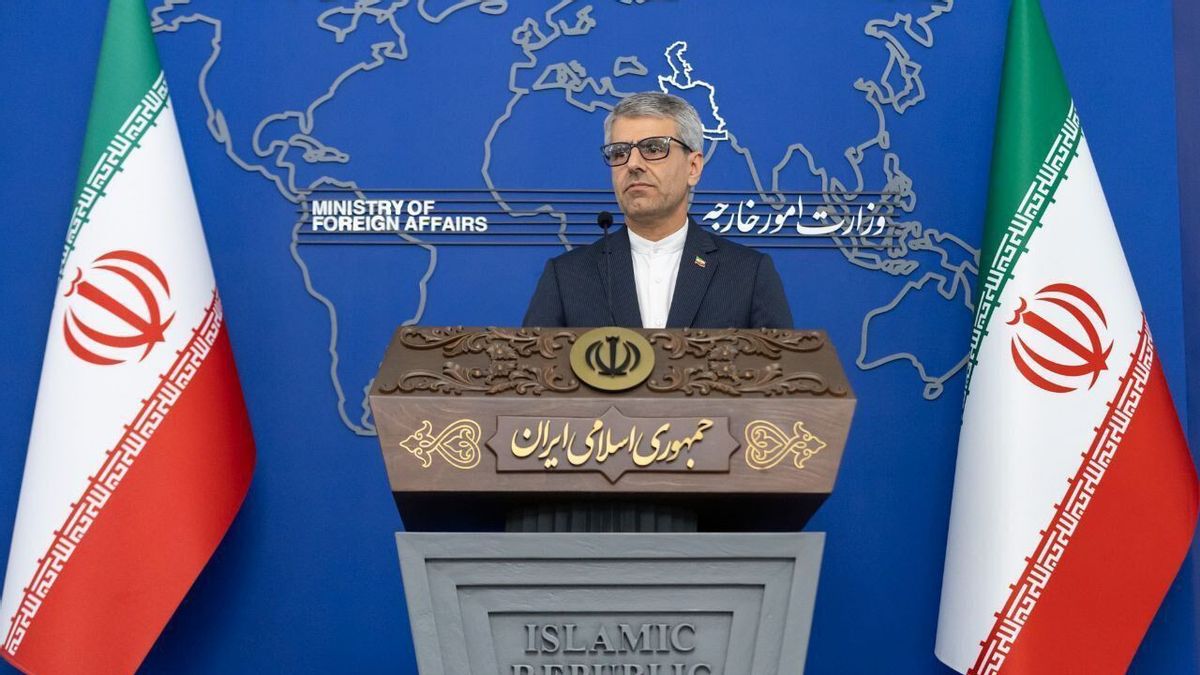


JAKARTA - The spokesperson for the Iranian Ministry of Foreign Affairs on Monday said that Tehran had formulated its position and demands in response to the recent ceasefire proposal submitted through intermediaries, adding that negotiations "do not correspond to ultimatums and threats to commit war crimes."
Iran is engaged in a conflict with the United States and Israel, along with an attack on Tehran and a number of other cities in the country on February 28 that killed more than 1,340 people, including the late Supreme Leader Ayatollah Ali Khamenei and a number of other senior officials.
Spokesman Esmaeil Baghaei said Tehran had a set of requirements based on its national interests that had been conveyed through intermediaries, adding that previous US demands such as a 15-point plan were rejected as "excessive."
"Iran does not hesitate to clearly state what it considers to be legitimate demands and this should not be interpreted as a sign of compromise, but rather as a reflection of confidence in maintaining its position," Baghaei said at a press conference, as reported by Al Arabiya from Reuters (6/4).
"We have formulated our own response" and will announce the details in due course, he added in response to an Iranian journalist's question about ongoing efforts to realize a ceasefire between Iran and the US.
In response to the February 28 attack, the Mullah's State retaliated with drone strikes and missiles targeting Israel, as well as Jordan, Iraq, and Gulf countries hosting US military assets.
In addition, Iran also restricts the movement of ships through the Strait of Hormuz, a waterway that is one of the veins of global oil and gas transportation.
Iran and the United States have accepted a plan to end hostilities that could take effect on Monday and reopen the Strait of Hormuz, a source familiar with the proposal said on Monday.
"A framework for ending hostilities has been drafted by Pakistan and exchanged with Iran and the US overnight," said the source, who outlined a two-stage approach with an immediate ceasefire followed by a comprehensive agreement.
"All elements need to be agreed today," the source said, adding that the initial understanding would be drafted as a memorandum of understanding completed electronically through Pakistan, the only channel of communication in the talks.
Axios first reported on Sunday that Washington, Tehran and regional mediators were discussing a potential 45-day ceasefire as part of a two-phase deal that could lead to a permanent end to the war, citing US, Israeli and regional sources.
The source told Reuters that the Chief of the Pakistan Army, Field Marshal Asim Munir, had been in contact "all night" with US Vice President JD Vance, Special Envoy Steve Witkoff, and Iranian Foreign Minister Abbas Araghchi.
Based on the proposal, a ceasefire will take effect immediately, reopening the Strait of Hormuz, with a time of 15-20 days to complete a broader agreement.
The agreement, which for now is called the "Islamabad Agreement," will include a regional framework for the strait, with the last face-to-face talks in Islamabad.
There was no immediate response from the US. Meanwhile, Pakistan's Foreign Ministry spokesman, Tahir Andrabi, declined to comment.
Meanwhile, a senior Iranian official told Reuters on Monday that the Iranian Mullah State would not reopen the Strait of Hormuz in return for a "temporary ceasefire," adding that Tehran considered Washington less prepared for a permanent ceasefire.
The official confirmed Iran had received Pakistan's proposal for an immediate ceasefire and was reviewing it, adding Tehran was not under pressure to accept a deadline and make a decision.
Iranian officials have previously told Reuters that Tehran is seeking a permanent ceasefire with assurances that it will not be attacked again by the US and Israel.
They said Iran had received messages from mediators including Pakistan, Turkey, and Egypt.
The English, Chinese, Japanese, Arabic, and French versions are automatically generated by the AI. So there may still be inaccuracies in translating, please always see Indonesian as our main language. (system supported by DigitalSiber.id)
Most Popular Tags
#Prabowo Subianto #donald trump #2026 World Cup #Febrie Adriansyah #8791Popular


