
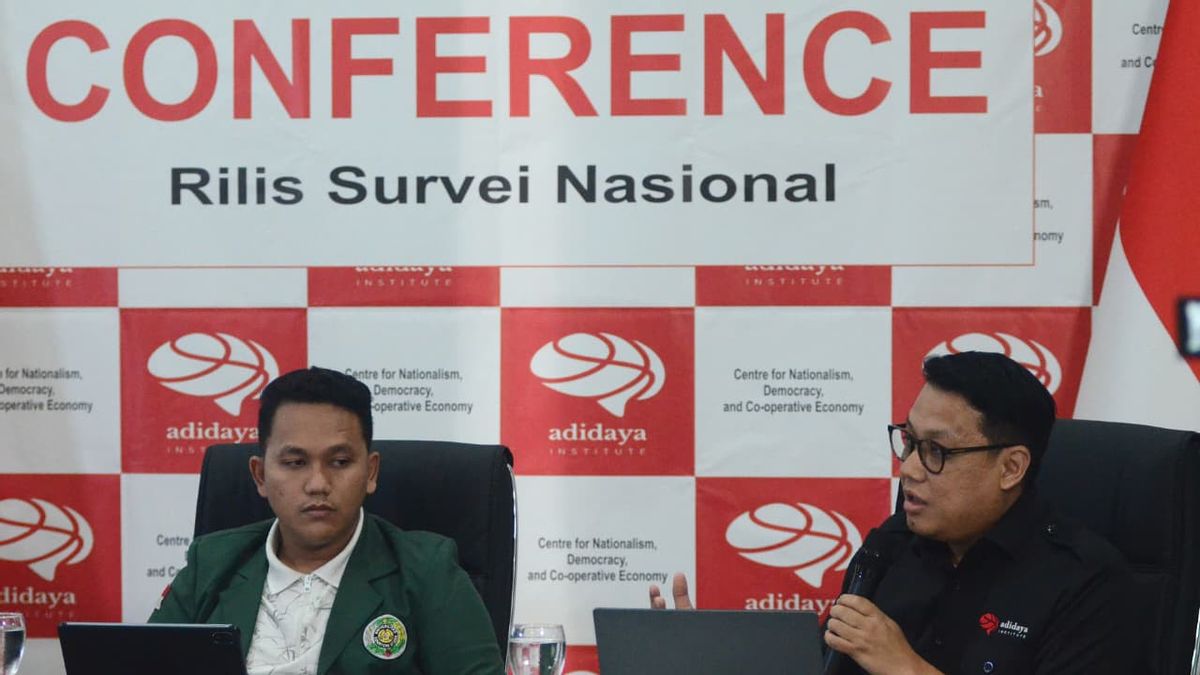


Adidaya Institute asked the government to change the model of the Free Nutritious Meal (MBG) program from a feeding program to an integrated food economy platform. Adidaya assessed that the feeding model was no longer adequate because it was only oriented towards food distribution and budget absorption.
"MBG is too simple if it is allowed to only be a food distribution program. MBG must be transformed into a national food economy machine," said Adidaya Institute Economist Bramastyo B Prastowo in a media dialogue that took place at the Adidaya Institute office in Kuningan, Tuesday, March 31.
According to Bram, this shift is not just a change in the model. This change in the scheme is a change in the way the state views this program. From the social spending framework to economic investment, from output (portion served) to outcome (growing food ecosystem), and from short-term programs to the foundation of long-term food security.
The reason is, said Bram, if it is only seen as a consumption program, then in every global turmoil such as when the Iran-Israel-US war occurs, the sustainability of the MBG program is certainly very threatened. In addition to causing rising costs, the MBG program will certainly cause pressure on the country's finances.
Bram explained that as long as MBG was designed only as a consumption program, every global turmoil would immediately hit its sustainability. Costs rise, the quality of the portion is threatened, coverage narrows, and pressure on the state's finances is getting heavier.
"If MBG still uses the old model, we are building a fiscal iceberg. Every day the cost goes up, but the local economy does not move. Without a change in policy design, MBG risks becoming a burden on the budget that continues to grow without comparable structural impacts. In a global situation like the current one, silence is the most expensive option," said Bram.
Therefore, the Adidaya Institute again emphasized the effort to change the transformation of the MBG program, from a consumption distribution program to a national food absorption platform based on local production. Thus, the large and regular MBG raw material needs will later become a structured demand that is absorbed directly from farmers, fishermen, livestock farmers, and domestic food MSMEs. For example, with a daily requirement of 61.6 million servings to buy from local production, that is the most visible multiplier effect for farmers and fishermen in every corner of the village.
"Imagine the impact. Farmers have a sure buyer (they dare to plant more). Fishermen enter the official supply chain (income increases). Village cooperatives become aggregators and distributors (villages become economic centers). Food MSMEs grow because there is a clear and sustainable market. State money circulates within the country - not flowing to importers," said Bram.
This paradigm shift is what Adidaya Institute wants to fight for. The reason is, as long as MBG is understood as a feeding program (feeding program), the measure of success is only whether the food has reached the hands of the recipient. In fact, if we look at the spirit carried out by President Prabowo, in the framework of Big Bang and Big Push, the MBG program is expected to be a program that can increase national income and welfare.
"The question about the effectiveness of MBG recipients is important, but it is not enough. He did not answer: where is the raw material? Who benefits? Does the local economy move? When MBG transforms into a local food ecosystem program, the question changes completely. What percentage of raw materials are absorbed from local production? How many farmers and fishermen are included in the official supply chain? How many food MSMEs are growing because of MBG? How much rupiah is circulating in the local economy - not going out to importers? "he said.
"MBG that only measures the number of portions is a MBG that is halfway. MBG that measures the growth of the local food ecosystem - that is the MBG that really works for Indonesia," continued Bram.
The English, Chinese, Japanese, Arabic, and French versions are automatically generated by the AI. So there may still be inaccuracies in translating, please always see Indonesian as our main language. (system supported by DigitalSiber.id)


