
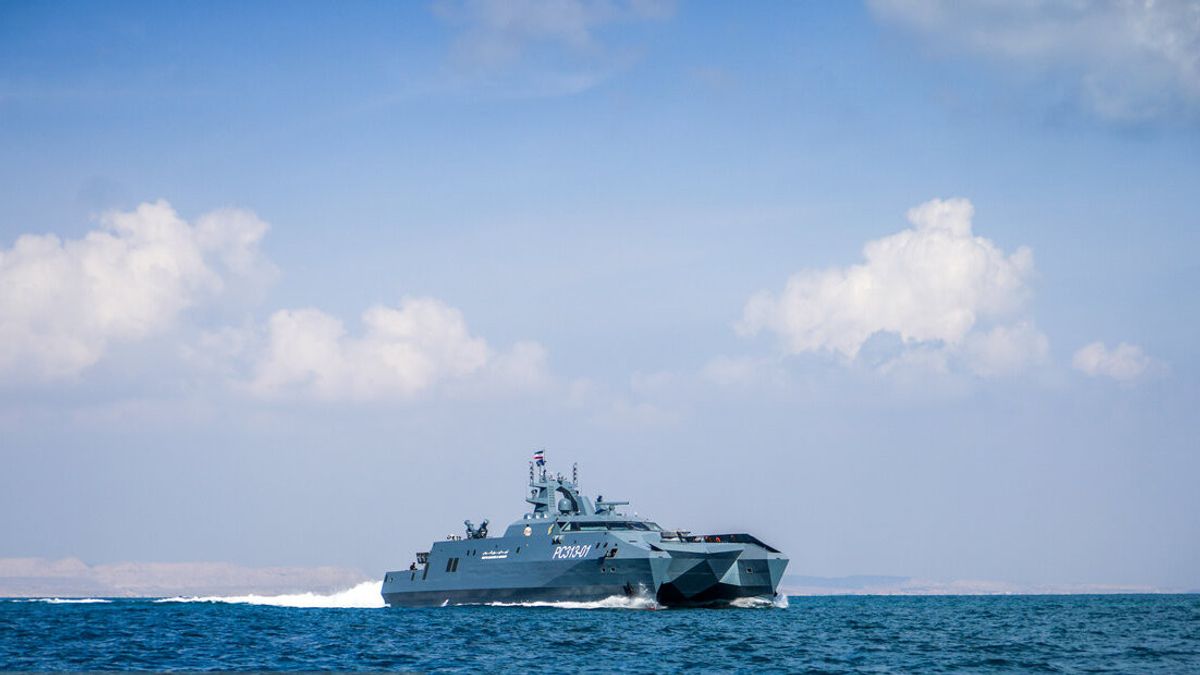


JAKARTA - The commander of the Iranian Revolutionary Guard Corps (IRGC) Navy said on Thursday that Tehran would deliver "the most severe blow to its enemies" while maintaining its strategy to keep the Strait of Hormuz closed.
In a statement on the social media X, Komodor Alireza Tangsiri said the move was taken "in response to the order of the Supreme Commander (Mojtaba Khamenai)," and Iranian forces would continue to implement strategies to keep the main waterway of the Gulf closed and "deal the harshest blow to the aggressor enemy," Anadolu reported (13/3).
Previously, the new Supreme Leader of Iran, Mojtaba Khamenei, said in his first public statement that the Strait of Hormuz must remain closed, which was blocked in response to the US-Israeli attack that began on February 28.
"The lever to block the Strait of Hormuz must really be used," Khamenei said of the strategic waterway through which a fifth of the world's oil traffic passes, Al Arabiya and AFP reported.
On Wednesday, Rear Admiral Alireza said any ship wishing to sail through the Strait of Hormuz must obtain Iranian approval; otherwise, the ship could be the target of an Iranian attack.
In a post on his X account, he wrote that two ships that ignored Iran's warning were targeted in the Strait that day.
Admiral Alireza highlighted the promise of the United States Government to escort and protect ships crossing the waterway, calling it "an empty promise."
"Every ship that intends to pass through the Strait must obtain permission from Iran," he said, quoted by Presstv.
Authorities have indicated the Strait of Hormuz, which before the war was crossed by almost a fifth of global oil, remains open and ships that do not serve the interests of the United States and Israel can sail safely.
It is known that tensions have increased in the Middle East, following the attacks by the United States and Israel on Iran on February 28, which Tehran said killed more than 1,300 people, including Ali Khamenei, the former supreme leader, and more than 150 students.
Since then, Iran has launched drone and missile attacks targeting Israel, Jordan, Iraq, and Gulf states hosting US military assets.
Tehran has also effectively tightened the Strait of Hormuz since March 1. This narrow waterway transports around 20 million barrels of oil per day and about 20 percent of global liquefied natural gas trade.
Mojtaba, who is the son of the late Ali Khamenei, was elected as his father's successor by winning 85 percent of the vote in the election in the Expert Assembly, according to the Iranian Embassy in Jakarta.
The English, Chinese, Japanese, Arabic, and French versions are automatically generated by the AI. So there may still be inaccuracies in translating, please always see Indonesian as our main language. (system supported by DigitalSiber.id)
Most Popular Tags
#Prabowo Subianto #donald trump #2026 World Cup #Febrie Adriansyah #8791Popular


