

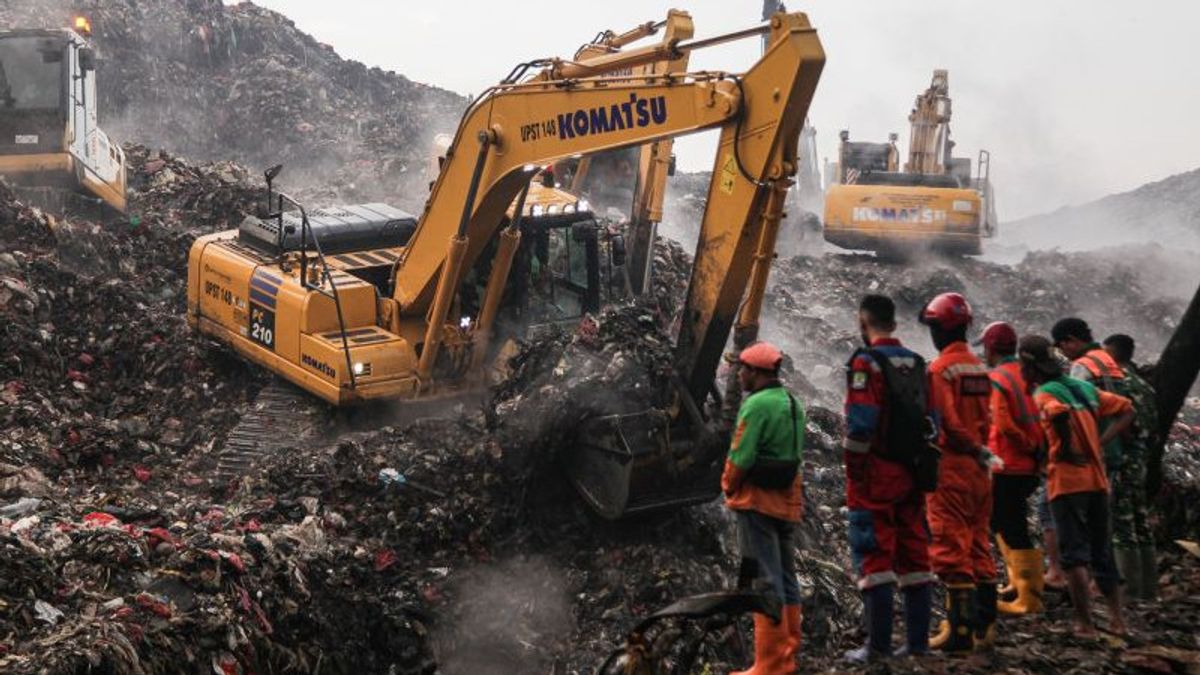


JAKARTA - The landslide of a garbage pile at the Bantargebang landfill, Bekasi City, West Java, claimed human lives. It is reported that 7 people died in the incident at the main waste disposal site from Jakarta.
This incident once again highlights the problem of waste management systems, which have so far been based on accumulation at the final processing site. For environmental organizations, this event shows the serious risks that continue to lurk for waste management workers, scavengers, and residents living around the landfill area.
The Indonesian Environmental Agency (WALHI) considers the tragedy in Bantargebang not just an accident. This event is referred to as a consequence of the waste management model which still maintains the pattern of collecting, transporting, and then disposing of it on a large scale.
According to WALHI, the practice of piling up garbage to form a mound resembling a hill not only causes environmental pollution, but also increases the potential for disasters, especially during the rainy season.
WALHI Urban Justice Campaigner Wahyu Eka Styawan said this incident should be a reminder for the government because a similar incident had occurred previously in Indonesia.
"This incident repeats an old wound that should have been an important lesson for the country. There was a large garbage landslide tragedy in Leuwigajah which killed hundreds of people. However, more than two decades later, the national waste management approach is still based on accumulation in landfills which continue to increase and become more dangerous," said Wahyu in his statement, Wednesday, March 11.
Wahyu assessed that the conditions in Bantargebang reflected a wider crisis that also occurred in various cities in Indonesia. Many landfills are said to have exceeded their capacity, while waste production continues to increase.
On the other hand, the strategy of reducing waste from sources has not been maximized. As a result, landfills remain the main focus for accommodating urban waste.
This situation is also seen from the many landfills that are closed because they still use an open dumping system. This condition is considered to show the limitations of waste management capacity in various regions.
Wahyu assessed that this series of events showed that Indonesia was facing a garbage mountain emergency.
"The crisis at the Bantargebang landfill is also a real example of how the waste crisis is only moved from one region to another. The failure of waste management in Jakarta is transferred to Bekasi, while the closure of the Cipeucang landfill in South Tangerang encourages the area to find a new disposal site to Serang and Bogor," said Wahyu.
Therefore, WALHI urges the government to accelerate changes to the waste management system by placing waste reduction from sources as a priority.
This organization assesses that the government needs to strengthen waste reduction policies, including encouraging producer responsibility through the Extended Producer Responsibility (EPR) scheme, to encourage industrial redesign to produce less waste.
In addition, the development of a sorting and reuse system for waste at the city and community levels is also considered important to reduce the volume of waste that ends up in landfills.
"The tragedy in Bantargebang must be a serious alarm for the government to immediately focus on implementing waste governance transformation from the downstream or source in line with Law Number 18/2008. Without fundamental changes in waste governance, cities in Indonesia will continue to face similar disaster risks in the future with increasing victims for humans and the environment," he concluded.
The English, Chinese, Japanese, Arabic, and French versions are automatically generated by the AI. So there may still be inaccuracies in translating, please always see Indonesian as our main language. (system supported by DigitalSiber.id)
Most Popular Tags
#Prabowo Subianto #donald trump #firearm #8791 #giias 2026Popular


