

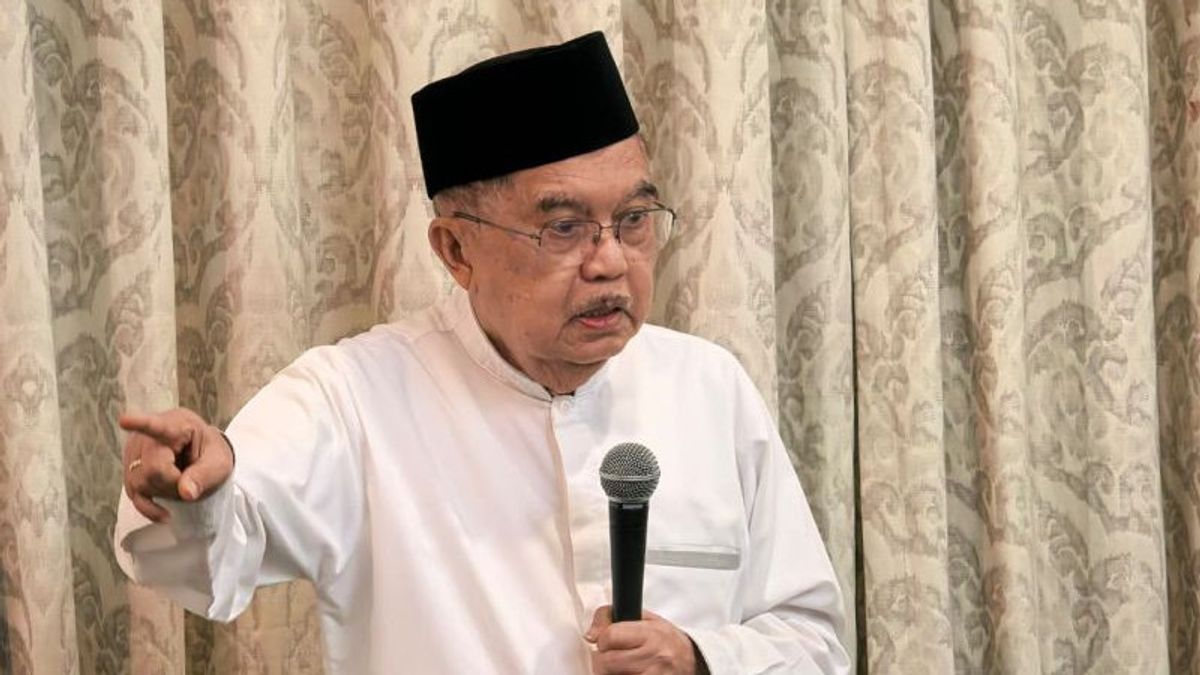


JAKARTA - The 10th and 12th Vice President Jusuf Kalla (JK) hopes that the government can adjust policies appropriately so that the national economy remains stable amid increasingly complex global dynamics.
This was conveyed by JK after the fasting and Tarawih prayer event with the management and members of the Islamic Student Association Alumni Corps (KAHMI) at his residence in South Jakarta, Friday (6/3).
JK assessed that the conflict in the Middle East (Timteng) has the potential to have a significant impact on Indonesia's economic conditions, especially related to rising energy prices and government subsidy burden.
He said an escalation of international conflicts would trigger an increase in the price of fuel oil (BBM) and LPG, which would ultimately increase the burden of state subsidies.
"The impact on Indonesia is immediately felt in the economy. Fuel prices are rising, LPG prices are rising and that means government subsidies will be bigger," he said as quoted by ANTARA.
He also reminded that a long-running conflict could disrupt the national energy supply. According to him, Indonesia's fuel stock is relatively limited so it needs to be anticipated by the government.
"If the war lasts a long time, our fuel stocks are limited. That can cause difficulties for economic and business activities," he said.
Apart from the economic impact, JK also assessed that Indonesia needs to have a clear political stance on the international conflict. As a country with the largest Muslim population, Indonesia is considered to need to show a firm diplomatic position.
He said the government could use Indonesia's role in international forums to encourage conflict resolution and peace.
JK also emphasized the importance of a thorough evaluation of national economic policies, especially related to state budget management in the midst of global uncertainty.
According to him, the government needs to determine the priority of state spending so as not to burden the state finances excessively.
"There must be a total evaluation of economic policies, especially in the use of the budget. The state must determine priorities so that spending is not too large," he said.
He reminded that if state expenditures are not controlled, the risk of pressure on the national economy can increase, even potentially affecting international confidence in the Indonesian economy.
JK also touched on a number of government programs that require large budgets. He assessed that the policy needed to be adjusted to the state's revenue conditions so that important sectors such as education, infrastructure, and strengthening the basic economy remained a priority.
The English, Chinese, Japanese, Arabic, and French versions are automatically generated by the AI. So there may still be inaccuracies in translating, please always see Indonesian as our main language. (system supported by DigitalSiber.id)
Most Popular Tags
#Prabowo Subianto #donald trump #firearm #8791 #giias 2026Popular


