

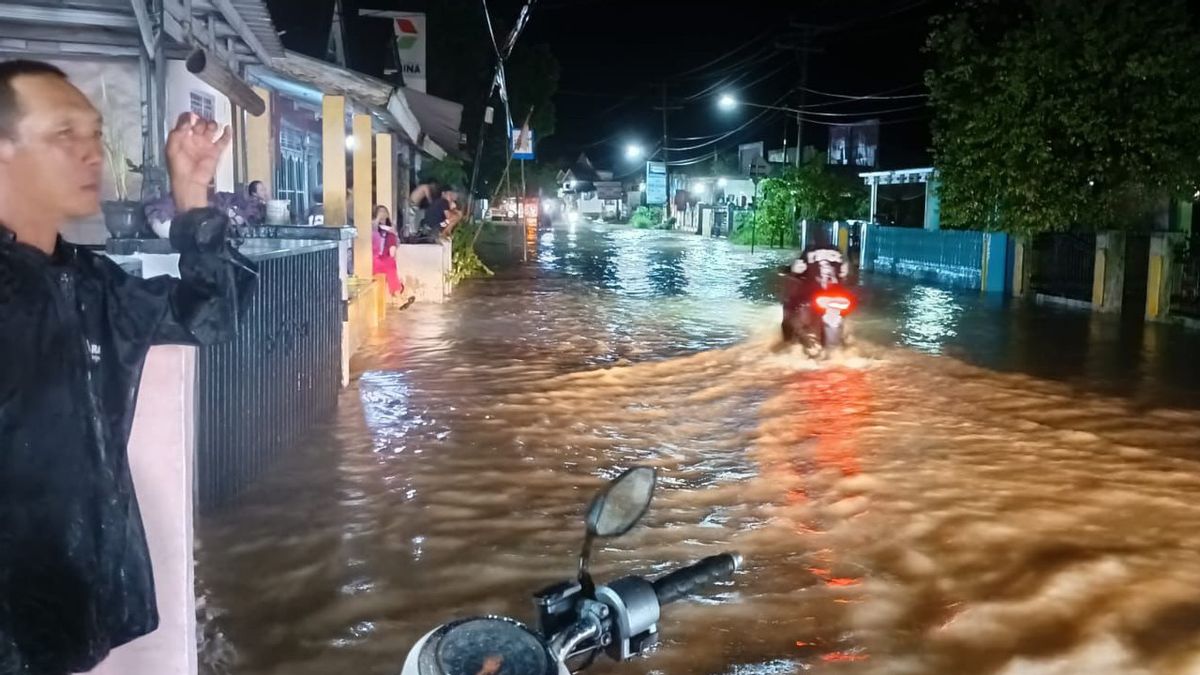


JAKARTA - The National Disaster Management Agency (BNPB) said that the flood that had flooded five sub-districts in Klaten Regency, Central Java, was not only triggered by high rainfall intensity, but was also exacerbated by damage to embankments or river flow retention talud.
Head of the BNPB Disaster Data, Information, and Communication Center, Abdul Muhari, said that heavy rain that hit the area caused the talud to be damaged so that the river water overflowed and flooded a number of residential areas.
"In addition to the high intensity of rain, flooding in Klaten is also exacerbated by the damage to the talud which serves to hold back the flow of the river so that the water overflows into settlements," said Abdul Muhari in his statement, Friday, March 6.
He explained that the overflow of water caused flooding in five sub-districts on Tuesday (3/3). Based on information collected by the Directorate of Coordination and Operation Control of the BNPB, as many as 121 residents had to evacuate due to the incident.
"Some residents occupy tactical posts prepared by the local government at the Cawas Village Hall," he said.
BNPB also noted that more than a thousand houses were affected by the flood. In addition, there are a number of public facilities that are also submerged, including 13 educational facilities, one health facility, 19 worship facilities, and one police sector office.
On Wednesday (4/3), the flood conditions were reported to have gradually receded and the refugees had returned to their respective homes.
Although he did not detail the condition of the talud damage, Abdul Muhari assessed that the event needed to be the attention of the local government and the local community, including the Regional Disaster Management Agency (BPBD) in Klaten.
"This incident is a reminder for local governments and the community to increase their readiness to face potential disasters," he said.
According to him, preparedness needs to be strengthened, both in terms of personnel, equipment, and emergency plans so that disaster response can be carried out quickly and appropriately.
BNPB also encourages the public to work with local governments to take simple mitigation steps to reduce the risk of disasters.
"The public can carry out mitigation efforts such as cleaning drains, checking the condition of the talud and embankment in the river, and pruning the branches of tall trees to reduce the risk of trees falling," said Abdul Muhari.
He added that this step is important considering the potential for extreme weather in the next few days. Based on the forecast of the Meteorology, Climatology, and Geophysics Agency (BMKG), on March 5-7, 2026, most of Indonesia, especially Java Island, is still potentially experiencing moderate to heavy rain which can be accompanied by strong winds.
The English, Chinese, Japanese, Arabic, and French versions are automatically generated by the AI. So there may still be inaccuracies in translating, please always see Indonesian as our main language. (system supported by DigitalSiber.id)


