

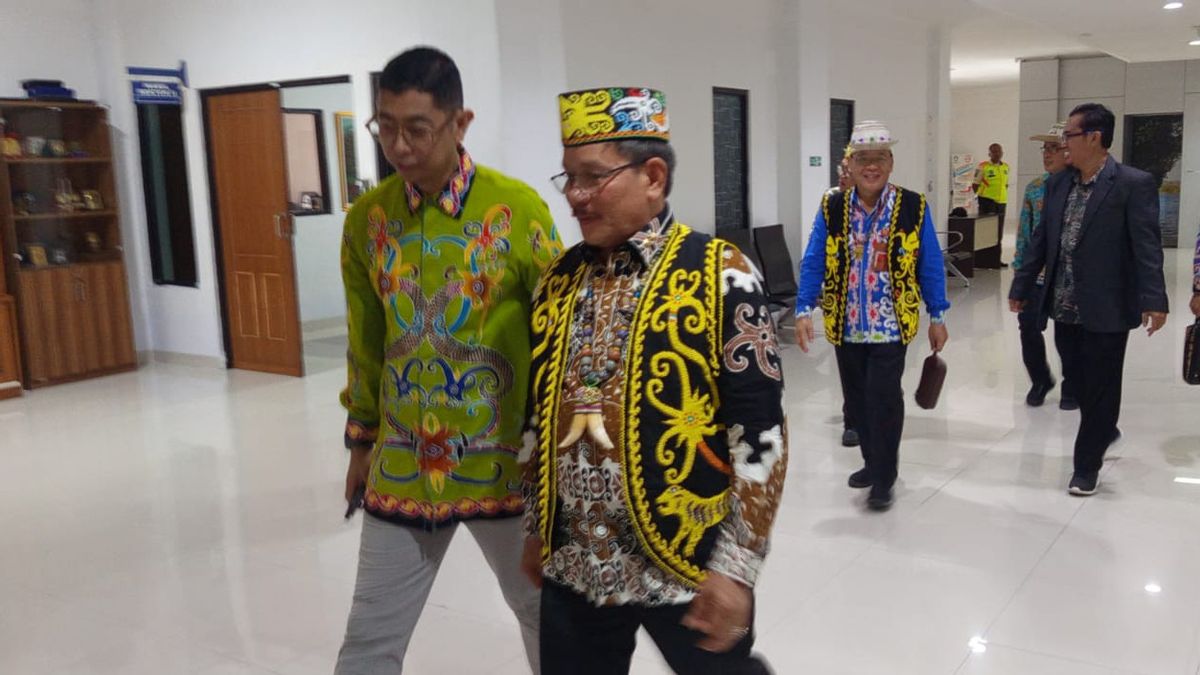


TARAKAN - The Kenyah Dayak Custom Institution of North Kalimantan Province (LADK-KU) held an audience with the leadership of the Tarakan Borneo University (UBT) at the Rectorate to discuss opportunities for access to higher education for Kenyah Dayak children, especially those from the interior and border areas of Kaltara.
This meeting was carried out as part of efforts to encourage the improvement of human resources (HR) among the Dayak Kenyah community living in the 3 T area (front, outermost, and lagging).
The Chairman of LADK-KU, Ingkong Ala revealed that until now the number of Dayak Kenyah sons and daughters who study in a number of study programs at UBT is still relatively limited.
"This condition is a concern for the indigenous institution so that the younger generation from the Dayak Kenyah community has a wider opportunity to access higher education at the only state university in Kaltara," said Ingkong Ala, who also serves as the deputy governor of Kaltara.
"We also note that there are still very few sons and daughters from our community who have the opportunity to study at UBT," he continued.
He explained, a number of community leaders said that so far many children from border areas have the desire to continue their education, but are constrained by distance, cost, and limited access to information about universities.
"This is what we are trying to discuss with the Rector of UBT, the access to education and the presence of students from the border is very important to produce human resources who will later be able to rebuild their home areas," he said.
Meanwhile, UBT Rector Prof. Yahya Ahmad Zein ensured that the opportunity for children from border areas to continue higher education at UBT is increasingly open. This campus policy also provides additional special value for prospective students who come from border areas and families who are unable to afford it.
"For regional children, there are 20 percent. Border children get an additional 10 percent, and for those from families who are unable to afford it there is also an addition. So the total can reach around 40 percent," he said.
However, Yahya reminded prospective students from border areas to ensure that their supporting documents are uploaded correctly during registration.
Because, many applicants are actually from the border but do not include administrative evidence, so the system cannot provide additional value.
"Often border children do not upload documents showing that they come from the border area. Even though it is important because the selection system works automatically. For this reason, we hope that this can be the attention of the Dayak Kenyah adat figure," he said.
Yahya said that although his party still implemented strict selection to maintain the quality of students, especially in strategic study programs.
"But the campus is also committed to presenting policies that are in favor of the border community. The principle is how Kaltara children, especially from border areas, can get greater opportunities in important study programs. That's what we're fighting for," he said.
The English, Chinese, Japanese, Arabic, and French versions are automatically generated by the AI. So there may still be inaccuracies in translating, please always see Indonesian as our main language. (system supported by DigitalSiber.id)
Most Popular Tags
#Prabowo Subianto #donald trump #Febrie Adriansyah #8791 #giias 2026Popular


