

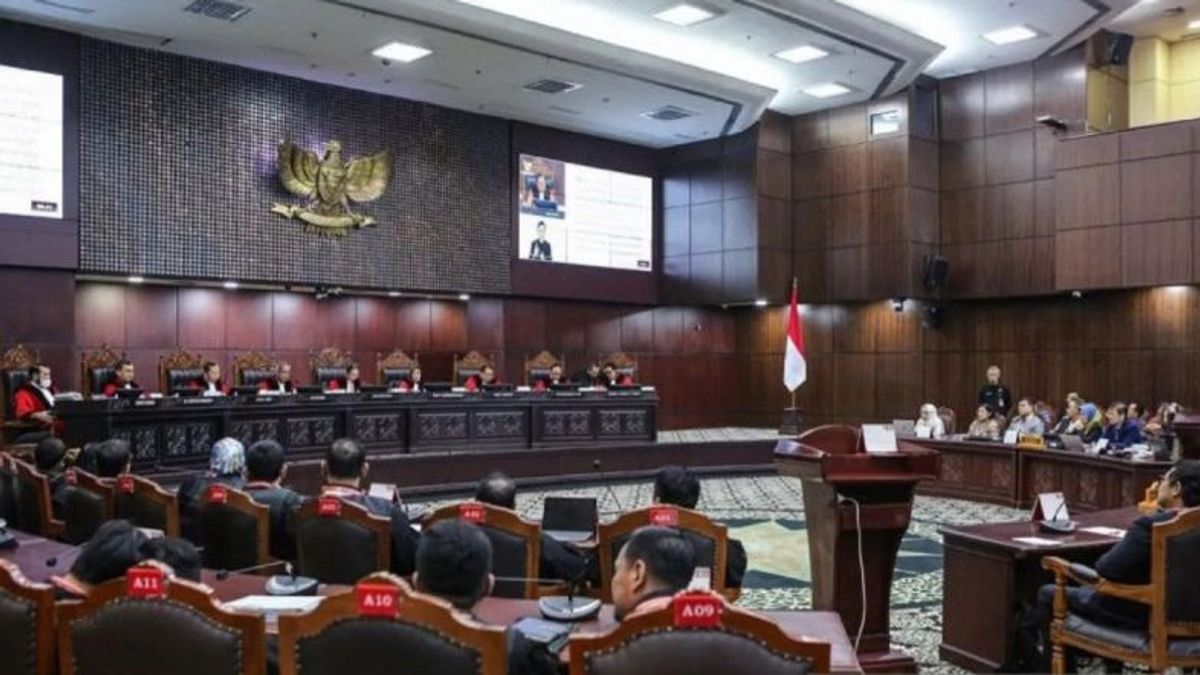


JAKARTA - The Constitutional Court (MK) changed the wording of the article on obstruction of justice or obstruction of justice in Article 21 of Law Number 31 of 1999 concerning the Eradication of Corruption Crimes (Tipikor Law) so that it is not easily misunderstood.
Through the decision number 71/PUU-XXIII/2025, the Constitutional Court stated that the phrase "directly or indirectly" in the norm of Article 21 of the Corruption Law is contrary to the constitution and does not have binding legal force.
"Granting the applicant's request for a part," said Chief Justice Suhartoyo reading the verdict, reported by ANTARA, Monday, March 2.
In the legal consideration section, Constitutional Judge Arsul Sani said the phrase "or indirectly" in the provision on judicial obstruction allowed for forms of acts that did not seem explicit, but were considered to hinder the judicial process.
This act, added Arsul, is like the spread of disinformation, social pressure or the use of intermediaries whose assessments are subjectively carried out by law enforcement officers.
If associated with the applicant's profession, the activities of the lawyer to publish through the media or hold public discussions and seminars in order to defend his client will potentially be categorized as a form of indirect judicial obstruction.
The same potential, according to the Constitutional Court, can also occur with journalistic activities that investigate a case that is ongoing with the aim of providing information to the public.
The Constitutional Court considers that the existence of the phrase "or indirectly" in Article 21 of the Corruption Tipikor Law has blurred the boundaries between lawful acts in the space of freedom of expression and unlawful acts.
"So it has the potential to cause what is called excessive criminalization or overcriminalization," said Arsul.
This condition will actually create legal uncertainty. Because, the public cannot predict whether an act that is actually legally justified will be categorized as an act that can be punished.
In addition, the Constitutional Court considers that the phrase "directly or indirectly" often gives rise to a non-single interpretation so that in addition to causing legal uncertainty, it often creates arbitrariness.
At that level, the Court held that the phrase could potentially be used loosely to ensnare anyone who was considered to be obstructing the legal process by law enforcement.
In addition, universally, the Constitutional Court refers to Article 25 of the United Nations Convention against Corruption (UNCAC). It turns out that the phrase "directly or indirectly" is not part of the delict of obstruction of justice.
"This means that, universally, the existence of a delict of obstruction of justice or a criminal act that obstructs the legal process does not depend on the existence or absence of the phrase directly or indirectly," he said.
On the other hand, in the development of national criminal law, the new Criminal Code does not include the phrase "directly or indirectly" in the regulation regarding the offense of obstruction of justice or the crime of obstructing the legal process.
Thus, according to the Constitutional Court, as long as each person intentionally prevents, obstructs, or frustrates the legal process, both at the investigation, prosecution, and examination stages in court proceedings against suspects and defendants or witnesses in corruption cases, they can be charged with Article 21 of the Tipikor Law.
"Based on the description of legal considerations above, according to the Court, the norm of Article 21 of the Corruption Law as far as it concerns the phrase 'directly or indirectly' has turned out to be contrary to the 1945 Constitution of the Republic of Indonesia and does not have binding legal force," said Arsul.
It is known that before this ruling, Article 21 of the Corruption Law reads, "Anyone who intentionally prevents, obstructs, or directly or indirectly impedes the investigation, prosecution, and examination in court of suspects and defendants or witnesses in corruption cases, shall be sentenced to imprisonment for a minimum of 3 years and a maximum of 12 years and/or a fine of at least IDR 150,000,000.00 and a maximum of IDR 600,000,000.00."
The English, Chinese, Japanese, Arabic, and French versions are automatically generated by the AI. So there may still be inaccuracies in translating, please always see Indonesian as our main language. (system supported by DigitalSiber.id)


