

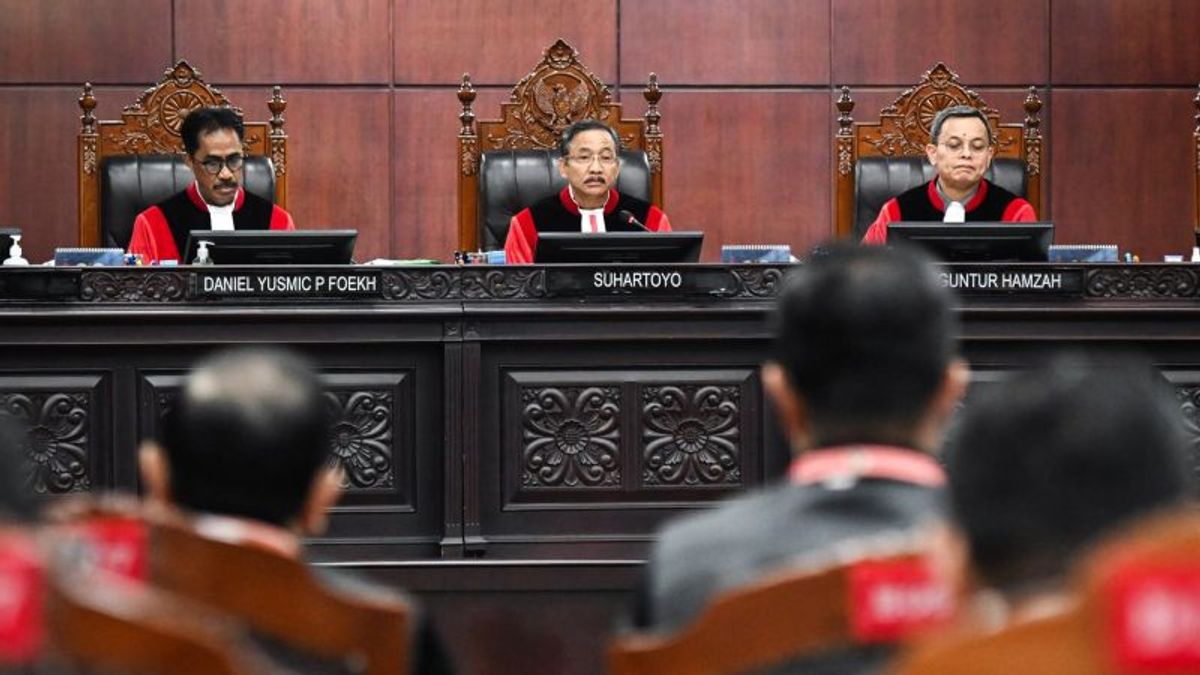


JAKARTA - The Constitutional Court (MK) stated that it could not accept the material test of the obstruction of investigation or obstruction of justice in the Corruption Eradication Law as requested by the Secretary General of the PDI Perjuangan Hasto Kristiyanto.
"Declaring the applicant's application inadmissible," said Chief Justice Suhartoyo, reading the verdict on the application number 136/PUU-XXIII/2025, reported by ANTARA, Monday, March 2.
Hasto's application was not accepted because of the loss of the object. The norm of Article 21 of Law Number 31 of 1999 concerning Eradication of Corruption Crimes (UU Tipikor) which Hasto tested has been amended by the Constitutional Court in the decision number 71/PUU-XXIII/2025.
Through the decision pronounced by the Court just before pronouncing the decision on Hasto's application, the phrase "directly or indirectly" in the norm of Article 21 of the Corruption Law is no longer valid.
The Constitutional Court stated that the phrase was contrary to the 1945 Constitution of the Republic of Indonesia and did not have binding legal force because it was not in line with the principle of fair legal certainty in law enforcement.
According to the Court, the phrase "directly or indirectly" is potentially used loosely so that it can ensnare anyone who is considered to hinder the legal process by law enforcement officials.
The article previously read, "Anyone who intentionally prevents, obstructs, or directly or indirectly impedes the investigation, prosecution, and examination in court proceedings against suspects and defendants or witnesses in corruption cases, shall be sentenced to a minimum of 3 years and a maximum of 12 years imprisonment and/or a fine of at least IDR 150,000,000.00 and a maximum of IDR 600,000,000.00."
Constitutional Justice M. Guntur Hamzah explained that because the phrase "directly or indirectly" in the norm of Article 21 of the Corruption Law has been declared unconstitutional, the object of the application submitted by Hasto is no longer the same.
"Thus, according to the Court, the quo (petitioner's) application has lost its object," said Guntur reading the legal considerations.
As for Hasto, in his petition, Article 21 of the Corruption Law was interpreted disproportionately and created legal uncertainty so that it was in conflict with the principle of a just legal state, as mandated by the constitution.
He wants the norms of the article to be clarified. In the petitum, Hasto asked the Constitutional Court to add the phrase "against the law" and "through the use of physical violence, threats, intimidation, intervention, and/or promises to provide undue advantages" to the article in question.
In addition, he also considered that the criminal threat in Article 21 of the Corruption Tipikor Law was disproportionate. For this reason, he asked that the criminal threat of obstruction of investigation be reduced to a maximum of 3 years.
Hasto also asked that the word "and" in the phrase "investigation, prosecution, and examination at trial" be interpreted as having a cumulative meaning.
He said a person can only be punished if they take action to prevent, obstruct, or thwart all stages of investigation, prosecution, and examination in court.
The English, Chinese, Japanese, Arabic, and French versions are automatically generated by the AI. So there may still be inaccuracies in translating, please always see Indonesian as our main language. (system supported by DigitalSiber.id)
Most Popular Tags
#Prabowo Subianto #donald trump #firearm #8791 #giias 2026Popular


