

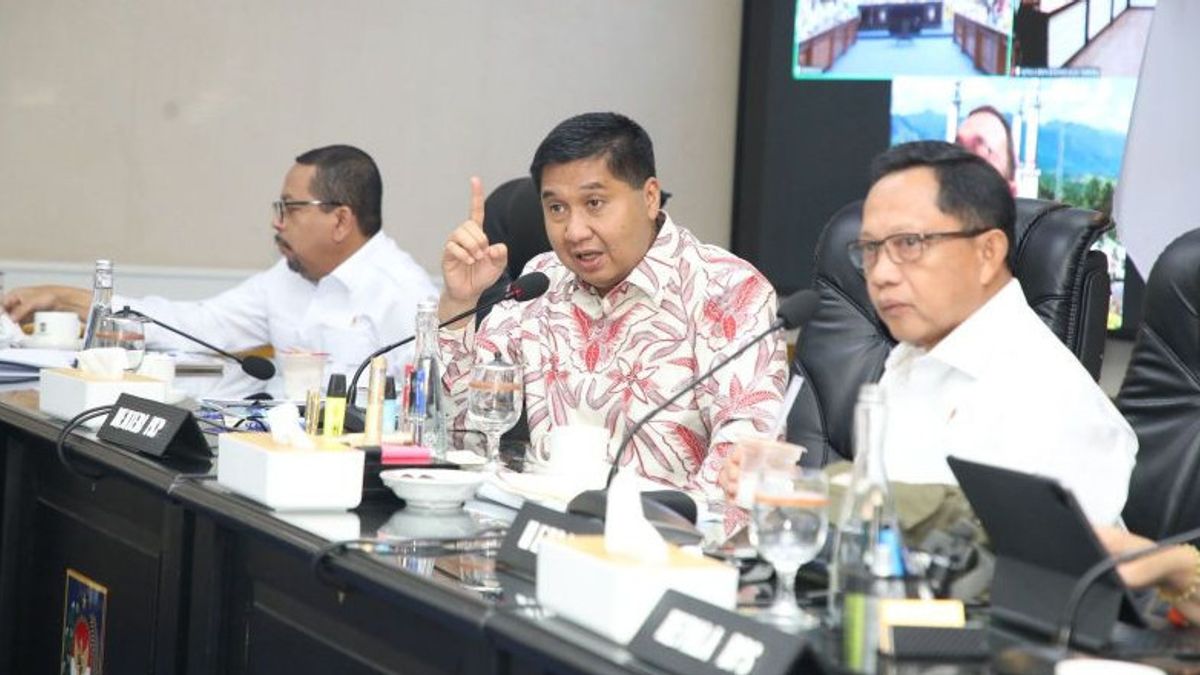


JAKARTA - The Minister of Home Affairs (Mendagri) Tito Karnavian as Chairman of the Task Force (Kasatgas) for the Acceleration of Reconstruction and Rehabilitation (PRR) after the Sumatra Region disaster revealed that the number of refugees after the Sumatra disaster had decreased significantly.
Based on data from the National Disaster Management Agency (BNPB) as of February 25, 2026, the number of refugees in the three provinces has decreased significantly from the original 2,108,582 to 11,250 people. The number of refugees is detailed as 10,400 refugees in Aceh Province, and 850 refugees in North Sumatra Province (Sumut).
"Then in West Sumatra Province, thank God there are no more refugees in our records. There are no more refugees in the tent, they are all in the huntara," said Tito as quoted by ANTARA, Friday, February 27.
This was conveyed by Tito in the Coordinating Meeting at the Ministerial Level of the Post-disaster Rehabilitation and Reconstruction Task Force in the Sumatra Region at the Coordinating Ministry Building (Kemenko) for Human Development and Culture (PMK), Jakarta.
In the meeting, he reported that there were five villages in two provinces that needed to be rearranged due to the impact of the disaster. The villages are 3 villages in Aceh Province and 2 villages in North Sumatra Province. Meanwhile, in West Sumatra (Sumbar) there are no villages that need to be rearranged.
Then Tito also explained that out of 52 regencies/cities affected by disasters, 38 regencies/cities were in normal condition. In addition, 3 regencies/cities are close to normal. Meanwhile, 11 regencies/cities still require special attention.
Tito explained that the indicator of normality of an area is determined by several variables. Among them are government, public services, land access, economy, social, and other basic indicators including gas stations, electricity, PDAM, internet, LPG gas, TPA-TPST, Bank Sampah, and river normalization.
"Previously, there was another one, namely the problem of rice fields and plantations which were also affected as well as ponds, fisheries," he added.
In the forum, he appreciated the ranks of ministries/institutions and local governments (Pemda) who have cooperated in encouraging post-disaster recovery. He ensured that currently the development of post-disaster reconstruction and rehabilitation showed positive progress, especially in terms of road access which has been fully functional, electricity flow that can be utilized by the community, to gas stations that have been operating normally.
"If the market is moving, all roads, but the UMKM is not [fully optimal]. It is still our task to clean up the mud, there are bridges, village roads, areas that we need to solve," said Tito.
Also present at the meeting were Coordinating Minister for Economic Affairs Pratikno, Coordinating Minister for Political and Security Affairs Djamari Chaniago, Coordinating Minister for Infrastructure and Regional Development Agus Harimurti Yudhoyono, Coordinating Minister for Community Empowerment Muhaimin Iskandar, and related parties from ministries/institutions and local governments.
The English, Chinese, Japanese, Arabic, and French versions are automatically generated by the AI. So there may still be inaccuracies in translating, please always see Indonesian as our main language. (system supported by DigitalSiber.id)


