

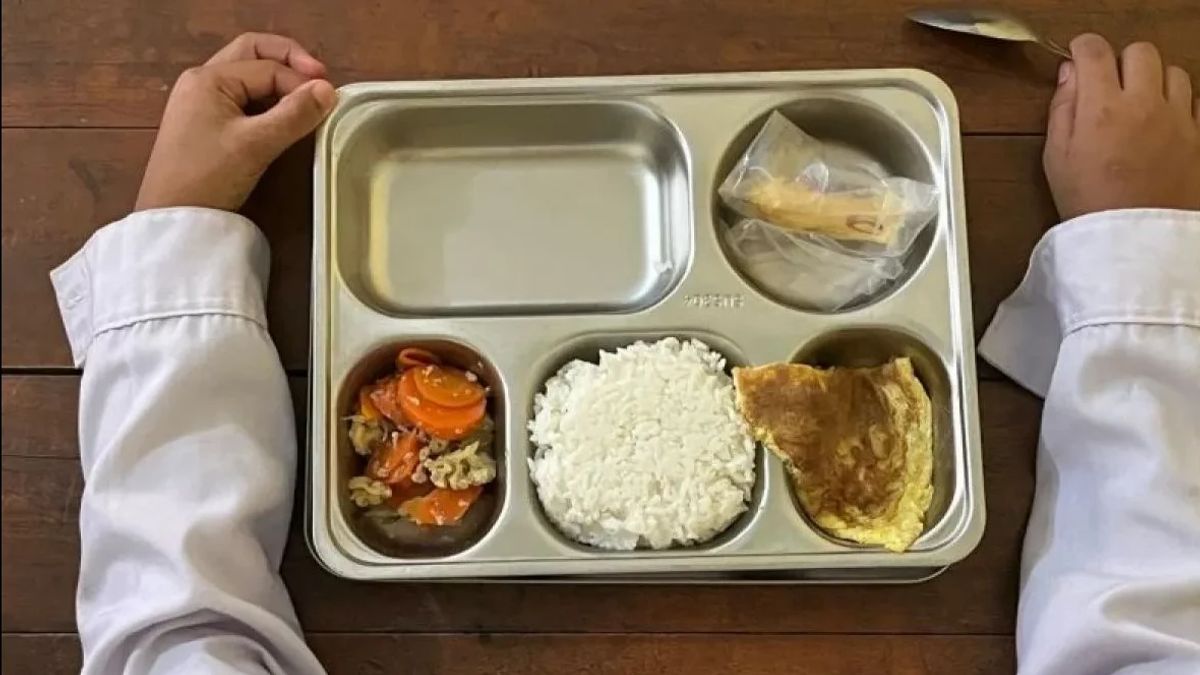


Member of the House of Representatives from the Gerindra Party Faction, Azis Subekti, highlighted the controversy over the budget for the Free Nutritious Meal (MBKM) program as an expropriation of the right to education for Indonesian children. In fact, according to him, the state budget must be read as honesty in the same figures that are allocated for the welfare of the people.
"There is an old habit in our politics: numbers are rarely treated as a thinking tool, but more often used as a tool to bully. Large numbers are raised like a hammer, hit on the public table, so that suspicions sound louder than explanations. In this habit, the debate about the APBN moves, not as a policy discussion, but as an emotional interpretation," said Azis Subekti in his statement, Thursday, February 26.
"The uproar surrounding the education budget and the nutritious meal program is the most recent example. The figure of hundreds of trillions is dragged into the public space as if there were a confiscation of rights, a dragging of basic needs, even a betrayal of the future of education. In fact, the problem is not that simple. In fact, if read honestly, the problem is not in the region described by the uproar," he continued.
Azis emphasized that the state budget is not a political pamphlet. He works with structures, classifications, and logic that are often not friendly to emotions. He emphasized, within the framework of the education budget, the state not only finances classrooms, books, or teachers' salaries, but also all the prerequisites for children to learn as whole human beings.
"At this point, the nutritious meal program is placed: not as a substitute, let alone a cutter, but as a supporter," he said.
Azis assessed that the error in thinking that continues to be reproduced is to equate 'part of the education budget' with 'taking from the basic needs of education'. According to him, this is not merely a technical error, but a deliberately simplified way of reading.
"The so-called efficiency by the state is not cutting effective rights and touching the community, but correcting the non-optimal spending from various positions, then directing it to programs that are considered to have a direct impact," he explained.
"Efficiency, in this sense, is not an amputation. It is an effort to return the budget to its purpose," added the Gerindra legislator from the Central Java V constituency.
He explained that the funds from the efficiency were then recorded in the education budget group because they were intended for schoolchildren. According to Azis, there was no irregularity there, what was strange was the way some parties twisted the administrative record into a narrative of cuts.
"The numbers are separated from the structure, then used to build suspicions. The public is invited to be angry, not to understand," he said.
Azis said, there was one other thing that was rarely conveyed clearly: when the state budget increased, the constitutional mandate for the allocation of education of 20 percent automatically increased. He emphasized, this is not a interpretation, but a mechanism.
"So when the need for a nutritious meal program increases because the beneficiaries increase, then allocated in the framework of education, the question that should be asked is not who is sacrificed, but whether other basic needs are still maintained," he said.
As far as can be read from the budget document, continued Azis, basic needs for education, teacher welfare, educational assistance, and other essential programs are not reduced. With a growing fiscal space, according to him, the state actually has the opportunity to do more things at once: improve schools, expand assistance, improve the quality of services, and ensure that children come to class with empty stomachs.
"At this point, criticism of the government does not stop, but finds its measure. The state must still be supervised, but supervision without disciplined thinking will only give rise to suspicion without solutions. What happens then is not a policy debate, but an emotional fight inherited from previous political choices," he said.
The member of Commission II of the DPR assessed that the narrative that separates feeding children from educating children is a wrong and dangerous narrative. "He complains of two interests that are actually on the same line. It's as if this nation has to choose between being full and being smart, between the body and the mind. In fact, education collapses when we let children learn in a hungry state," he said.
Azis said that this nation is too often hurt not because of a completely wrong policy, but because of the way we argue it is dishonest. Figures are used as bullets, not a trust. Data is cut to fit the anger that has been prepared in advance.
"Therefore, what we need to straighten out today is not only the content of the state budget, but also the way we read it. Honesty in reading numbers is the foundation of public trust. Without it, any policy, no matter how good its intentions, will always seem suspicious. And without that honesty, what is eroded is not only the budget, but also our sanity as a nation," he concluded.
The English, Chinese, Japanese, Arabic, and French versions are automatically generated by the AI. So there may still be inaccuracies in translating, please always see Indonesian as our main language. (system supported by DigitalSiber.id)
Most Popular Tags
#Prabowo Subianto #donald trump #2026 World Cup #Febrie Adriansyah #8791Popular


