
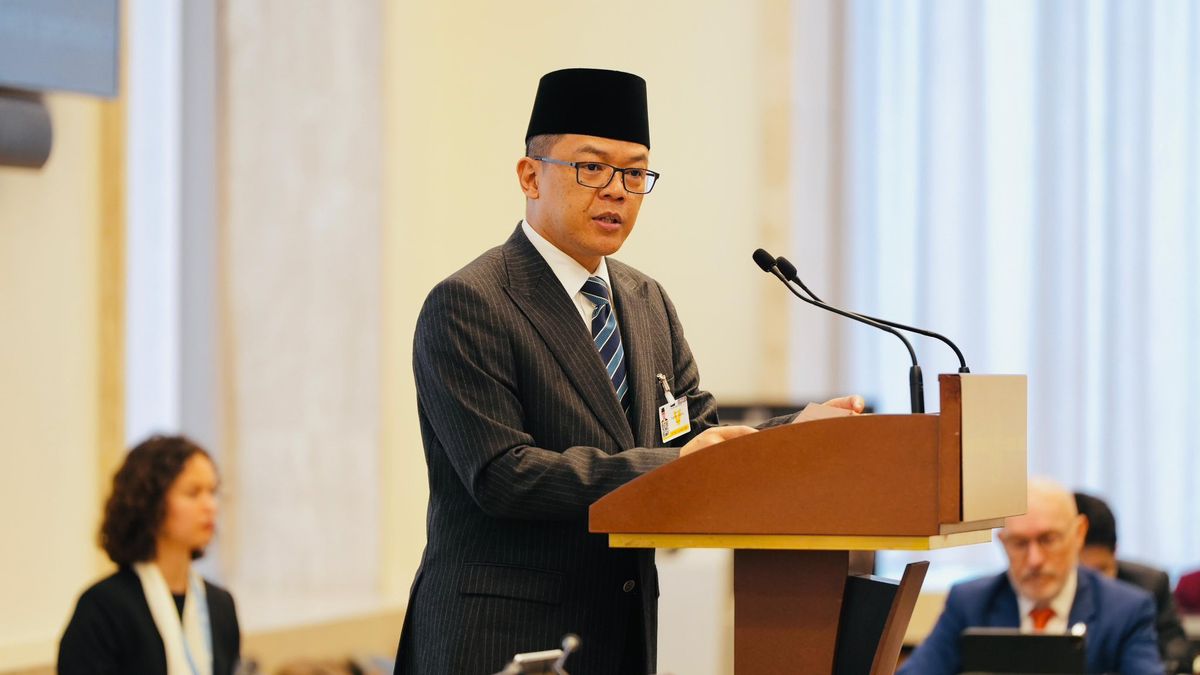


JAKARTA - Indonesian Minister of Foreign Affairs Sugiono emphasized Indonesia's commitment to multilateral disarmament as a pillar of peace and security, when global disarmament was considered to have regressed.
This was said by Foreign Minister Sugiono when delivering Indonesia's National Statement at the "High-Level Segment of the Conference on Disarmament 2026" in Geneva, Switzerland on Wednesday.
Opening his speech, Foreign Minister Ri said the current global situation is more uncertain, more polarized and more dangerous, with many countries turning to survival mode.
"International law is under increasing pressure," he said, adding that multilateral institutions are facing increasing pressure and the margin for miscalculation is narrowing.
"In this increasingly volatile environment, Indonesia remains firmly committed to multilateral disarmament as a pillar of international peace and security," the Indonesian Minister of Foreign Affairs said, quoting a copy of the Indonesian National Statement distributed by the Ministry of Foreign Affairs, Tuesday (24/2).
"We believe this commitment is not an idealism. It is a necessity," he said.
Furthermore, Foreign Minister Sugiono said that the global disarmament landscape today is not only stagnant, but regressing.
"More than 12,000 warheads still exist. The modernization program is getting faster. The armament is being expanded. And nuclear rhetoric is becoming more frequent and more worrying," said the Indonesian Minister of Foreign Affairs.
"It is a mistaken logic that prevention guarantees security, in fact, it deepens insecurity and perpetuates the perception of threats," said Foreign Minister Sugiono.
Furthermore, Foreign Minister Sugiono highlighted the New START Treaty, the last binding limit of the two largest nuclear-armed powers - the United States and Russia - marking a worrying moment.
"For the first time in decades, there is no agreed limit on their strategic nuclear forces," said the Indonesian Foreign Minister.
"And this is not a bilateral issue. The consequences are global. This affects every country, especially those countries that have chosen nuclear restraint. This reduces predictability, erodes transparency, and increases the risk of miscalculation and renewed arms races," said the Indonesian Foreign Minister.
"At the same time, new technologies such as AI, cyber capabilities and space add further risks. Without clear safeguards, these technologies strengthen uncertainty and increase the risk of unintentional escalation," he continued.
"Efforts to reduce multilateral weapons must be in line with this reality," said Foreign Minister Sugiono.
The Conference on Disarmament (CD) is the only multilateral forum mandated by the United Nations General Assembly to negotiate key treaties related to disarmament.
The membership of the CD consists of 65 countries, namely 5 permanent members of the UN Security Council and 60 countries with significant military capabilities, including Indonesia.
Since its establishment in 1978, the CD has negotiated and produced a number of related key agreements, namely the Treaty on the Non-Proliferation of Nuclear Weapons (NPT), the Convention on the Prohibition of the Development, Production and Stockpiling of Bacteriological (Biological) and Toxin Weapons and on Their Destruction (BWC), the Convention on the Prohibition of the Development, Production, Stockpiling and Use of Chemical Weapons and on Their Destruction (CWC) and the last one in 1996 Comprehensive Nuclear-Test-Ban Treaty (CTBT).
The English, Chinese, Japanese, Arabic, and French versions are automatically generated by the AI. So there may still be inaccuracies in translating, please always see Indonesian as our main language. (system supported by DigitalSiber.id)
Most Popular Tags
#Prabowo Subianto #donald trump #Febrie Adriansyah #8791 #giias 2026Popular


