

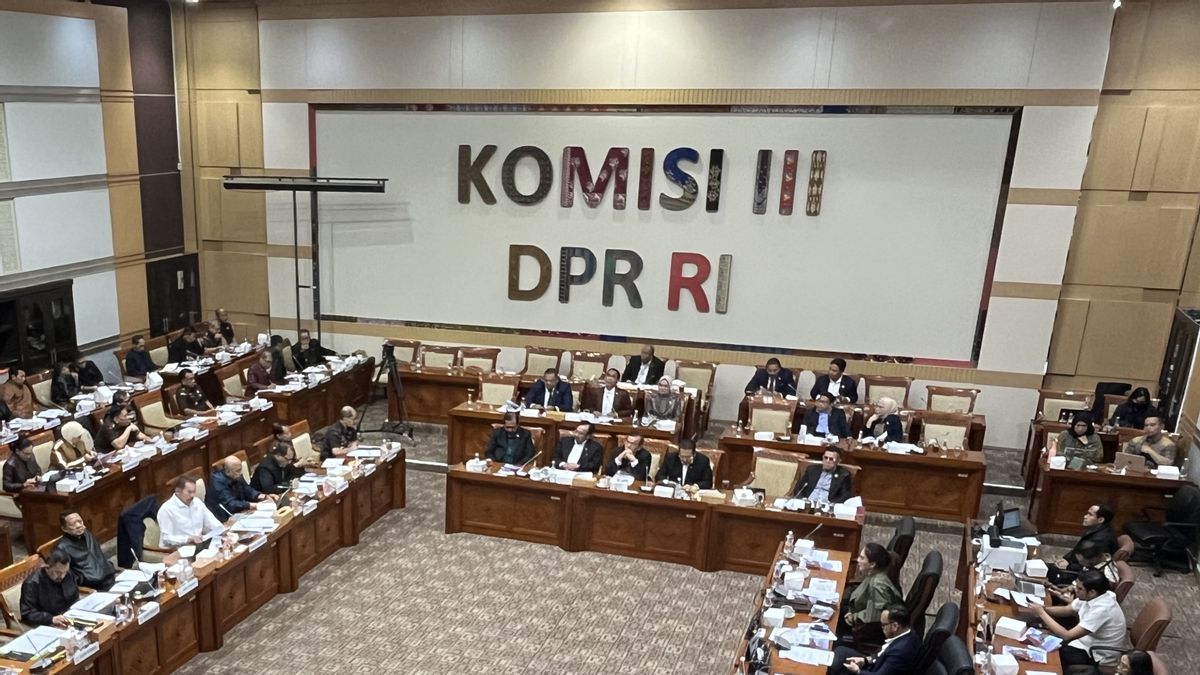


JAKARTA - Commission III of the Indonesian House of Representatives held a meeting regarding the case of a death penalty demand for a crew member (ABK), Fandi Ramadan, who was accused of carrying 2 tons of methamphetamine, where the case is being handled by the Batam District Court.
In this meeting, Commission III of the DPR reminded the Batam District Court that in the new Criminal Code, the death penalty is no longer a substantive crime, but rather the last alternative punishment that should be applied very strictly and very selectively.
"As we know, Fandi Ramadan is a crew member (ABK) whose ship contains drugs, then he as an ABK is sentenced to death. The meeting has just been conveyed and the results of this meeting will be immediately forwarded to the parties concerned, including the Batam District Court through the Supreme Court of the Republic of Indonesia," said Chairman of Commission III of the DPR, Habiburokhman as the leader of the meeting held at the Parliament Complex, Senayan, Jakarta, Monday, February 23.
"And today's meeting is a quorum, yes friends, yes? Quorum. So that this decision is valid," he continued.
Habiburokhman said, Commission III of the DPR RI pays serious attention to the case of the death penalty against Fandi Ramadan at the Batam District Court.
"We received information that it was clear that Brother Fandi Ramadan was not the main perpetrator, did not have a history of committing a crime, and had tried to warn about the potential for a crime," said Habiburokhman.
"Because this concerns human life, today the Commission III of the DPR RI held a special meeting to respond to the issue of the death penalty, in accordance with the provisions of Article 74 of the MD3 Law," he added.
Regarding the results of the DPR RI Commission III meeting related to the Fandi Ramadan case held today, among others, Commission III of the DPR RI reminded law enforcement, including the Panel of Judges in the Fandi Ramadan case at the Batam District Court, that in essence the new Criminal Code is no longer a retributive justice paradigm, which makes the law merely as a tool for retaliation, but shifts to substantive justice, rehabilitative justice, and restorative justice, namely the law as a tool for improving society.
"Commission III of the DPR RI reminds law enforcement, including the Panel of Judges in the Fandi Ramadan case at the Batam District Court, that the concept of the death penalty in the new Criminal Code is very different from the old Criminal Code. In Article 98 of the new Criminal Code, the death penalty is no longer a substantive crime, but rather the last alternative punishment that should be applied very strictly and very selectively," explained Habiburokhman.
The Commission III of the Indonesian House of Representatives reminded law enforcement, including the Panel of Judges in the Fandi Ramadan case at the Batam District Court, that Article 54 Paragraph 1 of the Criminal Code only stipulates that in sentencing, among other things, the form of the criminal offender's offense, inner attitude, and criminal offender's life history must be considered.
"According to the mechanism, we convey it to the leadership of the DPR to be forwarded to the relevant parties including the Batam District Court," said Habiburokhman.
The English, Chinese, Japanese, Arabic, and French versions are automatically generated by the AI. So there may still be inaccuracies in translating, please always see Indonesian as our main language. (system supported by DigitalSiber.id)
Popular


