

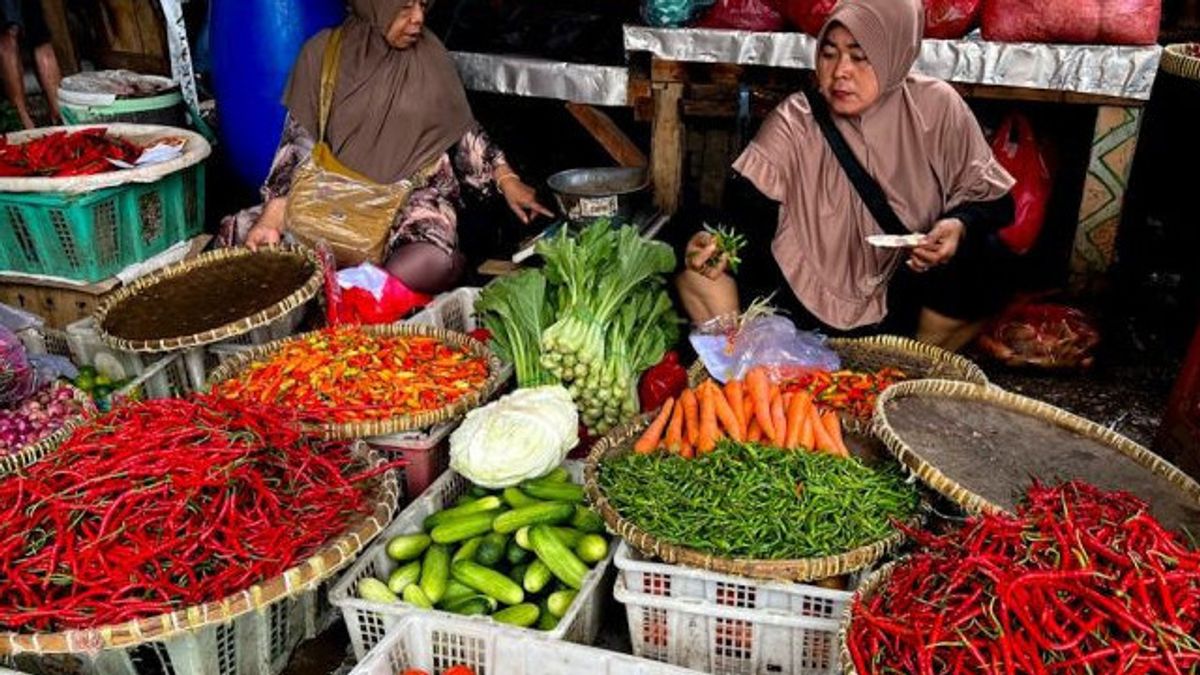


JAKARTA - The price of chili in Jakarta is observed to have started to fall on the fifth day of Ramadan 2026. On the infopangan.jakarta.go.id page, the price of curly red chili has dropped to Rp57 thousand per kilogram. Meanwhile, a few days ago, the price reached Rp90 thousand per kilogram.
Then, large red chilies fell to Rp56 thousand per kilogram, and green cayenne peppers fell to Rp65 thousand per kilogram. However, for the commodity of red cayenne peppers, prices are still skyrocketing with prices rising Rp1,606 from yesterday to Rp117 thousand today.
The decline in the price of curly red chilies, large red chilies, and green rawit chilies was also confirmed by the Governor of DKI Jakarta Pramono Anung. Pramono admitted that the decline in chili prices occurred before the DKI Provincial Government intervened further.
"Chili, without intervention, the price has already dropped," said Pramono at the DKI Jakarta City Hall, Central Jakarta, Monday, February 23.
Pramono admitted that the increase in chili prices ahead of Ramadan and the Chinese New Year celebration was a concern for the DKI Provincial Government. He asked the BUMD market managers to monitor the rate of price movements and prepare an intervention scheme.
"I have asked Pasar Jaya to monitor, in fact three are monitored. The first is the price of rice, then chili, the third is meat. Because these are usually components that will directly affect inflation," said Pramono.
After the price of chili began to fall, Pramono admitted that he would monitor the delivery of cattle from outside Jakarta before the level of demand increased ahead of Eid al-Adha, as well as the readiness of stocks until the end of this year.
"I want to know the stock because to control it, of course, it must be seen as a whole. But until today, the fifth day of this Ramadan, thank God, prices are still well maintained," he explained.
Previously, Pramono admitted that the increase in the price of curly chilies some time ago occurred because the supply from the production center area decreased. Then the supply from Java and South Sulawesi decreased due to high rainfall.
"The supply from Java and South Sulawesi has decreased due to rain. So this rainfall causes a decrease but with the current rainfall starting to fall," he explained.
The surge in chili prices is one of the commodities that must be handled because it has an impact on inflation, especially ahead of the momentum of Ramadan and Eid al-Fitr when demand tends to increase.
The DKI Provincial Government is preparing intervention steps to hold back the price surge ahead of Ramadan and Eid al-Fitr. According to him, with the weather conditions starting to improve and the government's intervention steps, prices will soon be under control.
The intervention scheme is carried out by the government's purchase of chili, which is then distributed to traders with a certain profit margin so that prices remain under control.
"We will buy chili and then sell it to retailers or traders, giving a profit of Rp. 5 thousand so that the price can be controlled because I believe that in this way the inflation in Jakarta can definitely be controlled. We have done this for it," said Pramono, some time ago.
The English, Chinese, Japanese, Arabic, and French versions are automatically generated by the AI. So there may still be inaccuracies in translating, please always see Indonesian as our main language. (system supported by DigitalSiber.id)


