



JAKARTA - The Ministry of Communication and Digital (Komdigi) explained the reason why unused internet quotas cannot be extended for the next active period or rollover.
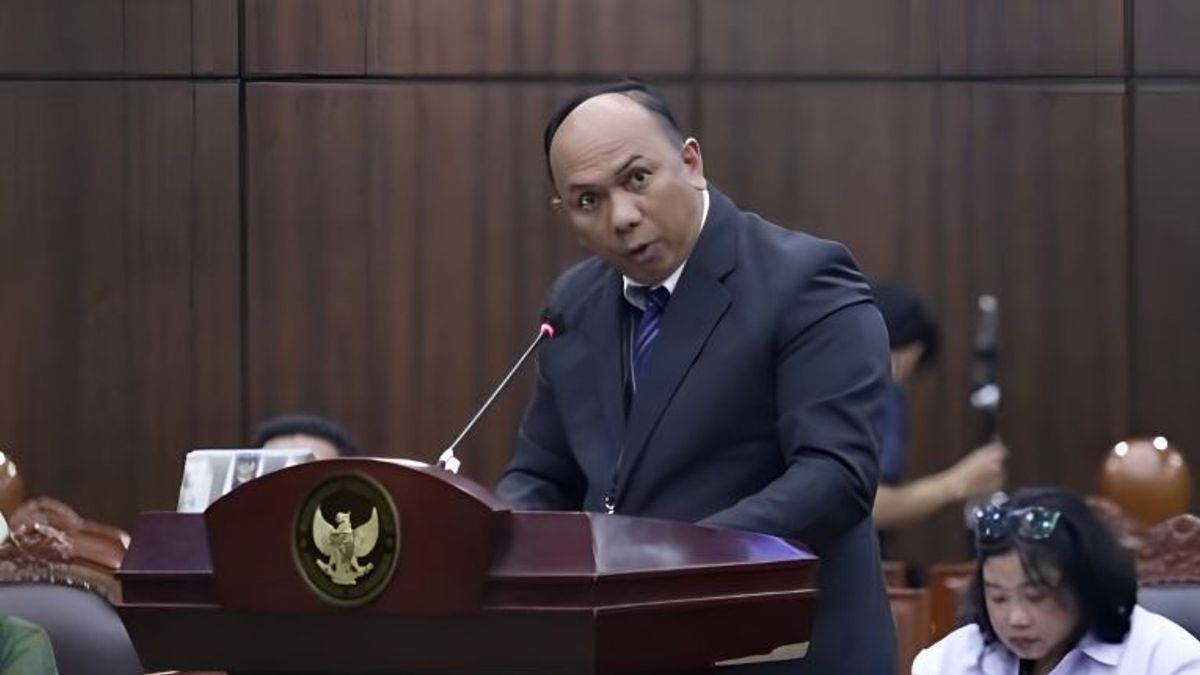
Director General of Digital Infrastructure Komdigi Wayan Toni Supriyanto in the continuation of the trial of the Job Creation Law at the Constitutional Court (MK), said that the rollover of the internet quota has the potential to impose additional burdens and costs on operators.
"The obligation to rollover or refund in general has the potential to create an unmeasurable burden of capacity and additional costs for communication organizers," he said when delivering government statements on the case that questioned the wasted quota, reported by ANTARA, Wednesday, February 18.
This condition, he added, can have an impact on tariff adjustments, reduced variety of affordable packages, decreased service quality due to network density, and disruption of network capacity planning.
According to Komdigi, the request for the internet quota to remain in force following the validity of the card or to be valid indefinitely has the potential to create legal uncertainty and an imbalance of obligations for operators or communication organizers.
"Because there is no clear limit on the end of the provider's responsibility for providing services," he said.
He explained that the service quota is part of the network capacity which is dynamic and limited so it must be managed efficiently and planned. Therefore, the implementation of the validity of the quota is not without reason.
At least four functions are applied to the validity of the quota, according to Komdigi, namely maintaining the efficiency of network utilization, preventing the accumulation of latent capacity, providing certainty for investment planning, and maintaining the quality of public services.
"If quotas are treated as rights without a time limit, this has the potential to create uncertainty in network management, increase operational costs, and reduce service quality, which ultimately harms the wider community," he said.
Therefore, Komdigi stated that the regulation on the validity period of the quota is a rational and proportional economic policy.
The government further assessed that the arguments submitted by the applicant in this material test application were not justified according to law so that the Court was asked to reject the application in its entirety.
In this case number 273/PUU-XXIII/2025, the online taxi driver (ojol) Didi Supandi and online culinary trader Wahyu Triana Sari tested Article 71 paragraph 2 of Law Number 6 of 2023 concerning Cipta Kerja.
The article which is a change to Article 28 of Law Number 36 of 1999 concerning Telecommunications regulates the rates for the provision of telecommunications.
The applicants basically question the system of withholding unused internet quotas when the quota expires by telecommunications service providers or operators.
The applicant's lawyer, Viktor Santoso Tandiasa, said that the article contains a multi-interpretable norm and has no limiting parameters, thus giving operators absolute freedom to mix between service rates and ownership duration.
"This creates legal uncertainty for telecommunications service users as consumers because they never know for sure why data commodities that have been paid for can be lost just because of a unilaterally determined variable time," Viktor said in the first hearing, Tuesday (13/1).
Article 71 paragraph 2 of the Employment Creation Law is also considered to create injustice. The applicants reasoned that the article allows operators as telecommunications service providers to receive full payment in advance, but the rights of users or consumers can be forcibly terminated.
On this basis, the applicants asked the Constitutional Court to declare Article 71 paragraph 2 of the Employment Creation Law to be in conflict with the constitution if it is not interpreted as: The determination of tariffs and schemes for the provision of telecommunications services must provide for the accumulation of residual data quotas (data rollover) that have been paid by consumers.
The English, Chinese, Japanese, Arabic, and French versions are automatically generated by the AI. So there may still be inaccuracies in translating, please always see Indonesian as our main language. (system supported by DigitalSiber.id)


