
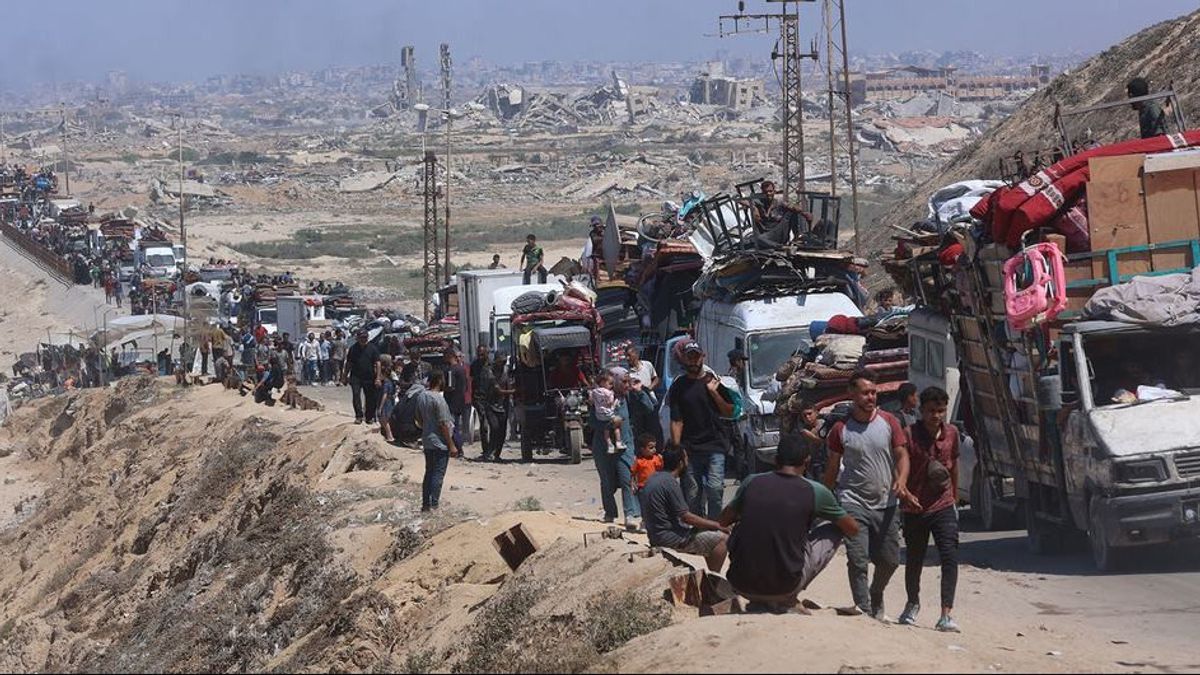


JAKARTA - Two Israeli human rights organizations, Adalah and Gisha, have called for a halt to a policy they say is an abuse and an illegal restriction on Gazans who want to return through Rafah. They warn that the move is tantamount to forced displacement.
In a statement on Thursday, the two organizations said they had sent urgent letters to Israeli defense chief Katz, Attorney General Gali Baharav-Miara, and the military prosecutor.
They demanded an immediate cessation of the restrictive policies and treatment deemed illegal against Gaza residents who want to return through the Rafah crossing on the Palestinian-Egyptian border.
Testimonies collected, including from elderly residents and children, described harsh interrogations by the Israeli military, but confirmed that residents who would return to Gaza remained determined to live on their land and rejected expulsion efforts.
The organization said the closure of the crossing had prevented injured and sick Palestinians from seeking treatment outside, as well as preventing thousands of people outside Gaza from returning.
All travelers, they said, must first receive security approval from Israel, with strict restrictions on the entry and exit process. Only a small number of residents who left during the war were allowed back.
Field reports show only a small number of people, mostly women and children, have been allowed back, though previously it was said around 50 people would be allowed in each day, with no clear explanation for the difference in conditions.
Testimony also described the practice of blindfolding, gagging, and confiscating personal belongings. Some Palestinians were transferred within Gaza by armed groups coordinating with the Israeli army and subjected to security interrogations with pressure and threats of arrest.
The organization assessed that the practice violated international law which guarantees the right to return without arbitrary restrictions, and warned that the prevention of return and the imposition of security conditions could be categorized as forced displacement which is prohibited under the Geneva Convention.
They called for the removal of all obstacles to return, the lifting of security conditions, and full compliance with international law.
Testimony in the field
In a widely circulated video, a resident who was returning to Gaza, Adel Imran, said the gunmen opened the bus door and moved the passengers to a military vehicle heading to the Morag area between Rafah and Khan Younis. There they were searched and then handed over to Israeli forces.
In the same video, Amani Imran said the gunmen confiscated their belongings before the Israeli soldiers called the passengers one by one to be photographed and interrogated about the reasons for leaving Gaza and the reasons for returning.
In another recorded testimony, an elderly Palestinian woman said she was interrogated for three hours after returning from a long medical trip to Egypt. He said the bus was surrounded by military vehicles before passengers were transferred to an area under Israeli control.
He added that they were then handed over to a unit called the anti-terror unit led by Ghassan al-Deheini, commander of the Abu Shabab militia in Gaza, and asked about the Palestinians killed during the war in an attempt, according to him, to intimidate residents returning to Gaza.
Egyptian and Israeli media previously reported that about 50 Palestinians would be allowed to enter Gaza every day, with a similar number leaving for Egypt for treatment, but the arrangement has not been implemented.
Palestinian estimates in Gaza indicate that about 22,000 injured and sick people need to leave the area to get treatment due to the collapse of the post-war health sector.
Semi-official data also showed 80,000 Palestinians had registered to return to Gaza, confirming widespread rejection of the expulsion and determination to return to Gaza despite the destruction.
Before the war, hundreds of Palestinians crossed Rafah daily in two directions through a mechanism managed by the Gaza Interior Ministry and Egyptian authorities without Israeli involvement.
In the first phase of the ceasefire agreement, Israel was supposed to fully open the crossing when the ceasefire took effect on October 10, but it has not yet been realized.
The English, Chinese, Japanese, Arabic, and French versions are automatically generated by the AI. So there may still be inaccuracies in translating, please always see Indonesian as our main language. (system supported by DigitalSiber.id)
Most Popular Tags
#Prabowo Subianto #donald trump #2026 World Cup #Febrie Adriansyah #8791Popular


