

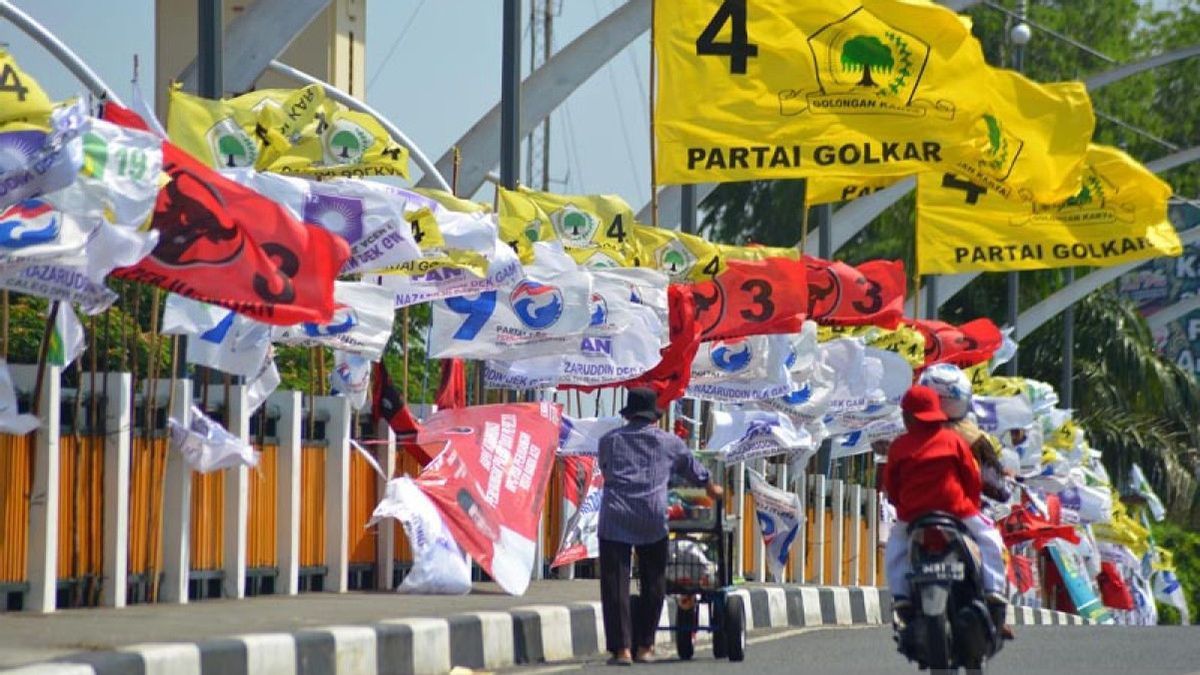


BADUNG - Deputy Coordinating Minister for Political and Security Affairs (Wamenko Polkam) Lodewijk Freidrich Paulus emphasized that the government still holds the benchmark for political party funding assistance (banpol) of Rp. 1,000 per vote per year, even though a number of political parties have proposed an increase.
"From the discussions conveyed by the representatives of political parties, they said it was still lacking, but while the benchmark (Rp 1,000 per vote per year) we hold," said Lodewijk in Badung Regency, Bali, Wednesday, February 11.
Lodewijk said that compared to other countries, the nominal assistance for political party funds in Indonesia is relatively small. However, the authority to propose changes to the figure is in the hands of the Corruption Eradication Commission (KPK). "The one who has the right to propose is the KPK, so we are still waiting if the figure starts to be considered irrelevant," he said.
As an illustration, Lodewijk cited the Golkar Party which won around 23 million votes in the election so that it received a banpol from the state budget of around Rp. 23 billion per year.
The Secretary General of the KPK, Cahya Hardianto Harefa, explained that in 2019 the KPK had proposed political party funding assistance of Rp. 16,900 per vote, with a financing scheme of 50% of the state budget or around Rp. 8,000 per vote.
The figure of Rp. 10,000 per vote also surfaced. However, the government finally agreed to Rp. 1,000 per vote per year, and this value is still valid until now.
The discussion of the increase in banpol has strengthened again after the Ministry of Political Affairs released the results of the 2025 Political Party Integrity Index (IIPP) measurement. In the report, the value of the party's financial dimension which is transparent and accountable has decreased significantly from 60 to 44.5.
Overall, the average IIPP 2025 is at 61.22 or a medium integrity category. The other four dimensions are still in the medium integrity category, namely the code of ethics (66), internal democracy (63.2), kaderization (61.4), and recruitment (60.8).
Political parties assess that if the government demands higher financial transparency, there needs to be state financing support as a form of reciprocity. In response to this, Cahya Harefa emphasized that the integrity of political parties should not only be measured by the amount of funding assistance.
"Whatever it is, it is important that political parties are expected to set an example. If the political party is integral, the cadres who are placed in various positions can also transmit good integrity," he said.
Although the assistance of political party funds has not increased, the KPK hopes that the party integrity index will increase in the coming years because it reflects the quality of national leadership that is born from political parties.
The English, Chinese, Japanese, Arabic, and French versions are automatically generated by the AI. So there may still be inaccuracies in translating, please always see Indonesian as our main language. (system supported by DigitalSiber.id)
Most Popular Tags
#Prabowo Subianto #donald trump #Febrie Adriansyah #8791 #giias 2026Popular


