

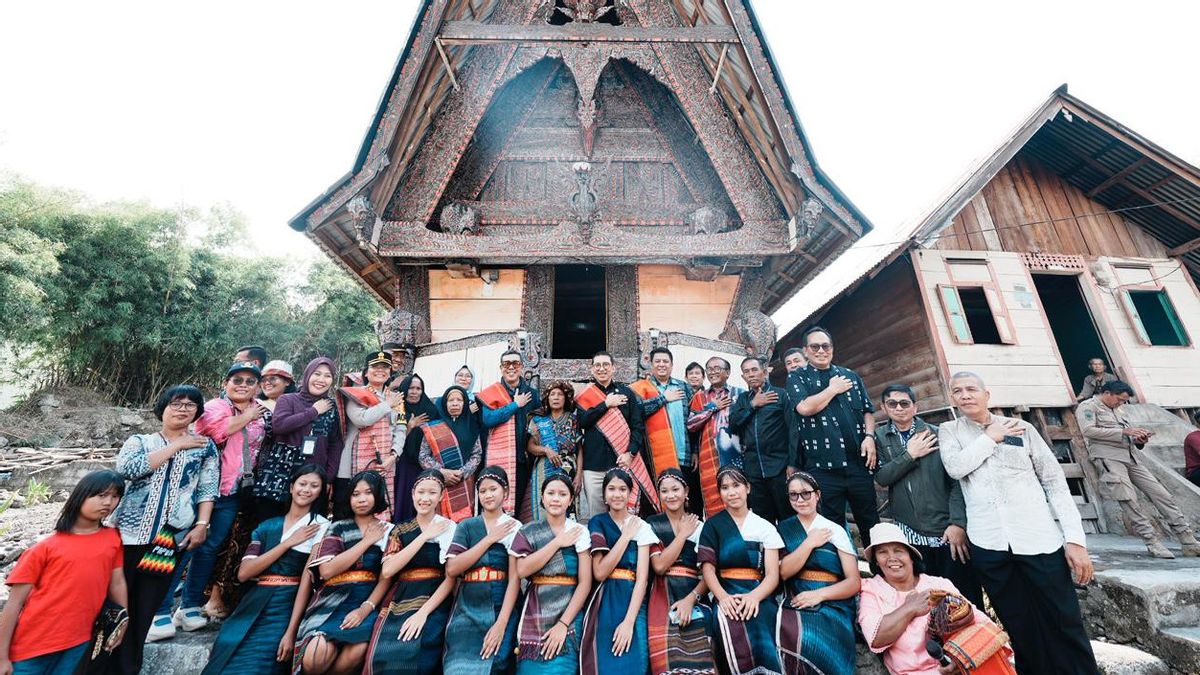


SAMOSIR - The Minister of Culture of the Republic of Indonesia, Fadli Zon, emphasized that museums must be "learning centers" and "education centers", not just exhibition spaces. He made this statement while reviewing the Batak Heritage Museum in Pangururan, Samosir Regency, North Sumatra, Saturday, February 7.
The Batak Heritage Museum is known to house various Batak cultural artifacts. Most of the museum's collection is the result of the collection of artifacts carried out by Pastor Leo, then arranged and developed into an educational exhibition space with a systematic storyline. The arrangement pattern makes visitors able to follow the journey of Batak people's lives in its entirety, from daily life, social systems, to rituals and traditional ceremonies in the past.
Fadli appreciated the arrangement of the museum, which was considered informative and easy to understand. He assessed that the Batak Heritage Museum was able to explain the dynamics of Batak people's lives before and after the entry of religious influences through missions, as well as showing the process of cultural change that occurred.
Fadli was accompanied by Samosir Regent Vandiko T. Gultom, Deputy Regent Ariston Tua Sidauruk was greeted with a warm welcome. (IST)
"Museum Pusaka Batak is a very important place to get to know the Batak culture. The collection on display is quite a lot and arranged with a very good storyline to explain how the life of the Batak people in the past, from daily life, rituals, to traditional ceremonies," said Fadli.
He also highlighted the richness of the ethnographic collection displayed, ranging from traditional sticks, traditional household equipment, to high-value symbolic objects such as king's purses. According to him, the completeness of the collection should be an example for regional museums in Indonesia.
"We see a lot of ethnographic collections that are very interesting and complete. This is what we hope for from museums in the region, namely to display local collections that represent the identity and history of the local community," said Fadli.
According to Fadli, the function of a museum does not stop at a display room, but becomes an effective means of education. With a relatively short visit time and the help of an educator's explanation, visitors can gain an understanding of traditions that still survive, experience acculturation, and those that are no longer practiced.
"Museums are learning centers, education centers, and cultural centers. Through museums like this, we can understand the journey of culture, social change, and values that shape society to this day," he said.
During the visit, Fadli was accompanied by Samosir Regent Vandiko T. Gultom, Deputy Regent Ariston Tua Sidauruk and a number of officials at levels 1 and 2 of the Ministry of Culture as well as the Head of the Cultural Preservation Agency for Region II of North Sumatra Province.
At the end of the visit, Fadli hoped that the Batak Heritage Museum would continue to be developed as a reference for cultural learning for local communities, young generations, and tourists who want to get closer to the Batak culture as part of Indonesian culture. He also hopes that the existence of this museum can contribute to the local economy.
The English, Chinese, Japanese, Arabic, and French versions are automatically generated by the AI. So there may still be inaccuracies in translating, please always see Indonesian as our main language. (system supported by DigitalSiber.id)
Most Popular Tags
#Prabowo Subianto #donald trump #firearm #8791 #giias 2026Popular


