

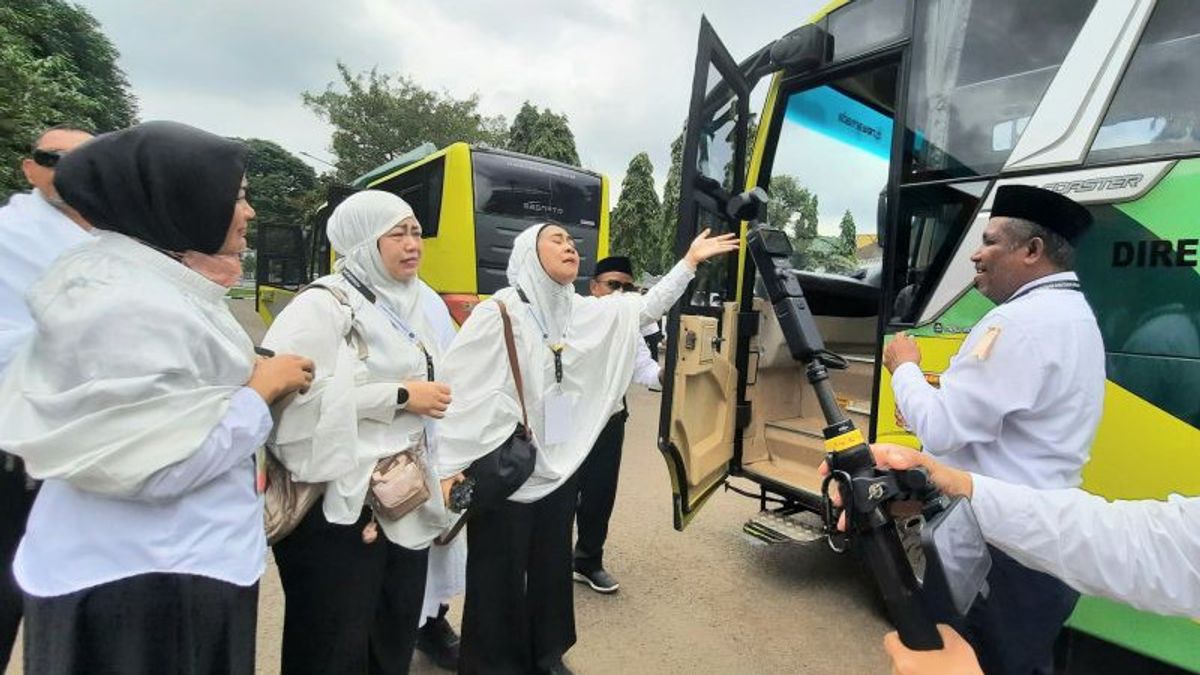


JAKARTA - Participants in the education and training (diklat) of prospective Hajj Service Officers (PPIH) in 2026/1447 H conducted a mock-up of the Arafah, Muzdalifah and Mina (Armuzna) operational post at the Pondok Gede Hajj Dormitory, Wednesday, January 28.
The activity is designed to simulate the peak situation of the hajj, which is known as the most difficult and critical phase in the implementation of the hajj.
In the simulation, participants were faced with various field scenarios, ranging from the movement of congregations, consumption services, to handling crises in the midst of mass density.
Head of the Operational Unit (Kasatops) Armuzna Lieutenant Colonel (Letkol) Infantry Surnadi, who directly monitored the trial, emphasized that the Armuzna phase did not provide room for error.
Considering the principle of "Al-Hajju Arafah" or Hajj is Arafah, the presence of officers who are quick and understand the main tasks and functions is the key to the success of the service.
"The activities witnessed in this rehearsal are aimed at ensuring that officers really understand their respective duties and functions. At Armuzna, coordination is the life of operations," said Surnadi, quoted by Antara.
Furthermore, Surnadi emphasized the mentality of problem solvers or problem solvers that every officer must have. In the real situation in the Holy Land, officers will face elderly pilgrims, pilgrims with high risks (risti), to pilgrims who are separated from the group.
"Our main task during Armuzna is to serve pilgrims who have difficulties. In principle, there should be no problems experienced by pilgrims that the officers have not found a solution. Hajj officers must be present, responsive, and solve problems on the spot," said Surnadi.
Apart from the logistics operational aspect, Surnadi also highlighted the aspect of guidance for worship, which is often overlooked in the midst of the hustle and bustle of Arafah.
He reminded that the challenge of officers is not only to ensure that pilgrims eat or get tents, but also to ensure that pilgrims carry out the pillars of Hajj perfectly.
There is a risk that pilgrims who have arrived at Arafah are passive, because of fatigue or ignorance, so that the very mustajab wukuf time is missed.
"An officer, especially the Guidance for Worship (Bimbad) team, must really supervise and direct. Don't let the congregation just sit still even though they are in Arafah. Officers must actively guide them to pray, meditate, and follow the wukuf procession with devotion," said Surnadi.
Through this Armuzna post test, it is hoped that the prospective Hajj officers of 2026 will not only be physically ready, but also have a high level of sensitivity to the situation. The simulation is the last preparation before they are directly deployed to the battlefield in Saudi Arabia.
The English, Chinese, Japanese, Arabic, and French versions are automatically generated by the AI. So there may still be inaccuracies in translating, please always see Indonesian as our main language. (system supported by DigitalSiber.id)
Most Popular Tags
#Prabowo Subianto #donald trump #Febrie Adriansyah #8791 #giias 2026Popular


