

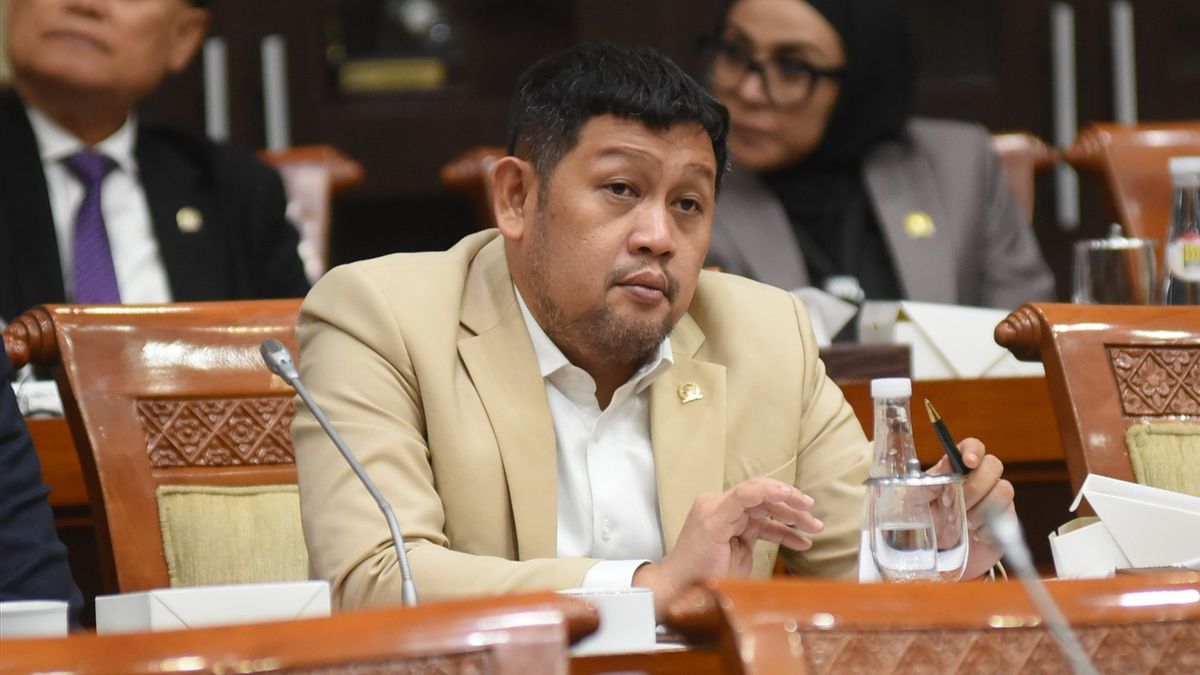


Member of Commission III of the Indonesian House of Representatives, Abdullah, supports the Indonesian National Police (Polri) to remain directly under the control of the President. He said that the institutional repositioning of the National Police under the ministry was a step backwards in the agenda of reforming the security sector in Indonesia.
This was said by Abdullah in response to the reappearance of the discourse on placing the National Police under a certain ministry which is being pushed by the National Police Reform Acceleration Commission.
"The discussion of placing the National Police under the ministry is a step backwards in the agenda of reforming the security sector. The current design is ideal to ensure the professionalism and independence of law enforcement," Abdullah said in a statement to reporters, Tuesday, January 27.
Abdullah reminded that the current position of the National Police has a strong historical and constitutional foundation, namely the TAP MPR Number VII of 2000. This policy was born during the reign of the fourth President of the Republic of Indonesia, KH Abdurrahman Wahid (Gus Dur), who is also the founder of the PKB.
According to Abdullah, Gus Dur courageously encouraged the separation of the National Police from the TNI to uphold civilian supremacy.
"Gus Dur's character is clear, the armed forces must return to barracks and uphold civilian supremacy. The structure of the National Police under the President is an ideological step to prevent the politicization of armed power," said the PKB legislator from the Central Java District.
Abdullah also welcomed the statement of the National Police Chief General Listyo Sigit Prabowo who said that the position of the National Police under the President was already ideal institutionally. He emphasized that his party would be the vanguard in maintaining Gus Dur's legacy of security reform.
"For us, the spirit and ideas of Gus Dur should not be replaced or changed. This is the product of the thinking of the founder of our party. If there is a party that represents the ideological cadres of Gus Dur but instead tries to change this order, PKB will stand at the forefront to reject it. We will fight," he concluded.
It is known that the discussion of the redeployment of the National Police previously emerged through the statement of the Member of the National Police Reform Commission, Yusril Ihza Mahendra, who mentioned negotiations regarding the possibility of redeploying the institutional structure of the National Police as part of efforts to strengthen the constitutional system.
Meanwhile, Commission III of the DPR provided eight points of recommendations for accelerating reform for the Indonesian National Police (Polri) in a working meeting with the National Police Chief General Listyo Sigit Prabowo. One of them emphasized that the National Police is under the President of the Republic of Indonesia.
"Commission III of the DPR RI emphasizes that the position of the National Police is under the President directly and not in the form of a ministry, which is led by the Head of the National Police of the Republic of Indonesia (Kapolri) who is appointed and dismissed by the President with the consent of the People's Representative Council of the Republic of Indonesia as stipulated in Article 7 of the TAP MPR Number Vll/MPR/2000 and applicable laws and regulations," concluded the meeting of Commission III of the DPR with the National Police Chief, Monday, January 26.
The English, Chinese, Japanese, Arabic, and French versions are automatically generated by the AI. So there may still be inaccuracies in translating, please always see Indonesian as our main language. (system supported by DigitalSiber.id)
Most Popular Tags
#Prabowo Subianto #donald trump #Febrie Adriansyah #8791 #giias 2026Popular


