
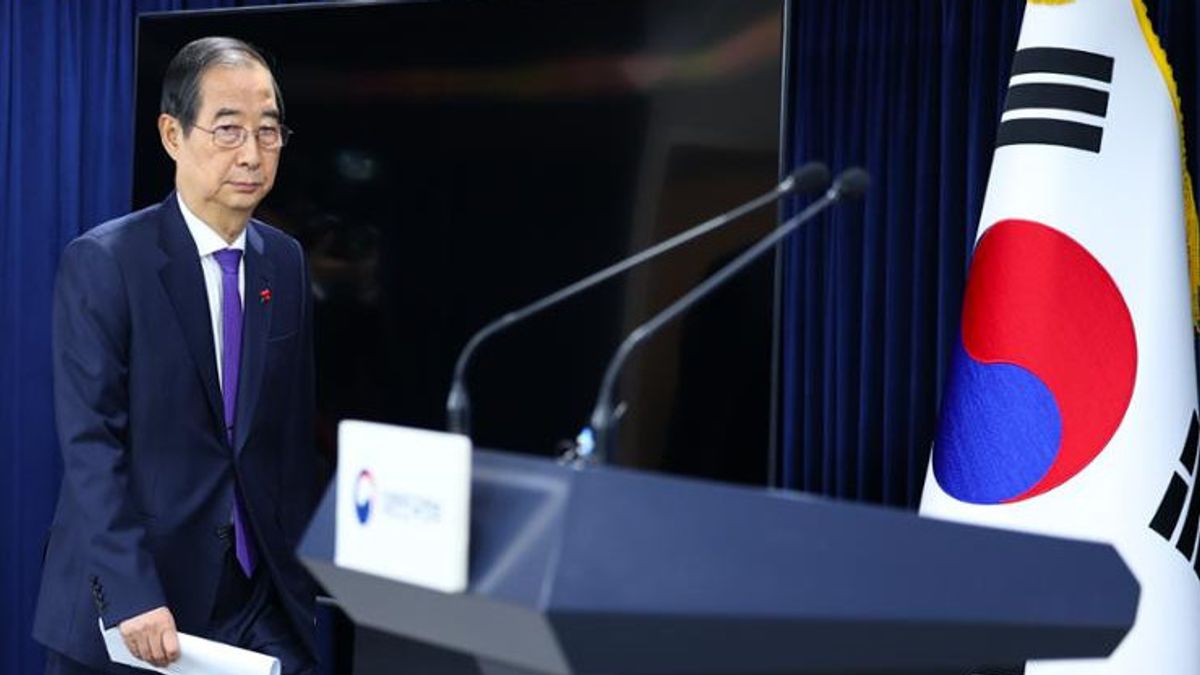


JAKARTA - The Seoul Court, South Korea on Wednesday sentenced former Prime Minister Han Duck-soo to 23 years in prison for his involvement in the declaration of a military emergency by former President Yoon Suk-yeol on December 3, 2024, after being found guilty of aiding the rebellion and playing a central role in its implementation.
The ruling marked the first explicit determination by a judicial institution on whether the declaration of a military emergency was an act of rebellion.
The ruling is expected to heavily impact the ongoing trial of former President Yoon, where a verdict on the rebellion charge is scheduled for next month.
Han's prison sentence is heavier than the previous request of the special prosecutor, which was 15 years. Han was immediately detained after the verdict.
"The declaration of a military emergency was issued with the aim of undermining the constitutional order, and is an act of rebellion," the Seoul Central District Court said, launching The Korea Times (21/1).
It said Han, as the second-highest official in the country, failed to take sufficient steps to prevent the declaration and instead engaged in procedures to make it appear legitimate.
The court cited his role in holding Cabinet discussions and his involvement in handling the military emergency decree prepared after the declaration, saying the move amounted to participating in "an important task in carrying out the uprising."
Prosecutors argued that Han played a central role in providing procedural legitimacy to what they described as an unlawful declaration of martial law.
The special prosecutor's team said Han was aware of the plan and failed to take meaningful steps to stop it, instead being involved in a Cabinet-level process that facilitated its implementation.
They argued that Han, as prime minister, had a constitutional obligation to restrain the president's arbitrary use of emergency powers.
They stressed his involvement in handling a decree prepared after the declaration, which was intended to address procedural flaws in the initial order. The document was later scrapped.
The court also found Han had approved actions such as cutting off electricity and water supplies to the media, actions it said amounted to playing a key operational role in the uprising.
Meanwhile, Han rejected the prosecutor's claim, while still stating that he did not support or assist the imposition of a state of emergency. In his last statement to the court, Han said he "never agreed with the state of emergency and never intended to help it," adding that although he tried to persuade the president to reconsider the decision with other members of the Cabinet, "there was no practical way to stop it."
He has consistently denied playing any role in the imposition of martial law. However, the court rejected this claim, citing evidence that Han did not intervene to block the action and instead let it go.
It is known that the verdict hearing for the former prime minister was broadcast live, reflecting the public significance of the case.
It marks the first case in which a former Cabinet member faces a court ruling over the incident, drawing attention to how the court will assess the legality of the declaration itself.
The ruling is widely seen as a key reference point for future court rulings against Yoon, who faces charges of leading the uprising.
Although a separate court had previously recognized the unconstitutionality of the military emergency declaration, the court did not go so far as to determine whether the action constituted a rebellion.
The English, Chinese, Japanese, Arabic, and French versions are automatically generated by the AI. So there may still be inaccuracies in translating, please always see Indonesian as our main language. (system supported by DigitalSiber.id)


