

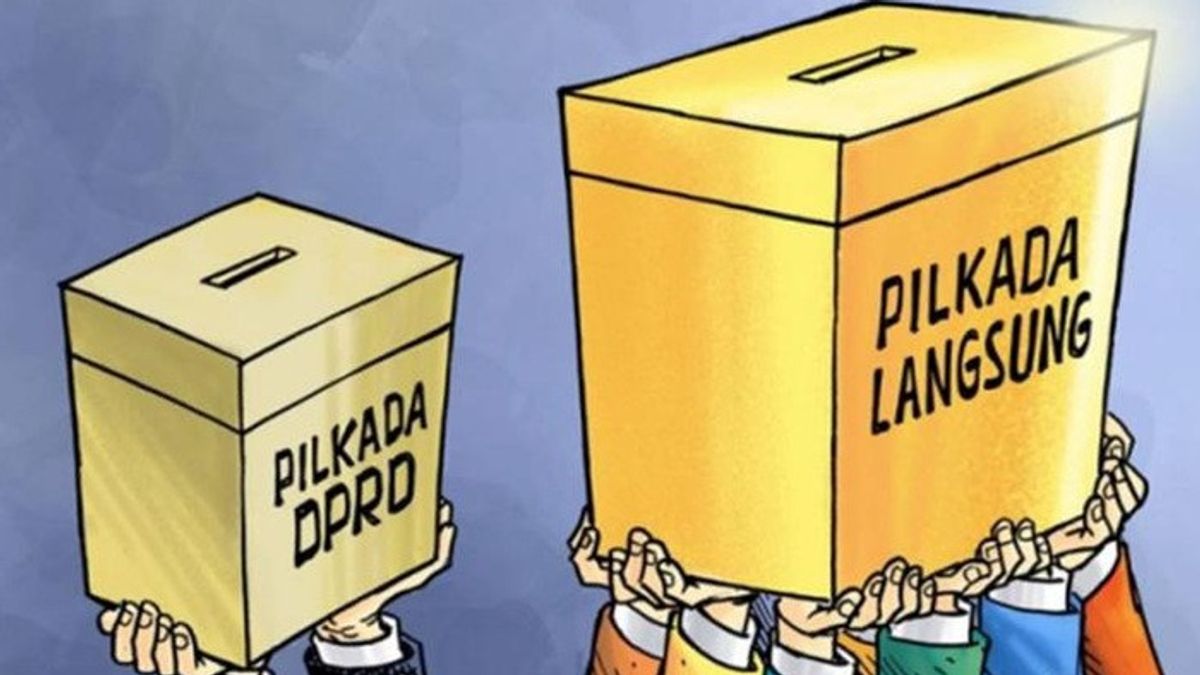


Guru Besar Ilmu Politik UPI, Cecep Darmawan, menilai bahwa status provinsi harus diubah bila pemilihan gubernur diubah menjadi tidak langsung melalui DPRD, sementara presiden hingga bupati/wali kota tetap dipilih rakyat.
"If you want to change it, it means that the province is not a region, it is an area. So the governor is appointed by the central government like in the past, the Dutch East Indies, the Governor General is like that. So the governors are not autonomous regions," he explained, Sunday, January 18.
He emphasized that elections at all levels must be consistent, whether it is direct elections of all, or indirect elections of all. "So if the presidential election is direct, directly below (the regent/mayor), in the middle (the governor) it is not, there are people who call it 'Donat Democracy', like a donut in the middle of it is hollow," he said.
According to Cecep, changes to the electoral system must touch the constitution if the indirect mechanism wants to be fully implemented. "If you want it to be indirect, change the constitution. The president/vice president is also not direct, he chooses it like before by the MPR. Then the district/city also chooses it indirectly. So don't separate it between governments," he continued.
He also reminded that the risk of political money could be more rampant if the election was completely delegated to the DPRD.
"If not immediately, how do we make it so that the representative institutions, the DPRD, later, do not also have money politics there. Whatever the choice, the important thing is the same, do not sort it out," said Cecep.
Previously, PKS politician, Mardani Ali Sera offered an asymmetric local election concept amid heated debates about the upcoming local elections. Seeing the latest developments in the discourse that emerged in the public, Mardani at least captured three concepts that were voiced for the upcoming local elections, namely direct local elections, DPRD local elections and asymmetric local elections.
According to Mardani, asymmetric local elections are the most likely model to be implemented in the future in the pattern of Indonesian politics as an archipelago country, as well as adhering to the regional autonomy system. "My view of all the dynamics that exist, the public's view is clearly very eager for democracy in direct local elections. But at the same time, districts/cities are the basis of regional autonomy, and at the same time the governor is an extension of the central government," he explained.
The English, Chinese, Japanese, Arabic, and French versions are automatically generated by the AI. So there may still be inaccuracies in translating, please always see Indonesian as our main language. (system supported by DigitalSiber.id)
Most Popular Tags
#Prabowo Subianto #donald trump #firearm #8791 #giias 2026Popular


