

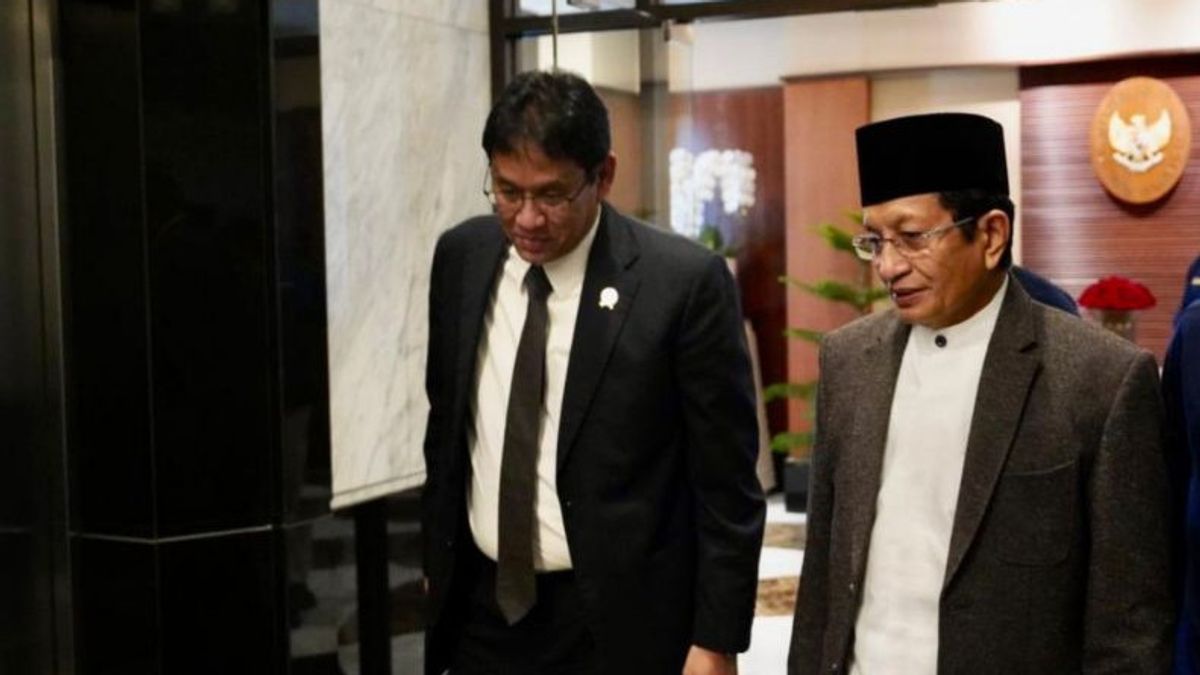


JAKARTA - Minister of Religion Nasaruddin Umar met with Minister of Finance Purbaya Yudhi Sadewa to discuss strengthening the synergy of the management of Islamic economics, especially the optimization of umat funds so that they can contribute significantly to the welfare of the Indonesian people.
"Some of the funds of the people who have not been active, not actual, need to be actualized so that they can contribute to the welfare of the people of Indonesia," said the Minister of Religion as quoted by ANTARA, Wednesday, January 14.
The Minister of Religion explained that the economic potential of the Indonesian people is very large, but some of the people's funds such as zakat, wakaf, infak, and alms are still not optimally managed.
The Minister of Religion assessed that there was a need for concrete steps to activate and actualize these funds so that they could have a direct impact on the people.
"In the future, mosques are not only positioned as places of worship, but are also expected to become centers for the development of the economy of the people. The management of zakat, waqf, infak, and alms must be carried out in accordance with sharia principles, transparent, and supervised," said the Minister of Religion.
The Minister of Religion also conveyed that his party was collecting and reviewing data from the Central Statistics Agency (BPS) to map the potential of the community's economy more comprehensively.
These data will be the basis for formulating more targeted and wide-reaching policies for the management of umat funds.
"The funds of the people must be managed professionally and supervised. The goal is clear, to help the people, not to enrich a few people," he said.
Previously, the Ministry of Religion strengthened the role of zakat as a religious social protection instrument in handling disasters in Sumatra, by converting it through the provision of ready-to-eat food, health, to the construction of temporary houses.
Director of Zakat and Waqf Empowerment of the Ministry of Religion (Kemenag) Waryono Abdul Ghafur encourages a paradigm shift in the management of zakat from mere charitable assistance to a social protection system for the working community from the emergency phase to recovery.
"Zakat should not stop as an emergency response. It must work as a system of social protection for the community, ensuring that survivors have access to food, clean water, education, electricity, and connectivity to recover their lives," said Waryono.
The English, Chinese, Japanese, Arabic, and French versions are automatically generated by the AI. So there may still be inaccuracies in translating, please always see Indonesian as our main language. (system supported by DigitalSiber.id)


