
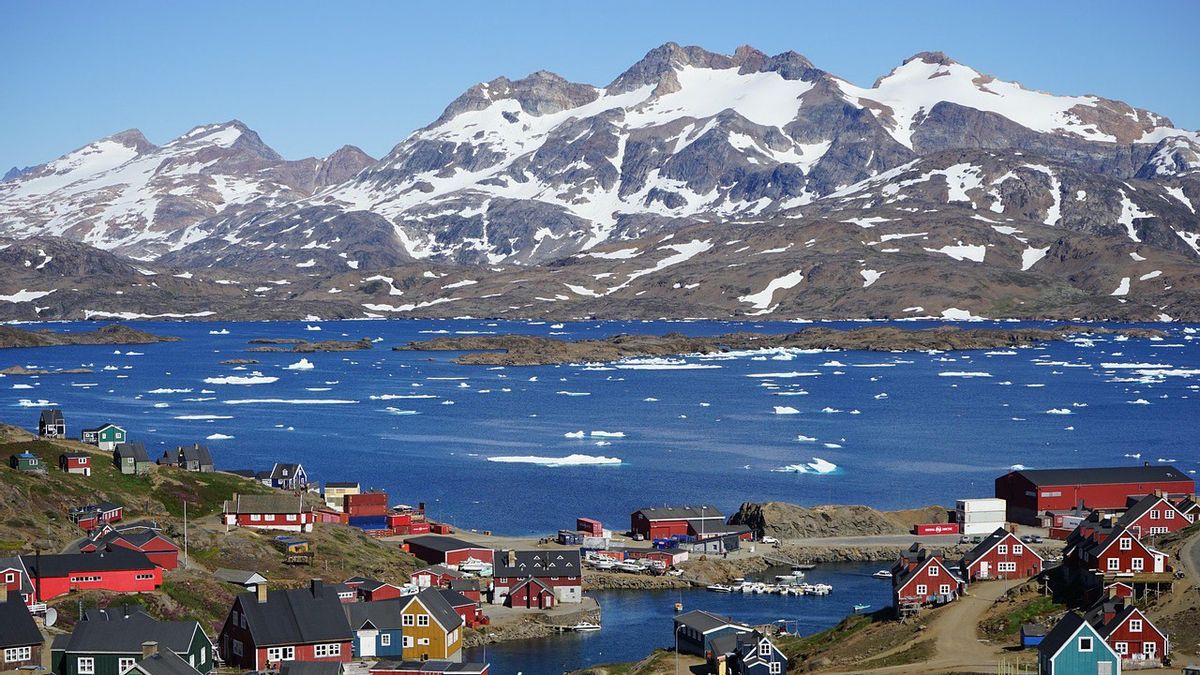


YOGYAKARTA - Greenland is once again in the spotlight after US President Donald Trump publicly expressed his interest in taking over the Arctic island. This statement sparked controversy because it concerns territorial sovereignty and international relations.
Geographically, Greenland belongs to the North American region, but politically it is in the Danish Kingdom. This issue makes many people start to ask, how important is Greenland for the world?
The interest of major countries in Greenland has also increased attention to its history, population, and resources. To understand the island's important position, we need to look at the various aspects that shape Greenland's current identity.
8 Facts About GreenlandFrom the giant ice sheet to the hidden mineral wealth, Greenland holds many interesting facts that are rarely known to the public. Reported by Wionews, here are eight facts about Greenland that need to be known.
Ancient Settlements and Modern PopulationsGreenland has been inhabited by humans for at least 4,500 years by groups migrating from the Arctic and North American regions. Currently, the population is around 56,600 to 57,000. About 19,600 people live in the capital Nuuk.
The majority of Greenland's population is Inuit. Greenlandic is designated as an official language and is widely used. Based on the region, the Inuit community calls themselves Kalaallit (residents of Western Greenland), Inugguit (from the Thule district), or Iit (residents of Eastern Greenland).
The Largest Island in the WorldWith an area of more than 2.16 million square kilometers, Greenland holds the status as the largest island in the world. Its size is almost two-thirds the size of India, although the population is very small. The size of this area makes Greenland unique geographically.
Around 80 percent of Greenland's land is covered by the Greenland Ice Sheet. This ice sheet plays a major role in regulating the global climate system. The ice-free area is generally located on the coast and is a center of settlement.
Government and Autonomy StatusGreenland is a self-governing territory within the Kingdom of Denmark. Since the Self-Government Act of 2009, Greenland has broad authority over domestic affairs. The Greenland Parliament is known as Inatsisartut.
However, Denmark still controls foreign and defense policy. Greenland was once part of the European Union through Denmark. In 1985, Greenland left the European Union but still maintained special relations.
Economy and LivelihoodsGreenland's economy has historically depended on the fishing sector. Fishing cod, shrimp, and other marine life is a major source of income. Traditional hunting activities have now been greatly reduced.
Tourism is growing rapidly as interest in the Arctic landscape increases. Tourists are interested in icebergs, wildlife, and extreme natural beauty. In addition, Greenland is also trying to develop the mining sector.
Natural Resources WealthGreenland has enormous mineral wealth. A 2023 survey showed that 25 of the 34 minerals considered "critical raw materials" by the European Commission are found in this region. This fact increases Greenland's strategic value in the eyes of the world.
Minerals such as graphite, copper, nickel, gold, and uranium are available in large quantities. However, the exploitation of oil and natural gas is prohibited for environmental reasons. Mining development also faces rejection from indigenous peoples.
Strategic Arctic LocationGreenland's location between Europe and North America makes it very important geopolitically. This region has strategic value for defense and military routes. In addition, Greenland is a center for Arctic climate change research.
Because of its location, Greenland attracts the attention of major countries. The United States is among those who show strong interest in this island. The geographical position and resources make Greenland a global strategic asset.
NATO Membership and International StatusGreenland is part of NATO through Denmark. This status gives it an important role in the North Atlantic defense system. The existence of a military base is one of its strategic aspects.
Greenland also has close ties with the European Union through a bilateral agreement. European and Danish leaders have made it clear that Greenland's sovereignty lies in the hands of its people and Denmark's constitutional arrangements, rejecting external claims that are coercive.
Climate Change ImpactsGreenland's ice sheet is melting faster than in previous decades, exposing land and potential mineral wealth, but also contributing to global sea level rise. This melting contributes to global sea level rise. The impact is felt not only in Greenland, but also around the world. Environmental issues are the biggest challenge for Greenland's future.
So that's the discussion of 8 facts about Greenland, follow other interesting articles at VOI.ID. So as not to miss the latest news, follow and monitor our social media accounts!
The English, Chinese, Japanese, Arabic, and French versions are automatically generated by the AI. So there may still be inaccuracies in translating, please always see Indonesian as our main language. (system supported by DigitalSiber.id)
Popular


