

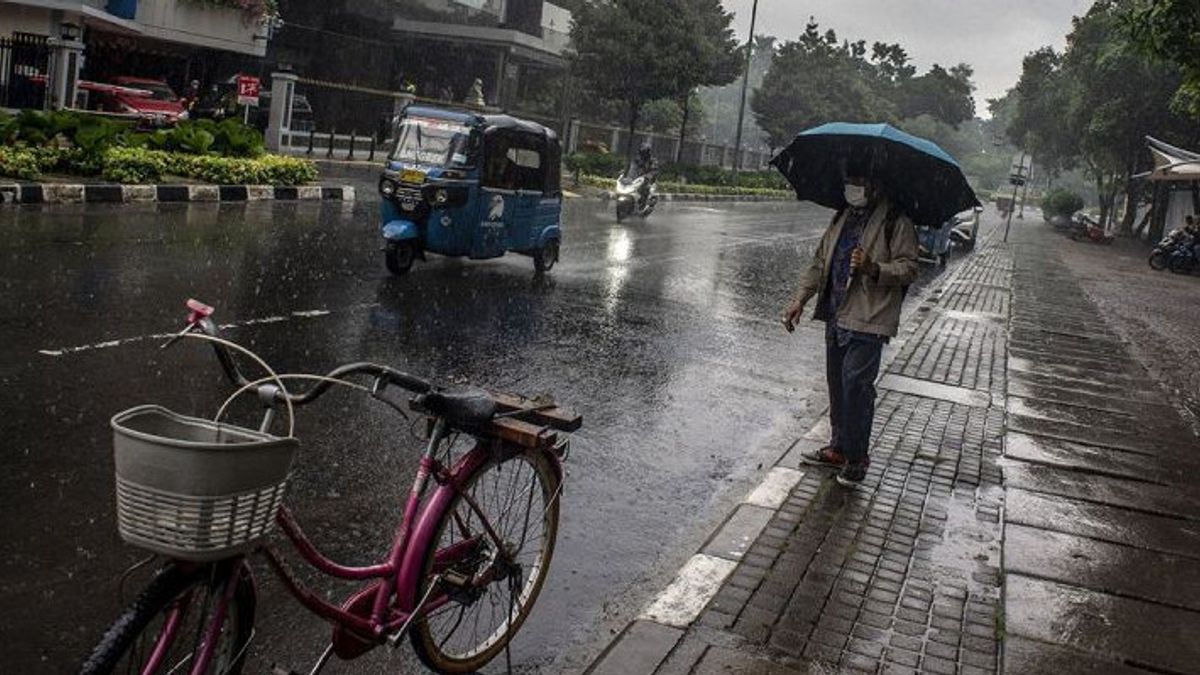


JAKARTA - The Meteorology, Climatology and Geophysics Agency (BMKG) predicts that most major cities in Indonesia are potentially hit by light to moderate rain on Friday, January 9.
In the BMKG weather early warning system, for the Sumatra region, the major cities that are potentially hit by light to moderate rain are Aceh, Medan, Pekanbaru, Tanjung Pinang, Padang, and Palembang.
"Jambi, Bengkulu, Pekanbaru, Pangkal Pinang, and Bandar Lampung are predicted to experience heavy rain accompanied by lightning," said BMKG Praktirawan Ina Indah in a broadcast quoted by Antara Jakarta.
Light to moderate rain is also potentially occurring in Jakarta, Bandung, Semarang, Yogyakarta, and Banten. Meanwhile, Surabaya has the potential to be hit by heavy rain accompanied by lightning.
In Kalimantan, Pontianak, Palangka Raya, and Samarinda are predicted to be hit by light to moderate rain. Tanjung Selor and Banjarmasin are predicted to be hit by heavy rain accompanied by lightning.
"Meanwhile, Bali and Mataram have the potential to be hit by light rain. Kupang is predicted to be heavy rain accompanied by lightning," he said.
For Sulawesi Island, light to moderate rain is potentially occurring in Mamuju, Makassar, Kendari, Palu, and Gorontalo. Meanwhile, Palu and Manado are cloudy.
Moving to the easternmost region, cities such as Ternate, Sorong, Nabire, Jayapura, Jayawijaya, and Merauke are predicted to be hit by light to moderate rain. Meanwhile, Manokwari and Ambon are predicted to be cloudy.
In addition, BMKG issued an early warning of the potential for high waves reaching six meters in a number of Indonesian waters, including in the North Natuna Sea area.
The Director of Maritime Meteorology of the BMKG, Eko Prasetyo in Jakarta, Wednesday, reported that the potential for high sea waves is expected to occur in the period of 7 - 10 January 2026.
The BMKG Meteorology Team confirmed that the condition was influenced by the presence of Tropical Cyclone Jenna in the southwest Indian Ocean and Tropical Cyclone 90W in the Philippine Sea which triggered an increase in wind speed and wave height in Indonesian waters.
BMKG noted that the wind pattern in the northern part of Indonesia generally moves from northwest to northeast with a speed of 6-25 knots, while in the south it moves from southwest to northwest with a relatively similar speed.
The Head of the Meteorology, Climatology, and Geophysics Agency (BMKG) Teuku Faisal Fathani emphasized that reliable, integrated, and sustainable information management from upstream to downstream is the main pillar in the management of hydrometeorological disaster risk.
Strong information is considered an important foundation to support early warning systems, mitigation efforts, and effective disaster decision-making.
The English, Chinese, Japanese, Arabic, and French versions are automatically generated by the AI. So there may still be inaccuracies in translating, please always see Indonesian as our main language. (system supported by DigitalSiber.id)
Most Popular Tags
#Prabowo Subianto #donald trump #2026 World Cup #Febrie Adriansyah #8791Popular


