

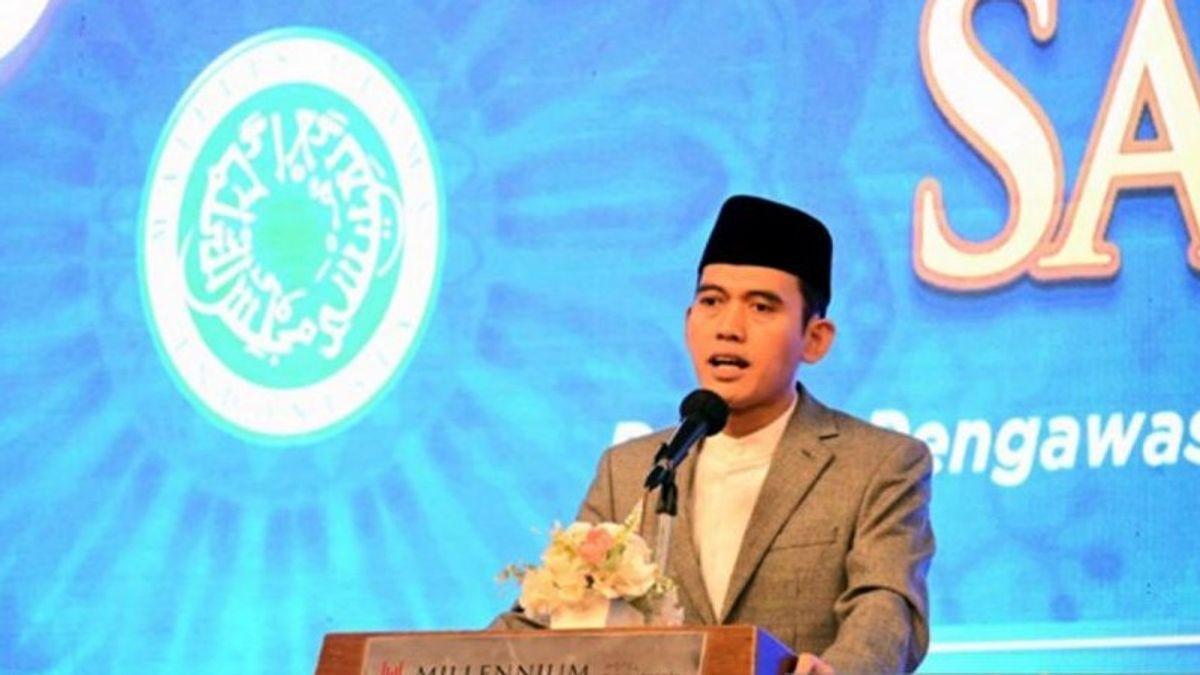


JAKARTA - The Indonesian Ulema Council (MUI) said that according to the results of the Ijtima Ulama Fatwa Commission in 2012, it was proposed that the election of regional heads be carried out through the DPRD, which is in line with the current developing discourse.
"MUI considers that political policies must be oriented towards public welfare and carried out with the principle of decency and efforts to minimize potential destructiveness," said MUI Chairman for Fatwa Asrorun Niam Sholeh, quoted by ANTARA from the official MUI website, Tuesday, January 6.
Asrorun Niam emphasized that in the religious perspective, policies set by ulil amri in public affairs must be directed to present the welfare of the wider community. Therefore, public policies need to continue to be evaluated objectively.
"Our task is to evaluate public policies. If it brings benefits, then continue. However, if it brings harm, it must be improved," he said.
MUI has conducted in-depth studies on the direct election system since the 2012 MUI Fatwa Commission Ulama Ijtima. In the study, MUI found various negative impacts that emerged from direct elections.
"In addition, it also causes high cost economics and money politics that damage the common sense and morality of the community," said Niam.
According to him, this condition has the potential to produce leaders who are not law-abiding and are more oriented towards returning social capital and economic capital, instead of the people's interests.
Based on these considerations, through the forum of ulama fatwa meeting throughout Indonesia in Tasikmalaya, MUI proposed that the election of regional heads be carried out through the DPRD.
The proposal, according to him, has been discussed by MUI since 13 years ago and is considered still very relevant to the current conditions.
"A civilized nation is a nation that wants to progress. A developed nation must learn from history. What is good we maintain, what is bad we evaluate and we improve. Nothing is impossible if we are oriented towards public welfare," he said.
The contents of the results of the Indonesian Fatwa Commission Ijtima at Cipasung Pesantren, Tasikmalaya, West Java, in 2012, namely, first, the process of selecting and appointing regional heads as bearers of trust for hirasah al-din and siyasah al-dunya can be carried out with several alternative methods agreed upon by the people as long as they bring benefits and are not contrary to the principles of sharia.
Second, direct elections in determining leadership can only be carried out if agreed by the people, guaranteed its welfare, and avoided mafsadat. The election is one of the media for learning democracy for the regional community and at the same time to realize the essential rights of individuals such as equal political rights and the opportunity to place individual positions in regional government.
Third, Pemilukada is directly intended to involve the participation of the community at large, so that in theory the public's access and control over the arena and actors involved in the pemilukada process become very strong. In the context of consolidating and strengthening democracy, pemilukada becomes a pillar that strengthens the building of democracy nationally.
Fourth, currently the election of regional heads directly has a very large mafsadatyang, among others, the emergence of disharmony in the national leadership hierarchy. This results in the high cost of democracy, delaying the scale of priority development of society which is currently in a difficult economy.
Then, it has the potential to create horizontal conflicts between elements of the community which can involve SARA elements. Fourth, moral damage that has hit the wider community due to the prevalence of money politics.
For this reason, if sociologically-politically and morally, the community is not ready, then based on the principle of prioritizing preventing corruption, the election of regional heads should be carried out with a representative system while still maintaining the principles of democracy.
The English, Chinese, Japanese, Arabic, and French versions are automatically generated by the AI. So there may still be inaccuracies in translating, please always see Indonesian as our main language. (system supported by DigitalSiber.id)
Most Popular Tags
#Prabowo Subianto #donald trump #Febrie Adriansyah #8791 #giias 2026Popular


