
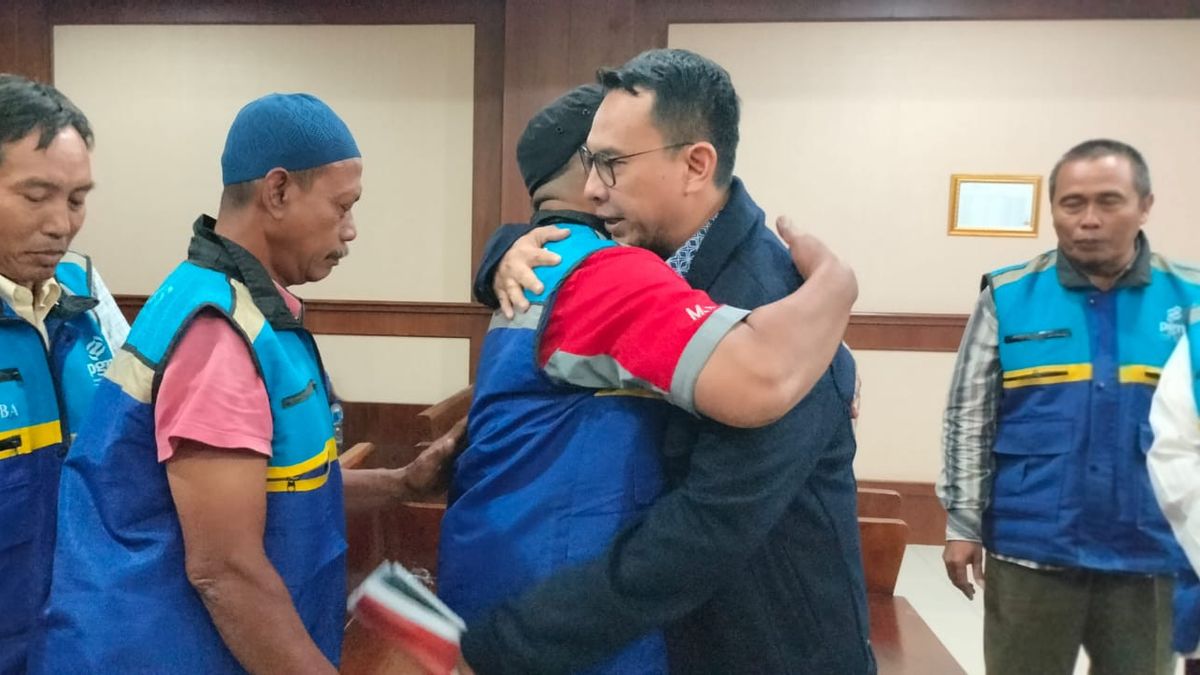


JAKARTA - Danny Praditya confirmed that there was no flow of funds or personal profit that he received in the alleged corruption case in the gas sales cooperation between PT Perusahaan Gas Negara and PT Inti Alasindo Energy (IAE)/Isargas Group.
The confirmation was made by Danny during a follow-up hearing at the Corruption Court in Central Jakarta, Monday, December 29, 2025.
During the trial, the former PGN Commercial Director read a personal defense note and a plea from legal counsel in case number 87/Pid.Sus-TPK/2025/PN/JKT/PST which ensnared him.
The pledoi read was titled "The Difficult Road of State-Owned Enterprises", which describes the defendant's position as a state-owned enterprise professional who is faced with legal risks due to strategic business decisions.
Previously, Danny was sentenced to seven years and six months in prison. In his plea, he stated that he stood before the panel of judges not only as a defendant, but as a professional who had served more than two decades in the national energy sector.
"I am innocent of committing a corruption crime. There is no flow of funds to me, to my family, or to other parties who have a relationship with me," said Danny in the trial.
Danny asked the panel of judges to assess the case comprehensively, including the intention behind the business decision-making, the track record of service in SOEs, and the fact that there was no personal gain from the PGN-IAE cooperation.
He also emphasized that there was still room for recovery through civil mechanisms, so he asked to be released from all legal demands (vrijspraak) or at least be released from legal demands (onslag).
The legal advisory team assessed that the indictment of Article 2 paragraph (1) jo Article 18 of the Corruption Law and Article 55 paragraph (1) of the Criminal Code was not proven to be legally and convincingly based on the facts of the trial.
One of the main points of the defense was the admission of the Public Prosecutor who stated that no money or wealth was found to have been received by Danny Praditya from the gas buying and selling transaction.
In addition, the payment of a down payment of US$15 million was confirmed as a business receivable, not a final state loss, because it was recorded as an advance payment for gas purchases in PGN's 2020 financial statements and was in a recoverable status.
Therefore, according to the defense team, this case is more appropriately positioned as a business risk and civil relations, not a corruption crime.
Attorney FX L. Michael Shah emphasized that from the beginning the PGN-IAE case was a dispute over a business contract, not a criminal act, and there was no flow of funds to the defendant.
"Advance payment is a down payment for the sale of gas, not a loan, and the element of state losses is not fulfilled because the gas has flowed and the contract recovery mechanism is still available," said Michael.
The defense team also highlighted the formal weakness of the BPK Inspection Report (LHP) which served as the basis for the indictment, because it was not stamped with a date and official stamp and ignored the letter from the Director General of Oil and Gas in September 2021.
The letter is said to actually allow the distribution of PGN-IAE gas with certain schemes, so that the construction of state losses is assessed to be built on assumptions, not final facts.
In the pledoi, Danny emphasized that the decision of the PGN Board of Directors had fulfilled the principle of Business Judgment Rule (BJR), because it was taken collectively-collectively, with good faith, prudence, and without conflict of interest.
A number of experts who were present at the trial also strengthened the defense. State administrative law expert Dr. Dian Puji Simatupang emphasized that the state's losses in the corruption case must be real, certain, and measurable.
"State losses should not be built on potential or assumptions, especially when the mechanism for civil recovery is still available," said Dr. Dian Puji.
Meanwhile, corporate law expert Prof. Nindyo Pramono emphasized that the application of the Business Judgment Rule protects directors as long as decisions are made in good faith and based on adequate information.
"Business risks that arise can then not be immediately convicted as long as there is no evil intent and conflict of interest," said Prof. Nindyo.
The English, Chinese, Japanese, Arabic, and French versions are automatically generated by the AI. So there may still be inaccuracies in translating, please always see Indonesian as our main language. (system supported by DigitalSiber.id)
Most Popular Tags
#Prabowo Subianto #donald trump #2026 World Cup #venezuela #konflik timur tengahPopular


