

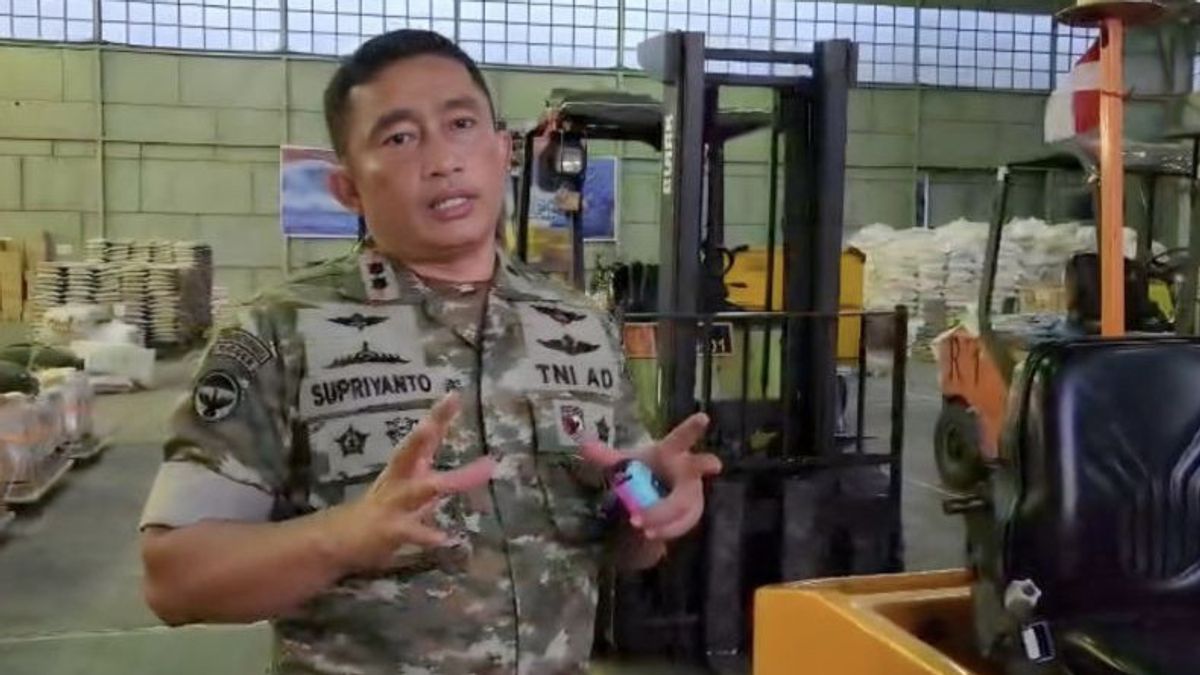


JAKARTA - The commander of the 5th Transportation Supply Battalion (Perbekang) 5 ARY, Lieutenant Colonel CBA Supriyanto, denied that the video of the assistance distributed by the TNI to residents affected by the disaster in Sumatra was only empty cardboard.
"Each helibox that is deployed has been inspected after being filled, inspected by members, and witnessed by officers. Both before being lifted onto the truck and before being loaded onto the plane. The contents are checked, the ropes and duct tape are ensured to be strong," he said through the Government Communication Agency (Bakom) RI, in Jakarta, Tuesday, quoted by Antara.
The TNI explained the concept of the helibox airdrop which was sent to the disaster-affected areas of Sumatra which were difficult to reach through direct landing.
He explained that the aid was dropped using standard procedures with authentic cargo according to the principles of air parachuting safety.
Supriyanto, who served as the Commander of the Airdrop Rigger Team at the Air Task Force on Monday, December 22, said that it was impossible for an empty helibox to be deployed.
He explained that the helibox is about 73 centimeters high, while the logistics load inside it is in the range of 30 centimeters.
This leaves a cavity at the top of about 35-37 centimeters. Visually, he continued, this condition often looks empty, even though the load has been tied and imprinted on the inside.
"The maximum weight limit of the helibox is 5 kilograms. If it is filled to capacity, it can weigh up to 9 kilograms and be at risk of being damaged during the airdrop. Therefore, the load is not filled to capacity, this is what often causes misunderstandings," he said.
The logistics cargo packaged in the form of logistics needs, such as rice or instant noodles, is arranged with special calculations so that it does not shrink downwards or crumble in the air when it is released from the plane.
The binding ropes are arranged to form a fan, according to the parachute pattern, to maintain the balance of the helibox while hovering towards the land.
Furthermore, Supriyanto explained that there were four layers of screening in each airdrop process.
First, the inspection by the rigging team during packing. Second, the re-inspection by the rigging team and the hangar personnel of the Indonesian Air Force during loading into the truck. Third, checking by the aircraft crew before the loading process. Fourth, coordination with territorial units on the ground to ensure that the airdrop results are safe, intact, and on target.
"If the helibox is empty, it has been dropped from the first filter. To this day, thank God, there have been no reports from below that the helibox is empty, as some individuals or netizens suspect," he said.
He hopes that this explanation can straighten out the wrong information so that the public understands that every assistance dropped by air has gone through a disciplined, careful, and layered process, to ensure that logistics really reach the people in need.
"Hopefully this will give us all an understanding, so that there is no misinterpretation or misperception of reality," he said.
The English, Chinese, Japanese, Arabic, and French versions are automatically generated by the AI. So there may still be inaccuracies in translating, please always see Indonesian as our main language. (system supported by DigitalSiber.id)


