

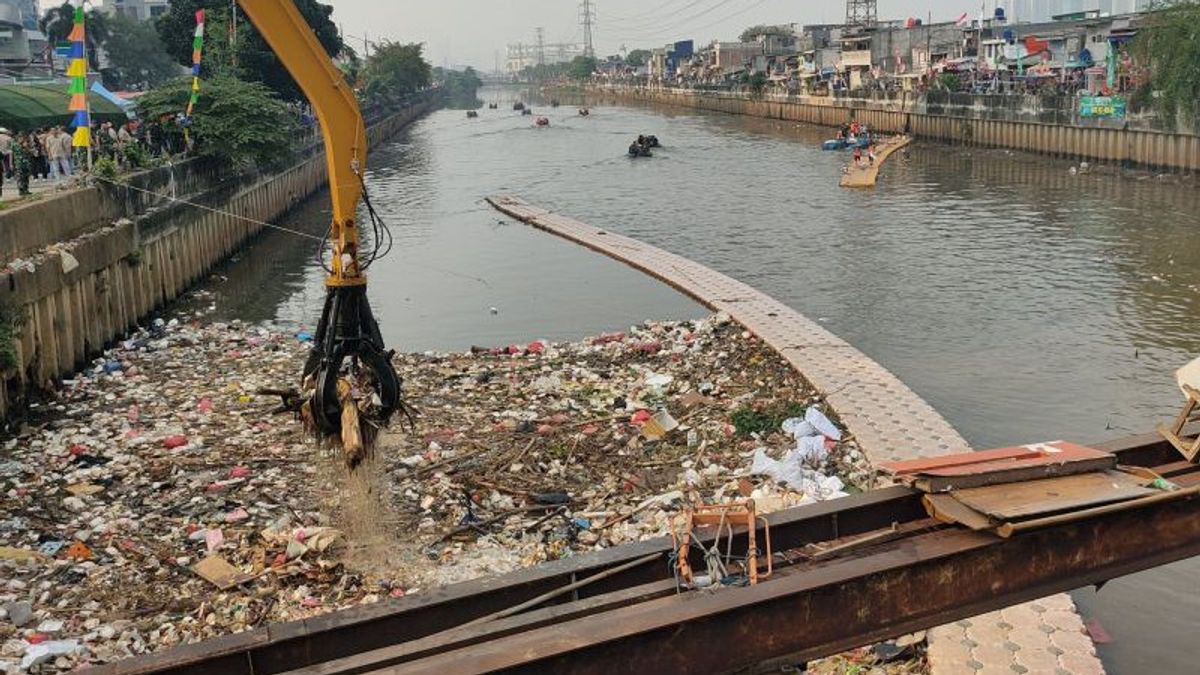


JAKARTA WEST - The West Jakarta Environmental Service (Sudin LH) has intensified the use of probiotic enzymes to reduce the smell of garbage at a number of Temporary Disposal Sites (TPS) in the area.
Head of the LH West Jakarta Sub-Directorate Achmad Hariadi said that in addition to suppressing unpleasant odors, probiotic enzymes also function to accelerate the decomposition process of waste that accumulates in the TPS.
"So, probiotic enzymes can kill pathogenic bacteria. That is bacteria that have the potential to appear when garbage piles up. If it smells, it means there are many pathogens. If it doesn't smell, it means the probiotics are working," said Hariadi when contacted in Jakarta, Antara, Thursday, December 18.
The use of probiotic enzymes has been applied at a number of polling stations that often experience waste accumulation and cause odors. In the future, this method will continue to be used in locations that have the potential to cause environmental disturbances.
"In some TPS we have applied and will continue to do. So, TPS that has the potential to pile up garbage, we spray with probiotics. So far it is effective for reducing odors," he said.
Currently, there are 45 permanent TPS spread across eight sub-districts in the West Jakarta area. In addition, there are more TPS based on carts and containers.
However, Hariadi explained that TPS based on carts or containers are rarely sprayed with probiotic enzymes because they have a higher intensity of transporting garbage to the Final Disposal Site (TPA).
"Usually container TPS is placed in locations that do not allow permanent TPS, such as in the market. Because the transportation is fast, it rarely causes a pile," he said.
Apart from efforts to control the smell of garbage, the West Jakarta LH Sub-Directorate also disciplined illegal TPS. Throughout 2025, as many as 10 illegal TPS have been closed because they are not included in the official waste management system.
"Formally, we have closed 10 illegal TPS in the West Jakarta area. The goal is to maintain the waste processing chain," said Hariadi.
The illegal closure of the TPS was also carried out to protect the assets of social facilities (fasos) and public facilities (fasum) so that they are not misused.
"In addition to maintaining the waste processing chain, this is also to maintain the assets of fasos and fasum. TPS-TPS are not officially registered," he said.
The illegal TPS that were closed included the PLN TPS, Bohlam TPS, and Gadog TPS in Kedoya Utara Village; the Pasar Patra TPS in Duri Kepa Village; the RW 03 TPS in Rawa Buaya Village; the RW 05 TPS in Cengkareng Barat Village; the Presidi and IPEKA TPS in Meruya Utara Village; and the Mercu Buana TPS in Meruya Selatan Village.
The English, Chinese, Japanese, Arabic, and French versions are automatically generated by the AI. So there may still be inaccuracies in translating, please always see Indonesian as our main language. (system supported by DigitalSiber.id)


