

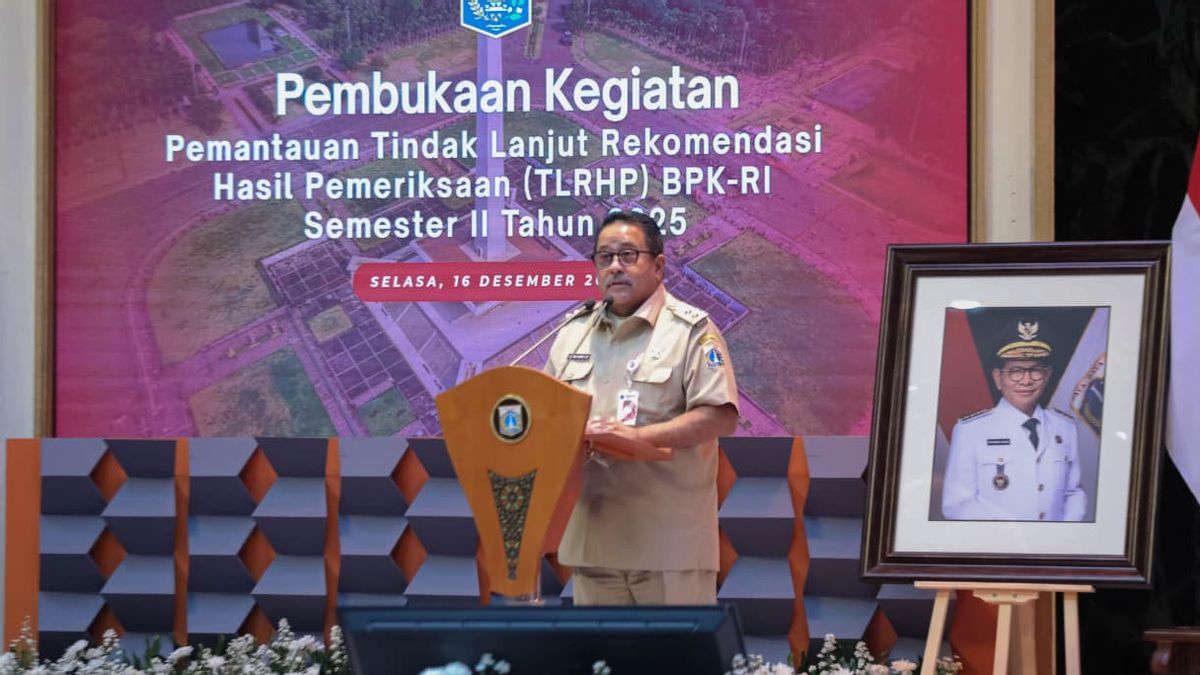


JAKARTA - Deputy Governor of DKI Jakarta Rano Karno admitted that there were still a number of obstacles faced by the DKI Provincial Government in following up on the recommendations of the results of the financial report examination by the Financial Audit Agency (BPK).
The issue includes billing of regional losses, deposit of substitute money, to the complexity of inventorying assets of social facilities and public facilities from the developer's obligations.
"We are still faced with a number of challenges that require attention and joint handling, including the obstacle of billing losses to employees who have retired or are unknown," said Rano at the DKI Jakarta City Hall, Tuesday, December 16.
In addition, the large regional losses are also a factor that hinders because it requires a gradual settlement mechanism. The BPK recommendation regarding policy and regulation improvements is also said to require a cross-sector process.
He also touched on the limitations on access to information related to the deposit of substitute money based on court rulings, as well as the complexity of the collection of fasos and fasum obligations.
"The limitations on access to information related to the deposit of substitute money for court decisions. As well as the complexity of billing social facilities or public facilities due to changes in ownership, bankruptcy conditions, and interrelationships with assets under the management of the central government and SOEs," he said.
Although acknowledging the challenges, Rano assessed that the completion of the BPK recommendations could still be achieved if supported by strong cross-sectoral coordination. Rano asked his staff to continue to complete all recommendations in accordance with the provisions.
"To all heads of regional units and BUMD ranks, I emphasize the importance of maintaining commitment in following up on all recommendations from the BPK audit in an appropriate and responsible manner within a period of 60 days in accordance with applicable regulations," explained Rano.
Rano said that although this commitment continues to be maintained, the DKI Provincial Government still faces a challenge that is not simple. One of them is related to the billing of regional losses to parties that are no longer easy to track.
"I realize that this process is not simple and requires strong cross-sectoral coordination. However, with a shared commitment, all BPK recommendations can be completed quickly, accurately, and in line with the principles of good governance," he said.
Previously, the BPK highlighted the follow-up to the recommendations of the results of the examination of the financial statements of the DKI Jakarta Provincial Government in Semester I of 2025.
Head of the BPK for DKI Jakarta Representative Ali Asyhar explained that the DKI Provincial Government had indeed carried out follow-up actions that were in accordance with the recommendations, indeed with a fairly high figure, which reached 86.24 percent or as many as 10,300 recommendations.
However, this figure has not closed the remaining homework. Of the total 11,943 recommendations issued by the BPK, 1,331 recommendations are still in the process or have not been in accordance with the recommendations given.
"Based on these data, there are several things that need to be the attention of all leaders in the DKI Provincial Government, namely the 1,331 recommendations that are still in the process or are not in accordance. It is hoped that the Inspectorate and the Working Unit will accelerate the completion," said Ali Asyhar.
He suggested that recommendations of an administrative nature could be immediately identified and resolved, including completing the supporting documents required. The BPK also opened a discussion room for SKPD that had difficulties in completing the recommendations.
"If necessary, please discuss with us at the office later. How about the recommendations that have been hanging for a while, how about the documents that are needed," he said.
In addition to the recommendations that are still in the process, the BPK also noted that there were 20 recommendations that had not been followed up at all or 0.17 percent, and 292 recommendations or 2.45 percent that were considered not appropriate to be followed up.
For recommendations that have not been followed up at all, the BPK hopes that at least there will be a status movement in this monitoring activity.
"For 20 recommendations that have not been followed up at all, we hope that during this monitoring activity all of these recommendations can be followed up or at least have moved to the status of being in the follow-up process," said Ali Asyhar.
English:
English:
The English, Chinese, Japanese, Arabic, and French versions are automatically generated by the AI. So there may still be inaccuracies in translating, please always see Indonesian as our main language. (system supported by DigitalSiber.id)
Most Popular Tags
#Prabowo Subianto #donald trump #Febrie Adriansyah #8791 #giias 2026Popular


