



JAKARTA - China's Ministry of Foreign Affairs has protested against the ratification of the "Taiwan Assurance Implementation Act" by United States President Donald Trump which regulates guidelines for US and Taiwan interactions.
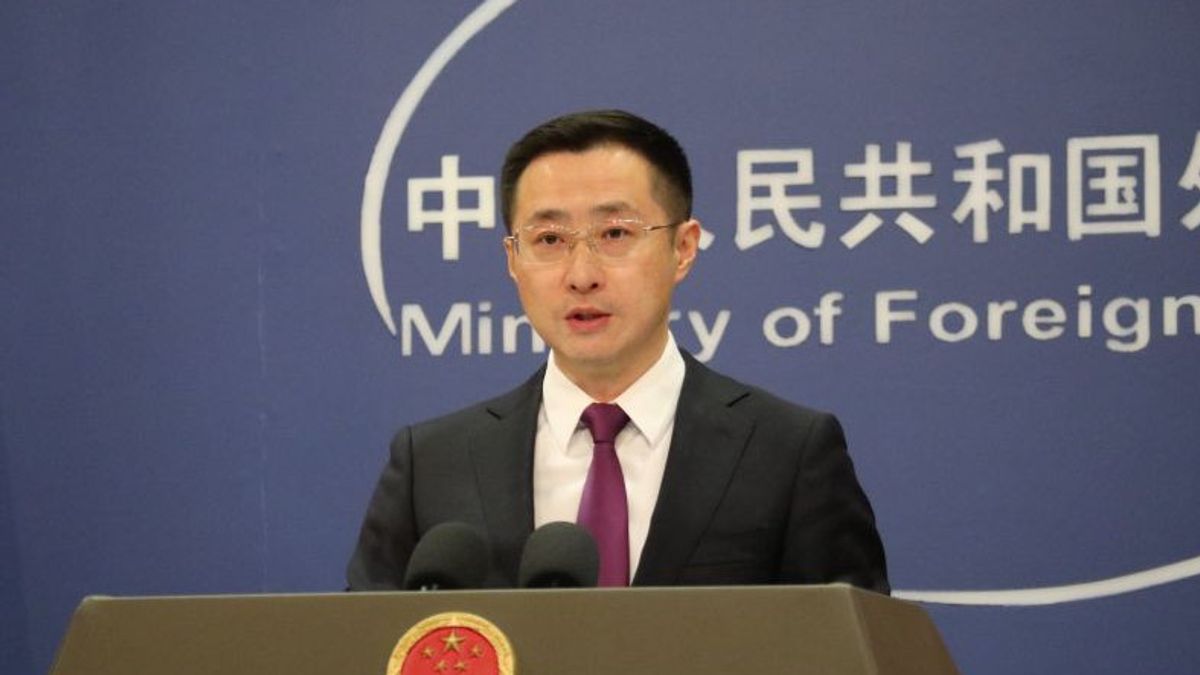
"China firmly opposes the official interaction between the US and Taiwanese territory which is part of China in any form. This position is consistent and clear," Chinese Foreign Ministry spokesman Lin Jian said at a press conference in Beijing, Wednesday, December 3.
US President Donald Trump has approved the "Taiwan Assurance Implementation Act" (Taiwan Guarantee Implementation Law) which requires the US State Department to periodically review and update guidelines regarding official US interactions with Taiwan.
The new law (UU) signed by Trump on Tuesday (2/12) is an amendment to the 2020 Taiwan Guarantee Law which focuses on reviewing guidelines for US interaction with Taiwan.
"Taiwan's issue is at the heart of China's interests and is the first red line not to be violated in China-US relations. The principle of 'One China' is the political foundation of China-US relations," added Lin Jian.
The US government, said Lin Jian, has made a clear commitment to China-US Joint Communique on the Establishment of Diplomatic Relations, with the US recognizing the government of the People's Republic of China as the only legitimate Chinese government.
"In this context, the US people will maintain cultural relations, trade, and other unofficial relationships with the Taiwanese people. China urges the US to seriously adhere to the principles of 'One China' and three communicants with China-US, address Taiwan's issues with extreme caution, stop US-Taiwan officials' relations, and stop sending wrong signals to separatists 'Taiwan independence'," said Lin Jian.
Previously, the US State Department was required to conduct a one-time review of guidelines governing relations with Taiwan.
However, based on the new law, the agency should conduct the review "no less than every five years." Then, the State Department must submit the latest report based on its findings "no more than 90 days after the review is complete" to the Senate and House of Representatives foreign relations committee.
Taiwan welcomed the move by stating that the law would strengthen the implementation of the 2020 Taiwan Guarantee Law and ensure an update of contact guidelines that keep bilateral relations stable.
Taiwanese official Lin Chia-lung of Taipei expressed his gratitude to the US government and Congress for their bipartisan support, and he described the signing of the law as "a major step forward in US-Taiwan relations."
He argues that a more frequent review of guidelines will allow both parties to engage further, including allowing Taiwanese officials to visit federal agencies to attend meetings, although the newly passed law does not specify the outcome.
The bipartisan law, proposed in February 2025 by Republican members of Missouri Ann Wagner, the late Gerry Connolly, and Ted Lieu, was passed by the House unanimously in May and approved by the Senate in November with unanimous approval.
After Washington cut diplomatic ties with Taiwan in 1979, the State Department set an internal "red line" governing contacts between diplomatic officials, the military, and other officials in the US with their partners in Taiwan.
In January 2021, during Trump's first term, then US Secretary of State Mike Pompeo announced the lifting of all existing restrictions related to US-Taiwan contacts.
The Biden administration later reimposed contact guidelines but relaxed them which allowed routine meetings between US officials and Taiwanese representatives in federal institutions and at Taiwanese representative offices in Washington.
The signing of the law only lasted a week from a telephone conversation between President Xi Jinping and President Trump on Monday (24/11) discussing Taiwan as part of China.
The English, Chinese, Japanese, Arabic, and French versions are automatically generated by the AI. So there may still be inaccuracies in translating, please always see Indonesian as our main language. (system supported by DigitalSiber.id)
Most Popular Tags
#Prabowo Subianto #donald trump #firearm #8791 #giias 2026Popular


