

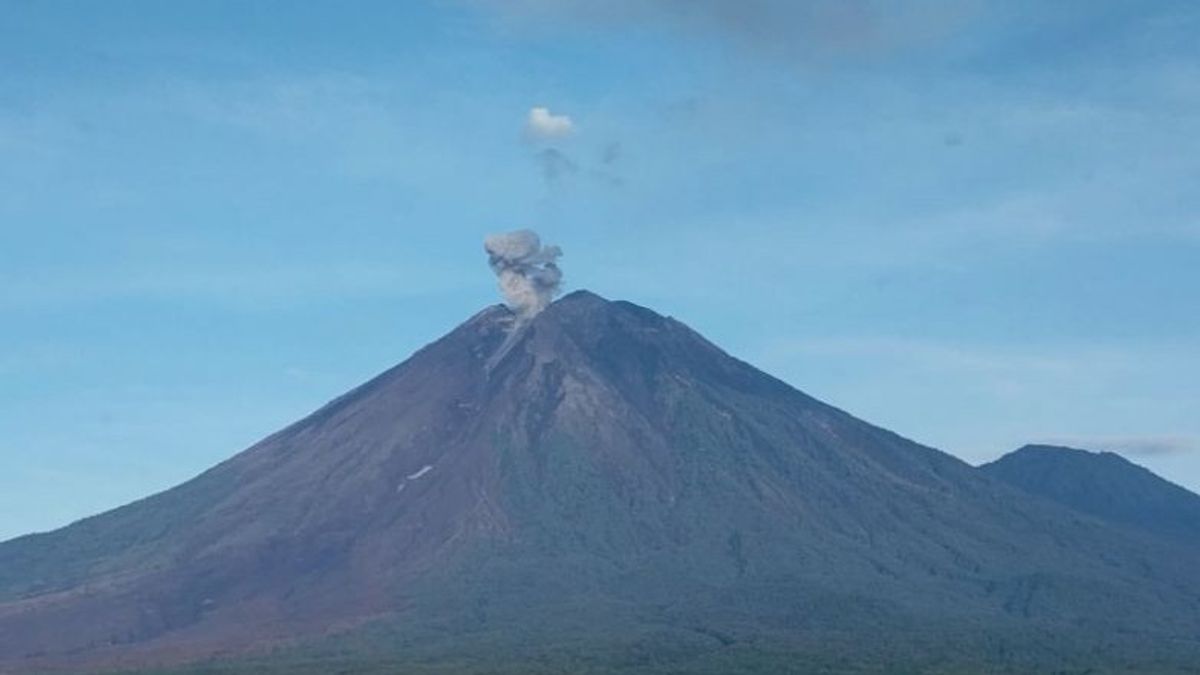


BANDUNG - Volcanology expert at the Bandung Institute of Technology (ITB) Mirzam Abdurrachman revealed that the phenomenon of rainy weather that is pouring down the East Java region is not only causing cold lava floods, but also triggering the effect of soda bottles that strengthen the Semeru eruption.
According to Mirzam, rain is an external factor that strengthens the pressure of the eruption of Mount Semeru through the mechanism for smoothing the crater cover.
The reason, said Mirzam, is that rain has a fatal double role in Semeru's volcanic activity. Where in addition to triggering a phreatic eruption due to water that touches the hot zone, rainwater also washes the volcanic ash layer at the summit which has been serving as a "upper" against magma pressure.
"The rain washing the covering ash layer makes the pressure barrier from below weaken. This can be likened to a bottle of soda drinks that has been shaken, then the lid is opened suddenly, so the contents will burst out strongly," said Mirzam as quoted by ANTARA, Tuesday, November 25.
The lecturer at the Petrology, Volcanology and Geochemical Skills Group, ITB, emphasized that the phenomenon of losing the burden of covering the crater due to this rainwater eruption is much more difficult to predict than regular eruptions that follow the cycle of filling the magma kitchen.
In addition to the pressure mechanism for the "bottle of soda", Mirzam, who is also the Secretary General of the Indonesian Geological Experts Association (IAGI), highlighted the specific threat at the river bends that often escape the public's attention.
According to him, the secondary danger in the form of lava flows depends not only on the volume of rainfall, but also on the geometry of the river. Lahar flows that have high viscosity or congestion have limited movement when passing through winding river topography.
"Heavy air cannot maneuver when facing river bends or turns suddenly. As a result, the river defecation area becomes the location with the largest potential overflow that residents should avoid," he said.
Regarding the increase in the status of Semeru activity, Mirzam said this was based on measurable parameters such as volcanic earthquake intensity, gas composition change, temperature increase, and mountain body deformation.
As a tactical mitigation measure for residents who still have to move at a safe radius but are affected by ash, he recommends the use of wet masks instead of dry masks.
"Maskers that are wet have higher reflectivity and suction power for volcanic ash particles, so that they are more effective in protecting the respiratory system," said Mirzam.
The English, Chinese, Japanese, Arabic, and French versions are automatically generated by the AI. So there may still be inaccuracies in translating, please always see Indonesian as our main language. (system supported by DigitalSiber.id)


