

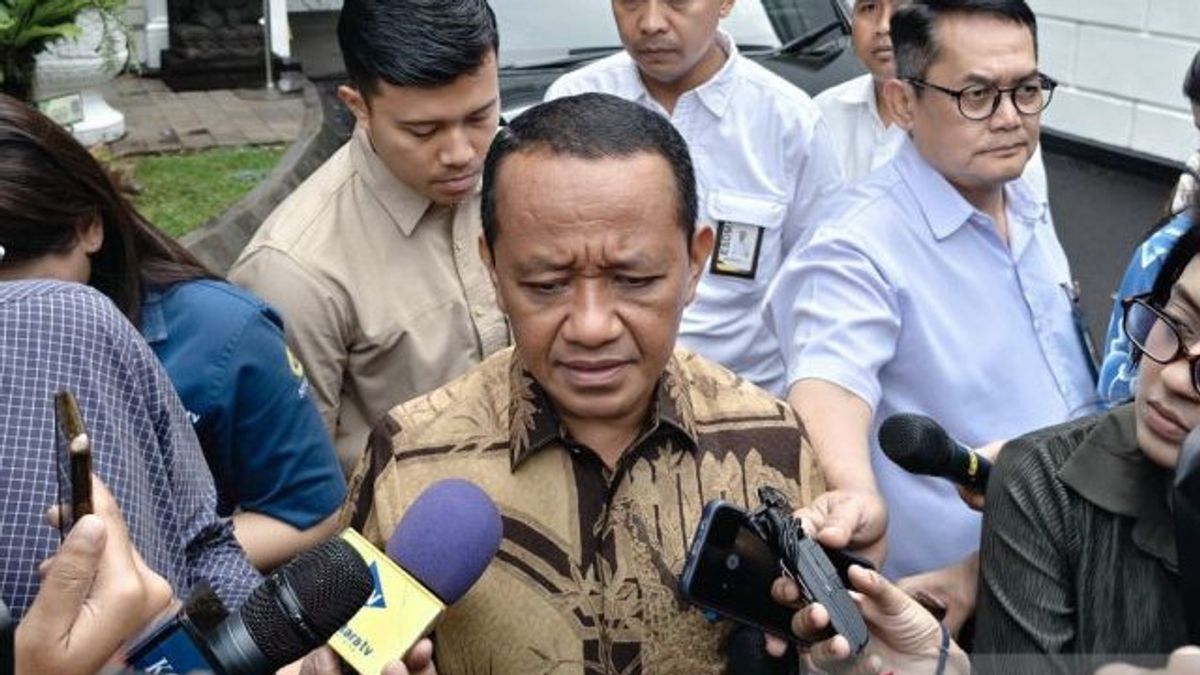


JAKARTA - The General Chairperson (Katum) of the Golkar Party, Bahlil Lahadalia, stated that the process of filing a judicial review of Law Number 17 of 2014 concerning the MPR, DPR, and DPRD (UU MD3) at the Constitutional Court (MK) is part of the applicable mechanism and needs to be appreciated.
"Those who apply for the community are taken to a judicial review at the Constitutional Court, so we can respect the process," said Bahlil at the Presidential Palace Complex, Jakarta, Thursday, which was confiscated by Antara.
Bahlil assessed that the delivery of aspirations is part of a democratic life and every citizen has the right to do so as long as it goes through the established procedures and rules.
Regarding the application for judicial review of the MD3 Law submitted to the Constitutional Court, he assessed that the process needed to be respected as the mechanism available.
"Our country is a democratic country, every citizen must be guaranteed whatever their aspirations are conveyed, but of course it must go through good mechanisms and governance and there are rules, we'll just have to wait," he said.
It is known, the applicant for the judicial review of the MD3 Law in the Constitutional Court requested that the people, in this case constituents, be able to dismiss members of the DPR RI.
The application was submitted by a student named Ikhsan Fatkhul Azis, Rizki Maulana Syafei, Faisal Nasirul Haq, Muhammad Adnan, and Tsalis Khoirul Fatna. They tested the constitutionality of Article 239 paragraph (2) letter d of the MD3 Law.
"The a quo application that was requested by the petitioners did not depart from hatred against the DPR and political parties, but as a form of concern for improvement," said Ikhsan, as reported by the MK's official website from Jakarta, Tuesday, November 18.
The article they tested regulates the terms of interim dismissal of members of the DPR. One of the conditions is "proposed by a political party in accordance with the provisions of the legislation."
According to the petitioners, the article led to an exclusion of political parties to dismiss members of the DPR.
However, they view that political parties in practice have often dismissed members of the DPR for no apparent reason and did not consider the principles of people's sovereignty.
SEE ALSO:
-
 | BERITA
Soal Teroris Targetkan DPR, Komisi III: Keamanan Gedung Parlemen Sudah Cukup Maksimal
19 November 2025, 16:11 -
 | BERITA
KPK Sita Rumah, Mobil Mazda CX-3 hingga Vespa Terkait Korupsi Kuota Haji
19 November 2025, 16:51 -
 | BERITA
Junta Myanmar Gerebek Markas Scam Online di Perbatasan Thailand, 10 Ribu Ponsel Disita
19 November 2025, 14:51 -
 | BERITA
Resmikan RS Hibah UEA di Surakarta, Prabowo Minta Masyarakat Tak Berobat ke Luar Negeri
19 November 2025, 13:57 -
 | BERITA
Kebakaran Permukiman di Jepang: 170 Orang Mengungsi, Lansia 70 Tahun Hilang
19 November 2025, 13:33



On the other hand, their argument is that when there are members of the DPR who are asked by the people to be dismissed because they no longer receive legitimacy from the constituents, political parties are actually maintained.
The absence of the mechanism for dismissing members of the DPR by constituents is considered to have placed the role of voters in elections only as formal procedures. This is because the elected DPR members are determined based on the most votes, but the dismissal no longer involves the people.
They also stated that they could not ensure that their representatives in the DPR really fought for the welfare of the people and carried out campaign promises because they no longer had bargaining power after the election was over.
On that basis, the petitioners admitted that they suffered a loss of constitutional rights that were specific and actual, or at least the potential due to the enactment of the provisions of the article was tested.
They considered that Article 239 paragraph (2) letter d of the MD3 Law contradicts the principles set by the constitution, including people's sovereignty, active participation and equal treatment of the running of the government, as well as equal treatment before the law.
Therefore, in its petitum, the petitioners asked the Court to interpret Article 239 paragraph (2) letter d of the MD3 Law as proposed by its political parties and/or constituents in the electoral district in accordance with the provisions of the legislation.
The English, Chinese, Japanese, Arabic, and French versions are automatically generated by the AI. So there may still be inaccuracies in translating, please always see Indonesian as our main language. (system supported by DigitalSiber.id)
Most Popular Tags
#Prabowo Subianto #donald trump #firearm #8791 #giias 2026Popular


