

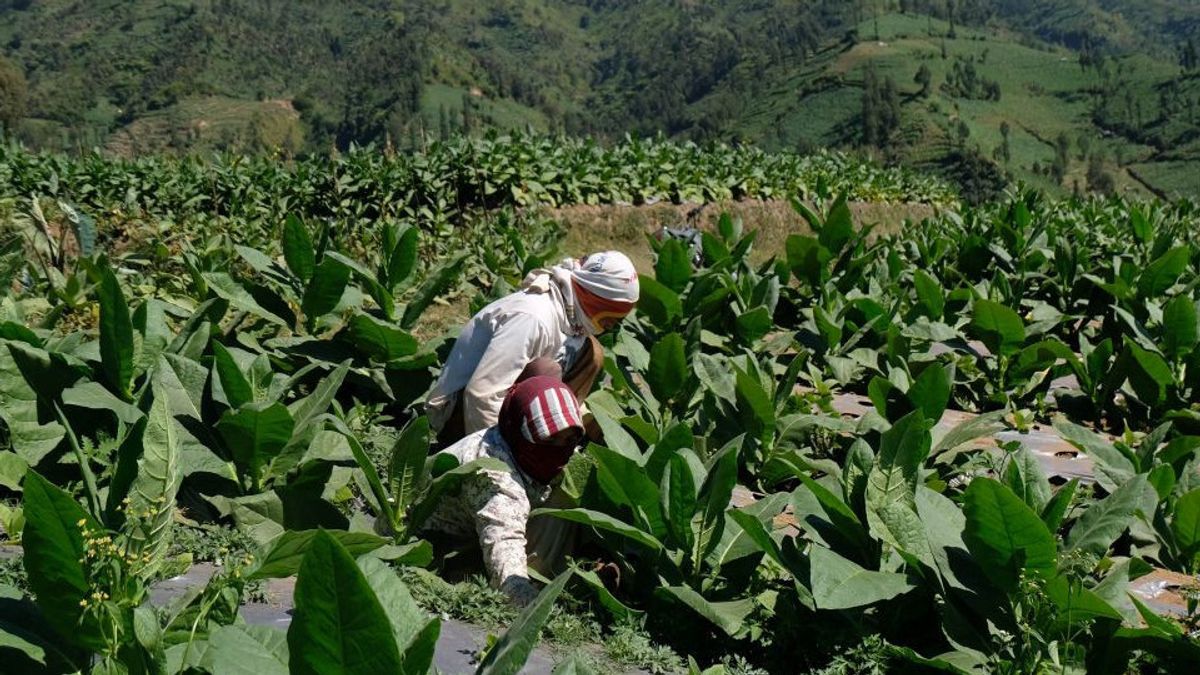


JAKARTA The land of former Business Use Rights (HGU) of PT Perkebunan Nusantara II (PTPN II) in North Sumatra experienced a drastic shrinkage. Of the total colonial heritage of 250 thousand hectares or about 3.5 times the area of DKI Jakarta, now only 5,873 hectares remain. This means that around 97.6 percent of the country's land is lost.
Secretary of the Founder of Indonesian Audit Watch (IAW) Iskandar Sitorus assessed that the shrinking of this land was not just negligence, but a systematic pattern that needed to be thoroughly investigated.
"This is not an ordinary negligence, but a systematic pattern and must be thoroughly investigated," said Iskandar in Jakarta, Saturday, November 1.
According to IAW records, the history of land tenure began in 1870, when *Agrarische Wet* (Dutch Agrarian Law 1870) gave way for Dutch companies, Deli Maatschappij and Senembah Maatschappij, to control fertile lands in East Sumatra. The two companies manage about 250 thousand hectares of land in the area between the Snake River (Deli Serdang) to the Wampu River (Langkat).
At that time, Deli tobacco was known as the world's leading commodity, dubbed the 'gold brown' because of its high quality. However, after the World War and the independence period, the people worked on the land for food needs. Under Law No. 86 of 1958, Dutch assets were then nationalized into state property.
IAW noted that the determination of the HGU for the Deli Tobacco VAT covering an area of about 59 thousand hectares was in accordance with the Decree of the Minister of Agrarian Affairs No. 24/HGU/1965 dated June 10, 1965. However, in practice, the Deli Tobacco VAT which later became PTPN II continued to control the land in excess of the provisions for efficiency and production security reasons.
The decree clearly states that Deli Tobacco VAT only has the right to around 59 thousand hectares for tobacco plants, while the remaining 191 thousand hectares must be the object of the land reform. However, this provision was violated," said Iskandar.
The decision of the Supreme Court (MA) No. 327 K/Sip/1976, which involved PT Perkebunan IX and the North Sumatra Regional Government, confirmed that there were restrictions on the expansion of the HGU. However, according to IAW, the decision was ignored for decades.
"From 1981 to 1997, the HGU of PTPN II actually expanded and many people's lands were lost. Based on the official letter of the President Director of PTPN II in 1997, it was recorded that there had been a transfer of land covering an area of 5,569 hectares to third parties," said Iskandar.
The findings of the National Land Agency (BPN) of North Sumatra also show that there is an excess land of around 61,382 hectares which is thought to have originated from the people's redistribution land. Thus, PTPN II is said to control more than double the area it should have.
The findings of the 2004 DPR RI Special Committee (Pansus) as stated in Special Committee Decree No. 016/RKM/PANSUS TANAH/DPR-RI/2004 strengthened the allegation. The special committee found discrepancies in land control and recommended controlling land administration.
"The Attorney General's Office through the North Sumatra Prosecutor's Office has followed up on the findings of the Special Committee of the DPR RI. However, what has not been done is to provide a sense of justice to the cultivators," said Iskandar.
According to IAW, the results of the examination by the Supreme Audit Agency (BPK) also show a pattern of repeated violations in the management of state land. The transfer of land rights without an official tender mechanism has the potential to cause state losses of up to IDR 3.4 trillion per year.
The IAW study assessed that this systemic violation stemmed from the unilateral control of PTPN II over people's land, which was then legitimized administratively through the issuance of the HGU certificate, and led to land commercialization through the transfer of function or transfer to other parties.
SEE ALSO:
-
 | BERITA
PDIP Tolak Soeharto Jadi Pahlawan Nasional, Hasto Bongkar Pesan Megawati!
02 November 2025, 06:08 -
 | MUSIK
Hujan Bukan Penghalang, Tampil Penuh Magis: BLACKPINK Sihir Ribuan Penonton di GBK Jakarta
02 November 2025, 07:15

Iskandar also highlighted the weak implementation of Agrarian Reform based on Presidential Regulation No. 86 of 2018 and the performance of the Agrarian Reform Task Force (GTRA) which is considered not optimal.
"Law enforcement must be carried out seriously, with coordination between law enforcement agencies that are transparent and the GTRA mechanism implemented according to the rules," he concluded.
The English, Chinese, Japanese, Arabic, and French versions are automatically generated by the AI. So there may still be inaccuracies in translating, please always see Indonesian as our main language. (system supported by DigitalSiber.id)
Most Popular Tags
#Prabowo Subianto #donald trump #2026 World Cup #Febrie Adriansyah #8791Popular


