

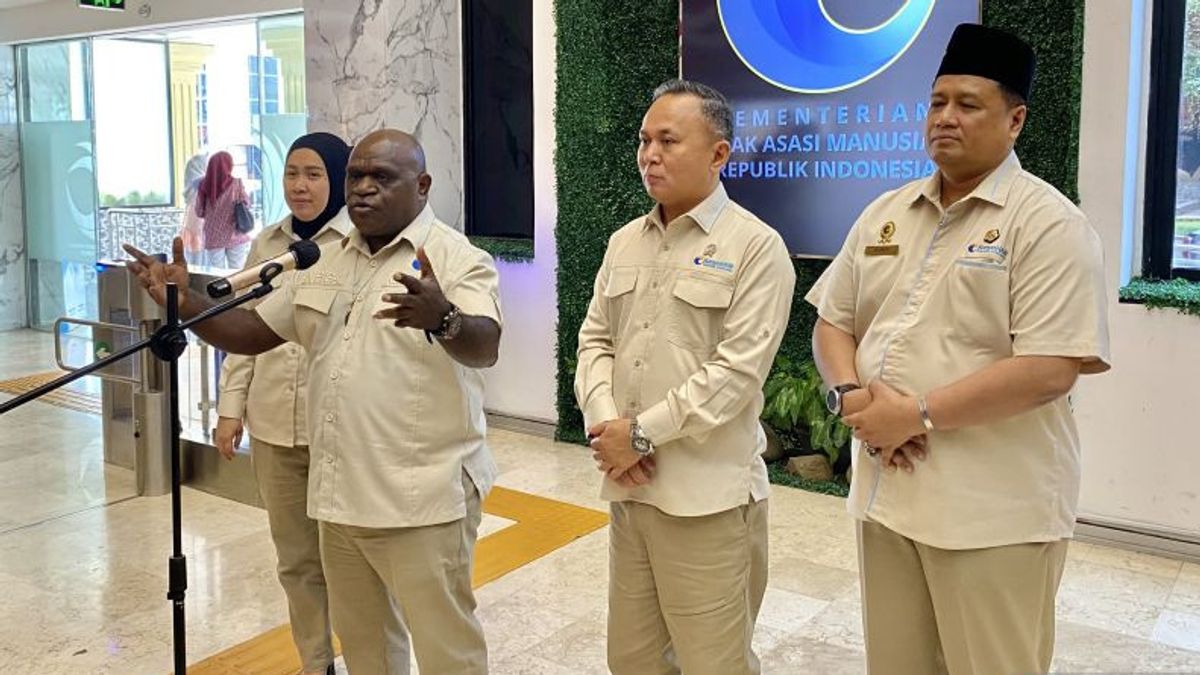


JAKARTA - Human Rights Minister (HAM) Natalius Pigai hopes that the House of Representatives (DPR) will approve the corruption crime plan (tipikor) as a human rights violation in the revision of the Human Rights Law.
Pigai said that the plan to include corruption as an element of human rights violation was the first in the world. According to him, no country has regulated it yet.
"We are the first to associate corruption and human rights, hopefully if the DPR approves this article, then Indonesia will be the first country to link, link corruption and human rights," he said as quoted by ANTARA, Tuesday, October 21.
According to Pigai, the arrangement has been compiled in the revised document of Law Number 39 of 1999 concerning the government's version of human rights. "The reason is that it already exists, we just leave it to the DPR," he said.
As a regulation, the law only regulates the big picture of a norm, including regarding corruption and human rights. For this reason, derivative regulations are present to regulate a more detailed explanation.
SEE ALSO:
-
 | BERITA
Di Israel, Wapres AS JD Vance Bakal Bahas Fase Kedua Gencatan Senjata Gaza
21 Oktober 2025, 16:38 -
 | BERITA
Polandia Ingatkan Putin tak Lintasi Wilayah Udaranya ke Hongaria Jika Tak Mau Ditangkap
21 Oktober 2025, 15:56 -
 | BERITA
Ekuador Bebaskan Pria dalam Kapal Diduga Angkut Narkoba yang Diserang Pasukan AS
21 Oktober 2025, 15:13

Corruption categorized as a human rights violation depends on certain considerations. Pigai gave an example, one of the corruptions classified as human rights violations, namely acts of corruption that causes lives to die.
"But if for example corruption is due to policy, corruption because it may be in business and others, no; but that was the emergency, which if corruption causes other people to suffer directly," he explained.
According to Pigai, the corruption plan regulated in the revision of the Human Rights Law has been discussed with academics to human rights experts and corruption experts.
"We combine this. And that is the first in world history we associate human rights and corruption," he said.
The English, Chinese, Japanese, Arabic, and French versions are automatically generated by the AI. So there may still be inaccuracies in translating, please always see Indonesian as our main language. (system supported by DigitalSiber.id)
Popular


