

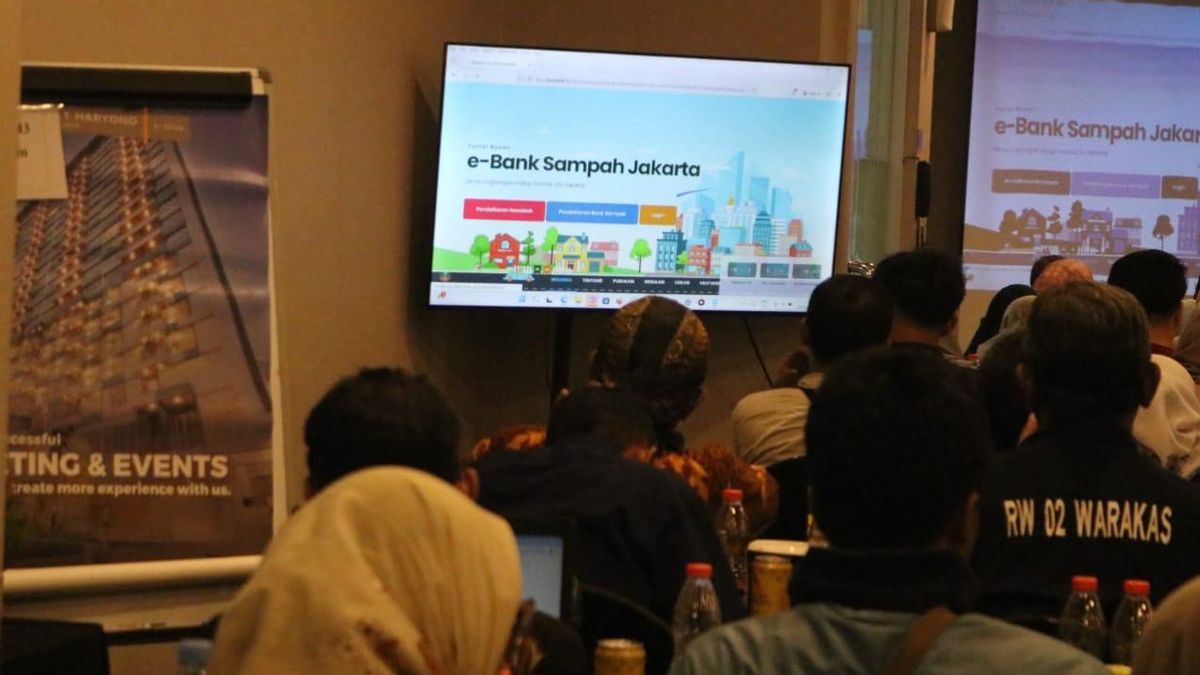


JAKARTA - The DKI Jakarta Environment Agency (LH) held training for waste bank assistants from all urban villages. This step was taken to accelerate the target of one RW of one active waste bank which is now the focus of community-based waste management in Jakarta.
Head of DLH DKI Jakarta, Asep Kuswanto, said that the assistants will work intensively for two months to form and reactivate waste banks in their respective areas.
They are expected to be the main drivers in encouraging citizen participation to sort and process waste from home.
Through empowering residents at the RW level, Asep targets a significant reduction in household waste volume which ends in the final disposal site.
"Jakarta has great potential to become a pilot city for community-based waste management in Indonesia. If all RWs have active waste banks and residents consistently sort waste from home, then we not only maintain the cleanliness of the city, but also build a sustainable Jakarta," said Asep in Jakarta, Tuesday, October 21.
Asep assessed that waste management is not enough to only depend on transportation services, but must start from public awareness. Waste banks are seen as one of the important instruments to encourage changes in people's behavior, as well as open up new economic opportunities through recycling.
SEE ALSO:
-
 | BERITA
Polandia Ingatkan Putin tak Lintasi Wilayah Udaranya ke Hongaria Jika Tak Mau Ditangkap
21 Oktober 2025, 15:56 -
 | BERITA
Ekuador Bebaskan Pria dalam Kapal Diduga Angkut Narkoba yang Diserang Pasukan AS
21 Oktober 2025, 15:13


Chairman of the Budhi Luhur Waste Bank, Tutik Sri Susilowati, said that the existence of a waste bank should not only function as a place to weigh or sell garbage, but also a space for togetherness that strengthens environmental awareness at the grassroots level.
"Banks are a learning space for people to cultivate behavior that cares more about the environment. Therefore, socialization, guidance, and sustainable assistance are the keys so that waste management runs effectively and provides real benefits," said Tutik.
Chairman of the Association of Indonesian Waste Banks (ASOBSI), Wilda Yanti, added that the role of a waste bank assistant is the key to the success of this program. He emphasized the importance of a good communication approach with residents and consistent education so that the habit of sorting waste can be formed.
"With more and more active waste banks, Jakarta residents can be empowered through a community-based green economy, as well as help reduce the burden of waste sent to the Bantargebang TPST," said Wilda.
The English, Chinese, Japanese, Arabic, and French versions are automatically generated by the AI. So there may still be inaccuracies in translating, please always see Indonesian as our main language. (system supported by DigitalSiber.id)


