
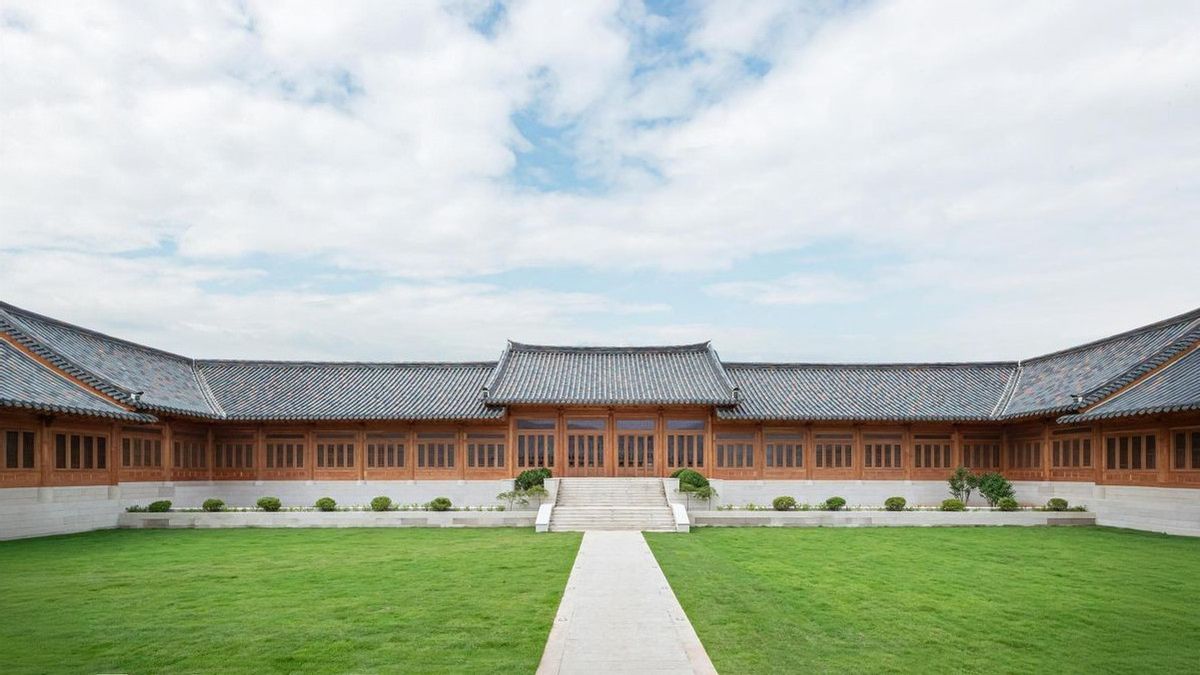


JAKARTA - The Hanok Heritage Hotel, South Korea's largest hanok hotel, opened to the public in Yeongwol, Gangwon Province, offering a modern hanok interpretation, a 1,000-year-old Korean architectural tradition.
Inspired by Jongmyo Jeongjeon's splendor, the main hall of the UNESCO-listed Jongmyo Temple, the hotel is fully designed with a traditional hanok style using wood, raising the calm atmosphere of Korean classical architecture.
With an area of more than 340,000 square meters, The Hanok Heritage was originally launched in 2023 as a member's special resting place featuring three villas and 10 guest rooms. This month, the hotel has been expanded with 14 new rooms in five types of accommodation, and is now welcoming public guests for the first time.
"Initially, I dedicated seven years to researching the right wood drying art and solving the challenges of hanok's unique construction. The next six years were spent diligently building this place. Some people considered it a difficulty, but for me, it was a joy of the opportunity to devote my entire passion to hanok," said CEO of fintech firm KONA I and founder of The Hanok Heritage Cho Chung-il at the inauguration last month, quoted from The Korea Times Oct. 10.
This hotel innovates by preserving the beauty and traditions of hanok as well as overcoming practical challenges such as wooden arches and insulation through the use of contemporary materials that last a long time. The result is a elegant combination between tradition and modernity, nature and space.
Every detail from the method of drying wood to lighting and furniture is monitored directly by Cho, whose dedication has won international recognition for this hanok resort.
Last year, the hotel won first place in the hotel category at the Versailles Prix architectural awards, hosted by UNESCO and the International Architects Union, as well as awards from IIDA (Interior International Design Association) Global Excellence Awards.
"What used to be an exclusive experience for a handful of people can now be accessed by more than 4,000 guests each year," said Chairman Cho, stressing that this opening was "not just a business expansion, but also a new starting point for the globalization of Korean culture."
"I have never considered this as my property or mine. I hope this hanok space becomes a proud cultural landmark where many people can come to enjoy the essence of Korean culture," he added.
One of the highlights of this hotel is the 84-meter-long wooden corridor.
"Traving through a hanok corridor of this size is a rare experience. It's not just a hallway, but a space that connects various areas," Cho said.
Built with the expertise of 25 craftsmen, the hotel is equipped with a Korean luxury restaurant, a day-long dining service serving seasonal ingredients, pavilions to observe stars, living room, and other facilities.
Guests can participate in various cultural programs and experiences, such as traditional Korean drinking, wearing hanbok (traditional clothing), and astronomical observations.
"I want to prove that hanok can be as grand as this. Seeing young people living in apartments, it feels like they have lost the beauty of space. Hanok is a special space for us, a place that is in line with nature. I want to share this special space with the younger generation and visitors from abroad," said Cho, remembering his old dream that had come true.
"Even for those who are not staying, we will present a variety of performances, events, and cultural programs so that more people can truly feel and enjoy hanok values," he said.
SEE ALSO:




The Hanok Heritage has ambitious plans. Two additional villas are scheduled to open in January 2026, followed by the inauguration of a hanok-style swimming pool and a new cultural space in June. The full transformation into a comprehensive hanok cultural complex is scheduled for completion in 2028.
Cho's vision goes beyond Gangwon Province. He plans to build a 1.5 kilometer long hanok road in Seoul and is exploring global expansion, taking into account cities like New York and Paris.
"The future of the K architecture dream of The Hanok Heritage is to create the most universal value of Korean uniqueness. By reviving and developing hanok, which has lasted for more than a thousand years, I hope hanok will shine as a world-class legacy around the world over the next thousand years," he concluded.
The English, Chinese, Japanese, Arabic, and French versions are automatically generated by the AI. So there may still be inaccuracies in translating, please always see Indonesian as our main language. (system supported by DigitalSiber.id)


