

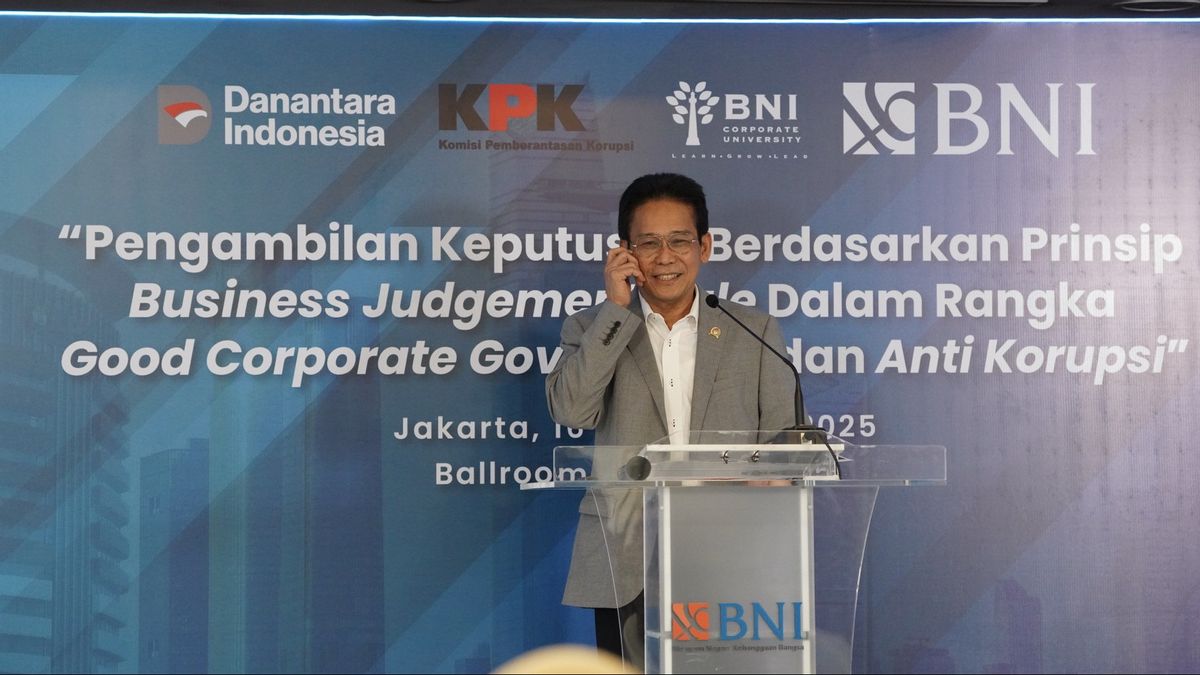


JAKARTA - The Corruption Eradication Commission (KPK) reminded the directors of state-owned enterprises (BUMN) to make business decisions that prioritize ethics and professionalism.
Implementation of the business judgment rule (BJR) does not mean that they are protected from the law when committing fraud.
This was conveyed by the Deputy Chairperson of the KPK Johanis Tanak while attending the Compliance Forum entitled 'Decision Making Based on Business Judgment Rules Principles in the Context of Good Corporate Governance and Anti-Corruption' at Grha BNI, Tuesday, September 16.
The provisions of BJR are known to be listed in Article 97 paragraph 5 of Law Number 40 of 2007 concerning Limited Liability Companies. It is stated that the board of directors cannot be held accountable for the company's losses as long as they can prove losses not due to mistakes or negligence; the decision was taken in good faith, with care, according to the company's objectives; no conflict of interest; and steps have been taken to prevent or minimize losses have been taken.
"The business judgment rule is not a protection for immunity, but a guideline so that every business decision is based on the good faith, prudence, and interests of the company," Johanis said in an official release from the institution, Saturday, September 20.
Johanis said that the implementation of BJR did protect the directors and commissioners.
As long as their decision is transparent, accountable, and without a conflict of interest so that it is not only short-term profit-oriented, but also safeguards the company's sustainability, protects the interests of the country, and increases public trust.
In implementing BJR, continued Johanis, each company must make decisions that are in line with the Company's Work Plan and Budget (RKAP). This principle is expected by the company to be able to build healthy governance as well as achieve optimal performance.
"The prevention of corruption must start from strengthening the system. With the implementation of the correct Business Judgment Rule, SOEs will be more daring to make strategic decisions, protected from baseless criminalization, as well as more immune from corrupt practices," he stressed.
In addition, Johanis also mentioned KPK data which stated that 181 cases were handled and involved BUMN/BUMD throughout 2004-2025. Of that number, 38 of them occurred in 2024.
"This fact confirms that every business decision must be based on the objectivity and principles of good corporate governance," said Johanis.
SEE ALSO:
-
 | BERITA
KPK Jadwal Ulang Pemanggilan Kasi Pidsus Kejari Kolaka Yayan Alfian terkait Suap RSUD Koltim
20 September 2025, 11:20 -
 | BERITA
Penyidikan Korupsi Kuota Haji Disebut KPK Tak Mengarah ke Ormas Keagamaan
20 September 2025, 10:50
Meanwhile, BNI President Director Putrama Wahyu Setyawan emphasized his commitment to preventing corruption. He also agreed that BJR is legal protection for decision makers as long as it is carried out with the principle of prudence and company interests.
BNI is committed to building an anti-corruption culture through various sustainable initiatives. Among them are the internalization program of anti-corruption values through BNI Corporate University, the provision of new employees, to strengthening the gratification control system," said Putrama.
"We also continue to remind all BNI personnel to refuse and report gratification as a step to maintain the integrity of the company," concluded Putrama.
The English, Chinese, Japanese, Arabic, and French versions are automatically generated by the AI. So there may still be inaccuracies in translating, please always see Indonesian as our main language. (system supported by DigitalSiber.id)
Most Popular Tags
#Prabowo Subianto #donald trump #2026 World Cup #Febrie Adriansyah #8791Popular


