

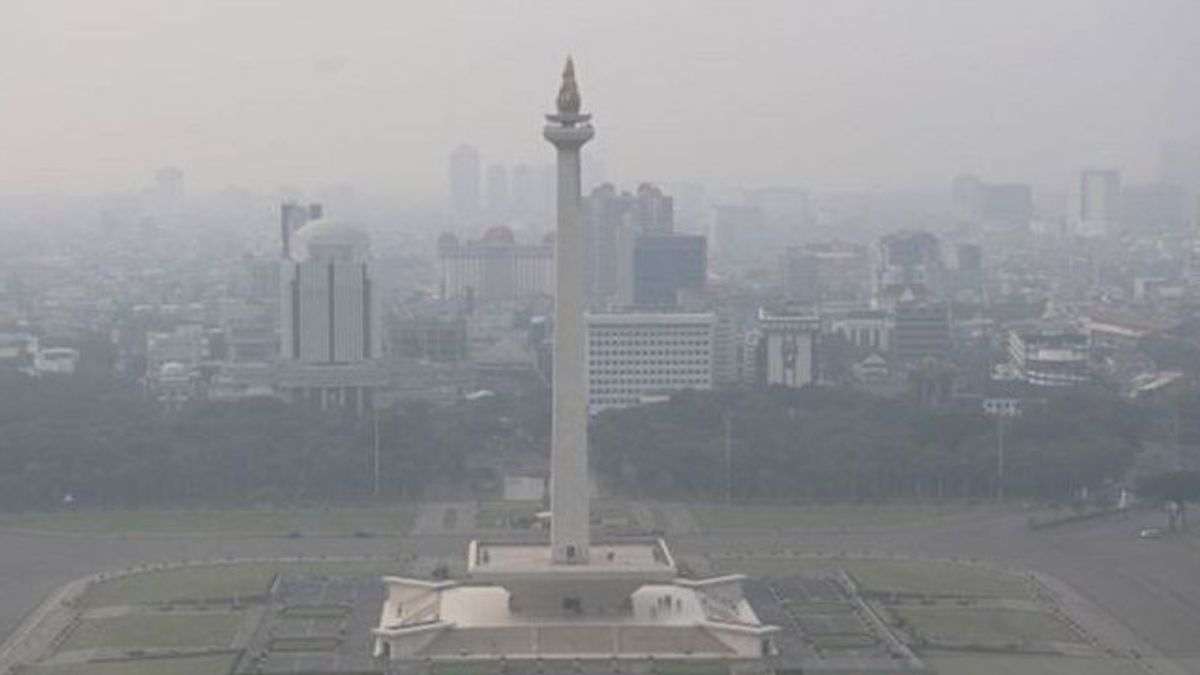


JAKARTA - The air quality of the City of Jakarta on Tuesday, September 16, was recorded as unhealthy for sensitive groups, so they were advised to wear masks when they were outside the house, according to the IQAir page with an update at 05.00 WIB.
According to ANTARA, IQAIR noted that Jakarta's air quality was at point 132 with a concentration level of PM 2.5 pollutants of 48 micrograms per cubic meter or 9.6 higher in the annual air quality guide value of the World Health Organization (WHO).
PM 2.5 is a 2.5-micrometer smaller particle found in the air including dust, smoke and jelaga. This particle exposure in the long term is associated with early death, especially in people who have chronic heart or lung disease.
Health recommendations related to the current air quality in addition to wearing masks, also avoid outdoor activities, closing windows in order to avoid dirty outside air, and turning on air filters.
Jakarta's air quality is recorded to be in second-worst place in Indonesia, after South Tangerang; Banten with 179 points.
The DKI Jakarta Provincial Government (Pemprov) noted that the decline in air quality in Jakarta is not only influenced by activities within the region, but also by meteorological conditions and contributions from surrounding agglomeration areas, such as Bogor, Depok, Tangerang, Bekasi, and Cianjur.
Based on the emission inventory that has been carried out, it is known that the transportation and industrial sectors are still the two main sources of air polluters in Jakarta.
For this reason, the DKI Jakarta Provincial Government is currently focusing on controlling emissions from these two sectors through a number of steps, including socializing the use of mass public transportation and requiring motor vehicle emission tests accompanied by law enforcement, especially for heavy vehicles.
SEE ALSO:
-
 | TEKNOLOGI
AS Ancam Lanjutkan Larangan TikTok Jika China Tidak Hentikan Tuntutan Tarif dan Teknologi
16 September 2025, 02:05

Other efforts are strict supervision of industries such as measuring sustainable emissions in industries that have the potential to carry out pollution.
In addition, reforestation efforts, waste burning control, and exploring the implementation of the Low Integrated Emissions Area (KRE-T) are also continuously encouraged to improve air quality in a sustainable manner.
The English, Chinese, Japanese, Arabic, and French versions are automatically generated by the AI. So there may still be inaccuracies in translating, please always see Indonesian as our main language. (system supported by DigitalSiber.id)
Most Popular Tags
#Prabowo Subianto #donald trump #2026 World Cup #Febrie Adriansyah #8791Popular


