


JAKARTA - US President Donald Trump asked the Supreme Court to ratify his broad emergency rate after two setbacks in the appeals court.
Legal and trade experts say the majority of Republican-appointed Supreme Court judges could slightly increase Trump's chances of maintaining "return fees" and fentanyl-related rates.
Previously, a federal appeals court ruled Trump's tariff was illegal.
Trump said his government would seek an accelerated decision by the Supreme Court.
"Because we need a quick decision," Trump said.
He warned of a "collapse" if the duties he imposed under the International Emergency Economic Power Act (IEEPA) were canceled.
The US Court of Appeals to the Federal Circuit agreed on Friday with lower courts in deciding the IEEPA did not authorize the president to impose tariffs and laws in 1977 did not mention the term among the regulatory authorities he permitted in a national emergency.
This ruling marks a rare setback for Trump, who has sought to reorganize the global economy in the US interest through tariffs by declaring a national state of emergency after experiencing a trade deficit for decades.
Trump has won a series of his policies at the Supreme Court since returning to office, from allowing migrant deportation to allowing bans on transgender people in the military.
High government officials, including Finance Minister Scott Bessent, said they hoped the Supreme Court would support the use of the IEEPA to justify tariffs, but would switch to other legal channels if needed.
The tariff will remain valid until at least October 14 to give the government time to appeal to the Supreme Court.
SEE ALSO:
-
 | BERITA
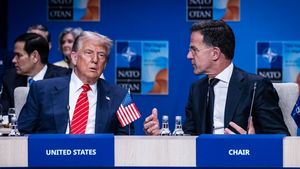
Sekjen NATO Ingin Kepastian Segera Jaminan Keamanan Eropa untuk Ukraina
03 September 2025, 16:55 -
 | BERITA
Zelenskyy: Agresi Rusia Berlanjut karena Kurangnya Tekanan ke Moskow
03 September 2025, 16:39

Trump's Department of Justice believes the law allows tariffs based on emergency provisions authorizing the president to "regulate" imports or completely block them.
How far the unwritten regulatory authority applies is the biggest challenge for Trump's appeal.
Two defeats have prompted several legal experts to predict an initial decision by the International Trade Court against tariffs will eventually be strengthened.
"I find it hard to believe that the Supreme Court will interpret the IEEPA so widely that the President can rewrite the rate code at will, on certain days, and for certain reasons," said John Veroneau, a former US Deputy Representative for Commerce appointed by Republicans and partners in Covington and Burling.
Veroneau said the case would test the Supreme Court's "keyhouse of questions", which states that Congress wants to authorize executive bodies to make decisions that are "very economic and political," it must be carried out explicitly.
The doctrine was used to counter former President Joe Biden in 2023 when the Supreme Court ruled he had exceeded his authority by applying for a student loan cancellation of up to $400 billion.
The key question is whether the court will apply the same standards to Trump's rates. Comparing this to the impact of canceling student loans, the appeals court said in its ruling, "the overall economic impact of the rates imposed on the basis of the government's interpretation of the IEEPA is even greater."
The English, Chinese, Japanese, Arabic, and French versions are automatically generated by the AI. So there may still be inaccuracies in translating, please always see Indonesian as our main language. (system supported by DigitalSiber.id)
Most Popular Tags
#Prabowo Subianto #donald trump #2026 World Cup #venezuela #konflik timur tengahPopular


