

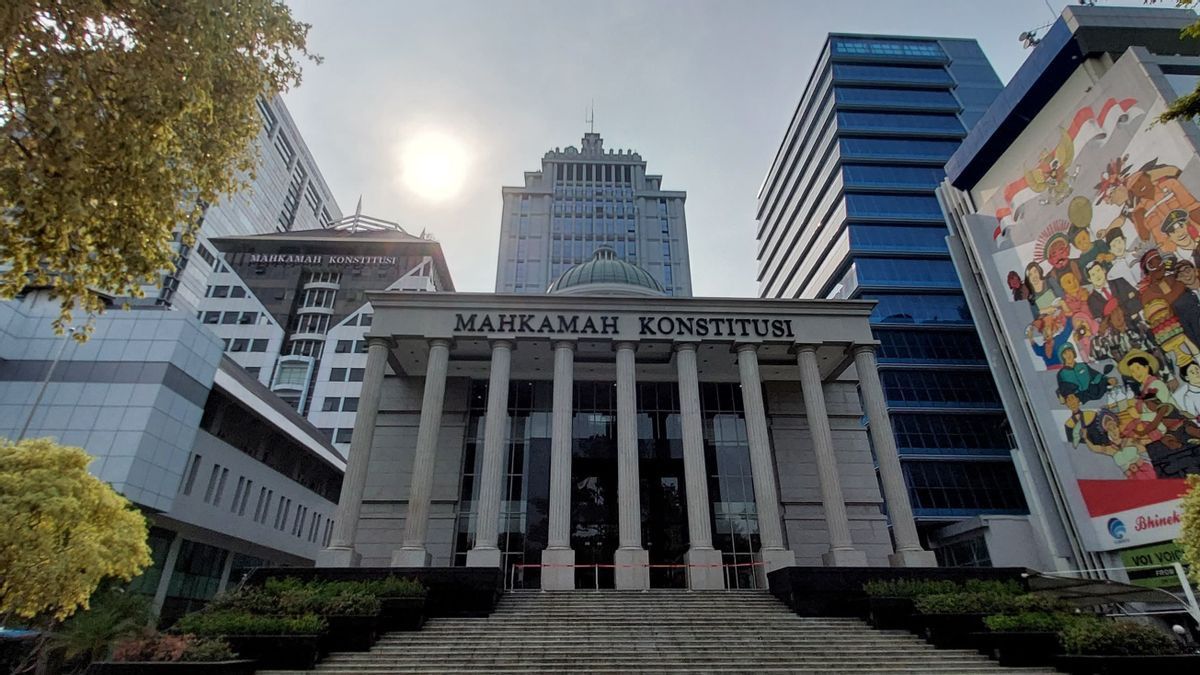


JAKARTA - The Constitutional Court (MK) was asked to exclude journalists, academics, and art actors from prohibiting the disclosure of personal data regulated in Article 65 paragraph (2) and Article 67 paragraph (2) of Law Number 27 of 2022 concerning Personal Data Protection (PDP).
The request was submitted by the Civil Society Coalition for Freedom of Information and Personal Data (SIKAP), consisting of the LBH Pers, the Institute for Community Studies and Advocacy (Elsam), the Alliance of Independent Journalists (AJI) Indonesia, SAFEnet, academics, and art activists.
The Director of LBH Pers, Mustafa, said that the provisions in the two articles are too broad and have the potential to ensnare anyone, including journalists, researchers, and artists.
"It's very wide coverage. There's not even a need to wait for an impact. When I reveal the name or photo of someone who can be identified, regardless of what the intention is, it can already be (criminalized)," said Mustafa at the Constitutional Court Building, Jakarta, Antara, Thursday, July 31.
Article 65 paragraph (2) reads, "Everyone is prohibited unlawfully from disclosing Personal Data that does not belong to him," while Article 67 paragraph (2) stipulates a maximum prison sentence of 4 years and/or a fine of up to IDR 4 billion.
Mustafa considered that the formulation in the article was rubber. He gave an example of a journalist case that revealed the names of public officials in the investigation report.
"When journalists reveal the names of public officials who may have been criticized for alleged corruption, then the official is not happy, then it could be reported," he said.
The same thing, according to him, also has the potential to happen to art actors who voice criticism through visual works, such as caricature.
Similarly, the Coordinator of LBH Pers Advocacy, Gema Gita Persada, highlighted the absence of articles in the PDP Law that explicitly refer to public officials' personal data as public information. In fact, data such as criminal and personal financial records are included in the category of specific data that is strictly regulated.
"Without exception to journalistic work or artistic activities, disclosure of criminal records or alleged corruption of public officials is also at risk of being charged with this article," said Gema.
SEE ALSO:
-
 | BERITA
Selain PPATK, Mensos Colek BI Minta Cek Rekening Penerima Bansos Anomali
30 Juli 2025, 06:54


On that basis, the coalition argued that Article 65 paragraph (2) and Article 67 paragraph (2) have the potential to violate the constitutional rights of citizens. They asked the Constitutional Court to state that the articles were contrary to the 1945 Constitution conditionally, if they were not accompanied by exceptions for the purpose of journalism, academics, arts, and literature.
The English, Chinese, Japanese, Arabic, and French versions are automatically generated by the AI. So there may still be inaccuracies in translating, please always see Indonesian as our main language. (system supported by DigitalSiber.id)
Most Popular Tags
#Prabowo Subianto #donald trump #2026 World Cup #Febrie Adriansyah #8791Popular


