


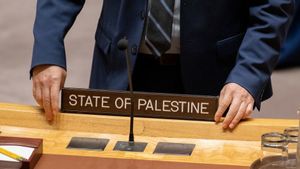
JAKARTA - Law and political observer Pieter C Zulkifli, criticized the government's sending of 10,000 tons of rice to Palestine at the direction of President Prabowo Subianto some time ago. He assessed that the delivery of this rice aid has the potential to be a form of pseudo empathy, both morally and politically.
Because according to him, the 'humanist' step was carried out in the midst of the suffering of the people themselves who are still struggling with hunger and food crises. Pieter said, when the state chooses to appear generous abroad but ignores millions of hungry stomachs in its own village, what happens is not solidarity but betrayal of priority.
"Leaders are not measured by the global image, but from concrete sides with their own people," Pieter Zulkifli said in a statement to reporters in Jakarta, Saturday, July 19.
The former chairman of Commission III of the DPR RI said that in the midst of the prolonged suffering of the Palestinian people, the assistance did reflect Indonesia's concern for the fate of the oppressed nation. However, according to Pieter, the assistance left questions, especially regarding the news that millions of children in the country were still starving.
SEE ALSO:
-
 | BERITA
MK Tak Terima Uji Materi Wamen Rangkap Jabatan karena Pemohon Meninggal
17 Juli 2025, 14:33

"Is this nation really in a position capable of sharing, when the stomach is not full yet?" he said.
Pieter Zulkifli stated that so far the data shows that more than 20 million Indonesians are still experiencing food insecurity. In Papua, East Nusa Tenggara, and a number of Kalimantan areas, said Pieter, the stunting rate for children is still high and millions of families depends on social assistance.
"The public also asked, does this policy reflect a fair priority? The people do not reject aid to Palestine. But they have the right to sue policy logic that seems to think more about global imaging than handling domestic crises," he said.
"And is this really a decision because of the food surplus, or is it just a symbolic step on the international stage? It should be remembered that the national rice reserve stock was below the safe threshold earlier this year," he continued.
Meanwhile, in other data, Pieter continued, Perum Bulog confirmed that as of February 2025, climate disruption and crop failure in a number of areas had caused a significant decline in Government Rice Reserves (CBP). In this context, Pieter said, sending 10,000 tons of rice abroad was not only a logistical issue, but a matter of leadership alignment.
"This is where the public begins to feel bitter. The inequality in the life of the Indonesian people is rarely touched by state political policies, because their leaders are often dissolved in the hedon lifestyle and the imaging stage," he said.
Pieter Zulkifli also emphasized that humanitarian diplomacy is indeed important, but not by ignoring the fact that children in their own country are still malnourished and basic food prices continue to soar.
Meanwhile, according to a recent SMERU Research Institute report, inequality in access to food and nutrition in Indonesia has increased since 2022, exacerbated by the impact of the pandemic and global price spikes.
Pieter assessed that the government can certainly show empathy for Palestine, but the form does not have to be in the form of physical food assistance. For example, he said, diplomatic support, medical contribution, or active role in peace could be a more proportional alternative, without ignoring domestic needs.
Not only that, Pieter also assessed that Prabowo had a great opportunity to record history as a leader with social justice, but the initial step must show firm partiality to the Indonesian people first.
"Hands that are stretched abroad will be more meaningful if the same hands also help the poor hamlets in remote areas of the country," he said.
Pieter Zulkifli agreed that helping Palestine is a calling for conscience. However, he reminded that ensuring the stomach of Indonesian children is not empty is a constitutional mandate.
"In the midst of a world full of conflict, Indonesia is indeed required to appear as a moral force. But that strength can only be strong, if it moves on domestic justice. Otherwise, humanity will fall into a political stage, and empathy is only a diplomatic rhetoric that loses meaning," he concluded.
As is known, the Ministry of Agriculture (Kementan) officially released 10,000 tons of rice to Palestine on Monday, July 7. Minister of Agriculture (Mentan) Andi Amran Sulaiman handed over the aid directly to the Palestinian Minister of Agriculture, Rezq Basheer-Salimia.
In a working meeting with Commission IV of the DPR on the same day, Amran stated that the assistance was a direct direction for President Prabowo Subianto ahead of his departure to the 2025 BRICS Summit (KTT) in Brazil.
"Empathy to Palestine is something to be respected. But the public also cannot turn a blind eye to domestic reality," Amran said.
The English, Chinese, Japanese, Arabic, and French versions are automatically generated by the AI. So there may still be inaccuracies in translating, please always see Indonesian as our main language. (system supported by DigitalSiber.id)
Most Popular Tags
#Prabowo Subianto #donald trump #firearm #8791 #giias 2026Popular


