

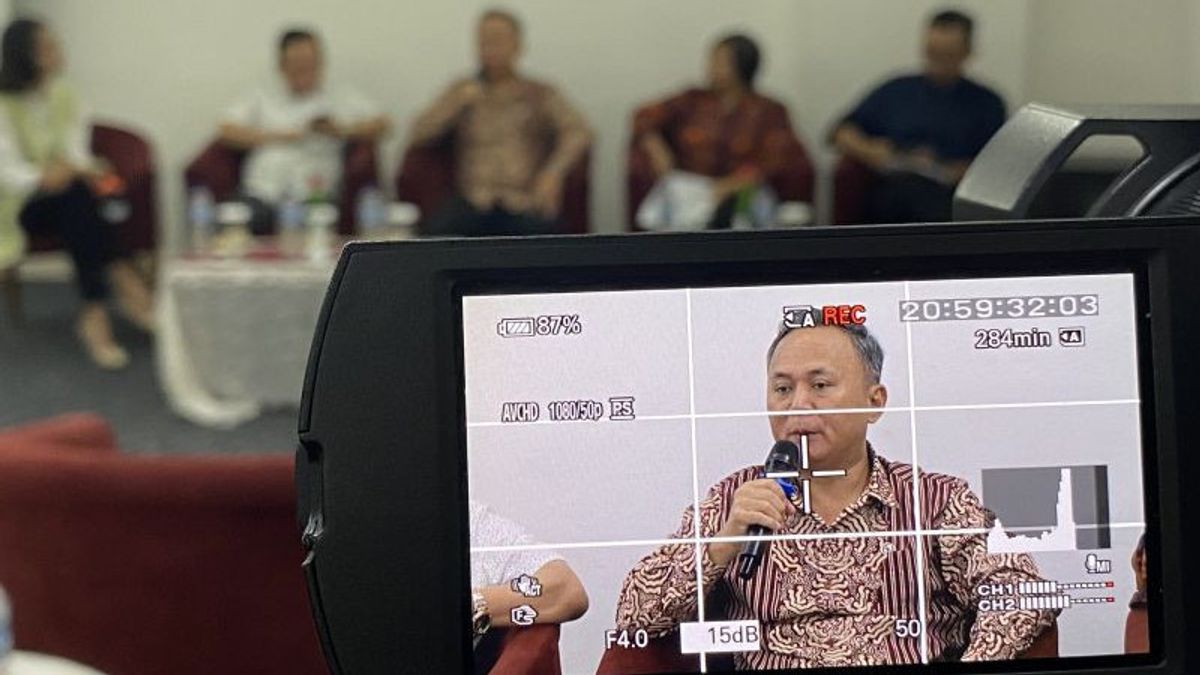


JAKARTA - Deputy Minister (Wamen) HAM Mugiyanto said it was appropriate if the revision of the Criminal Procedure Code (RKUHAP) was carried out quickly, but was not in a hurry, because considering the new Criminal Code (KUHP) would soon take effect.
The KUHP will start to function effectively on January 2, 2026. This must also be balanced by the Criminal Procedure Code which also has to be adjusted. In my opinion, it is appropriate when the spirit is that this revision is carried out quickly, but it is not rushed," he said in a discussion entitled Revision of the Criminal Procedure Code and Human Rights Guarantee reported by ANTARA, Friday, July 18.
According to him, being fast and not in a hurry reflects that there are careful steps. This is to ensure that the revision is really going to be improved, while ensuring that the aspirations that develop in society can be accommodated.
The Ministry of Human Rights, added Mugiyanto, also has an interest in the RKUHAP.
He said his ministry was responsible for ensuring the fulfillment of aspects of promotion, respect, protection, enforcement, and respect (P5) HAM.
"This means that the regulations issued by the government must hold on to the five Ps. In the context we are talking about, yes, there is protection of human rights against witnesses, suspects, and so on," he said.
For Mugiyanto, RKUHAP as a refinement of the old Criminal Procedure Code, which has been in effect for 44 years, was prepared to find a point of balance between legal order and human rights protection. Even though it was difficult, he was still optimistic that this could be achieved.
He said that human rights protection for the community had been accommodated in the RKUHAP which was currently rolling in Commission III of the DPR RI, because explicitly, witnesses had been allowed to be accompanied by advocates since the investigation stage.
Even so, Mugiyanto emphasized that there is still room for further improvement. In this case, he encouraged the government and the DPR to examine input and criticism from civil society groups.
SEE ALSO:
-
 | BERITA
Kardinal Yerusalem Bawa Bantuan ke Gereja Gaza yang Hancur Diserang Israel
18 Juli 2025, 18:48



He emphasized the importance of implementing the principle of meaningful participation (meaningful participation) as mandated by the Constitutional Court and has become a global agreement in the legislation process.
The meaningful participation is not only listened to or presented, but more than that. So, make sure the input is heard, included or not; and if not, why? So there is a process engagement (involvement), dialogue, like that so that all parties can accept it," he said.
Mugiyanto emphasized that the Ministry of Human Rights continues to coordinate with related ministries/agencies as well as parliament to ensure the achievement of this meaningful participation.
"We from the Ministry of Human Rights, as part of the government, yes, of course, will coordinate with the Ministry of Law regarding the inputs that exist in the community and will continue to coordinate and communicate with Commission III," he said.
The English, Chinese, Japanese, Arabic, and French versions are automatically generated by the AI. So there may still be inaccuracies in translating, please always see Indonesian as our main language. (system supported by DigitalSiber.id)


