

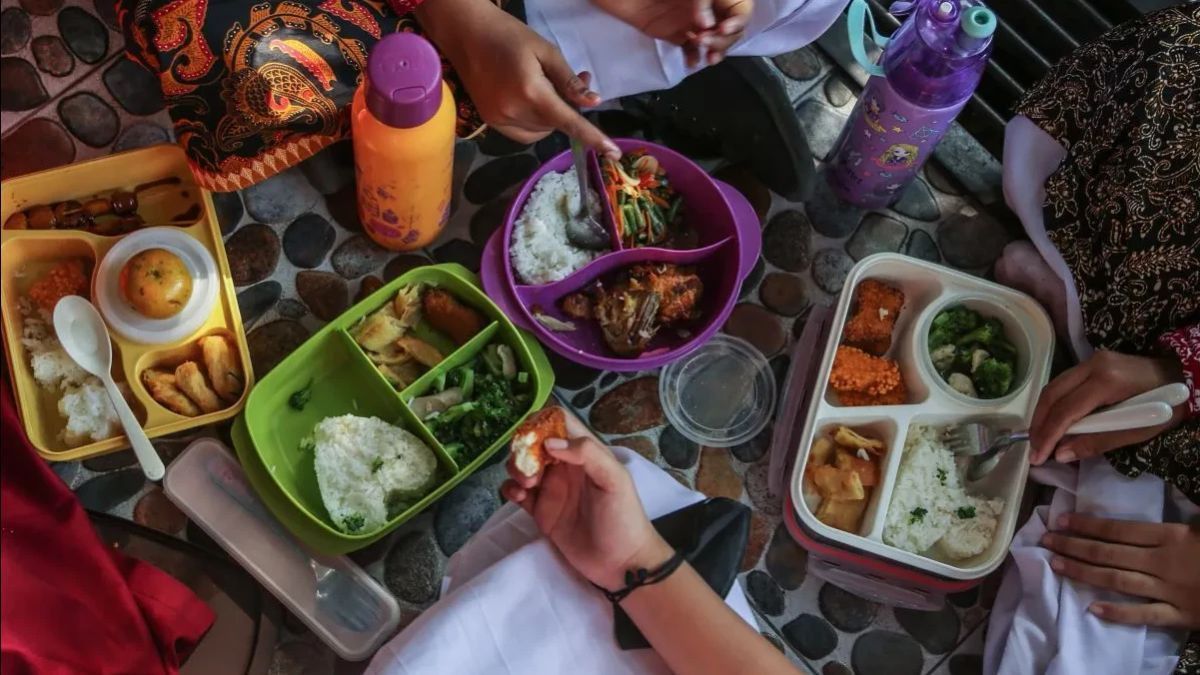


JAKARTA - Head of the National Nutrition Agency (BGN), Dadan Hindayana, emphasized that the implementation of the Free Nutrition Food Program (MBG) for students during the school holidays depends on the willingness of students to attend school. Food distribution is still carried out based on school, not on their respective homes.
"The implementation of MBG for school children is still school-based. So, it really depends on the willingness of children to attend. If students are willing to come to school, even if it is only once a week, then at that time we will provide fresh food and also supplies for two days. For example, in the form of boiled eggs, fruit, milk, nuts, or cake dry fortification," said Dadan, quoted by ANTARA, Wednesday, June 25.
He emphasized that there is no policy in the MBG program to distribute raw materials to students. This program is a nutritional intervention designed to provide ready-to-eat food, not raw materials or food assistance.
There has never been a policy of providing raw materials. If someone distributes raw materials, it is their own initiative and does not comply with the procedure," he added.
Dadan explained, if in an area no students or teachers are willing to attend school during holidays, then food distribution for school children is temporarily suspended. However, nutrition services continue to run for other vulnerable groups such as pregnant women, breastfeeding mothers, and toddlers.
"Every Nutrition Fulfillment Service Unit (SPPG) continues to serve the group because the distribution is carried out to their respective homes or to the posyandu, six days a week, and knows no holidays," he explained.
This statement was conveyed by Dadan in response to findings in a number of areas, including South Tangerang, Banten, where students reportedly received raw materials and ultra-process food as part of the MBG program during the school holidays.
Photos circulating on social media show packages containing rice, salted fish,gale eggs, snacks, instantarized cereals, biscuits, and fruits. The content drew public criticism because it was deemed inconsistent with the principles of nutrition intervention carried out by BGN.
SEE ALSO:


Dadan said the incident only occurred in one in 1,885 SPPGs spread throughout Indonesia. He asked that the case not be generalized, because the majority of MBG implementers had understood and carried out the procedure properly.
"If only one of the 1,885 SPPGs is wrong, it means that it is a misinterpretation of the procedure. Others remain solid in carrying out according to directions," he said.
The English, Chinese, Japanese, Arabic, and French versions are automatically generated by the AI. So there may still be inaccuracies in translating, please always see Indonesian as our main language. (system supported by DigitalSiber.id)
Most Popular Tags
#Prabowo Subianto #donald trump #Febrie Adriansyah #8791 #giias 2026Popular


