

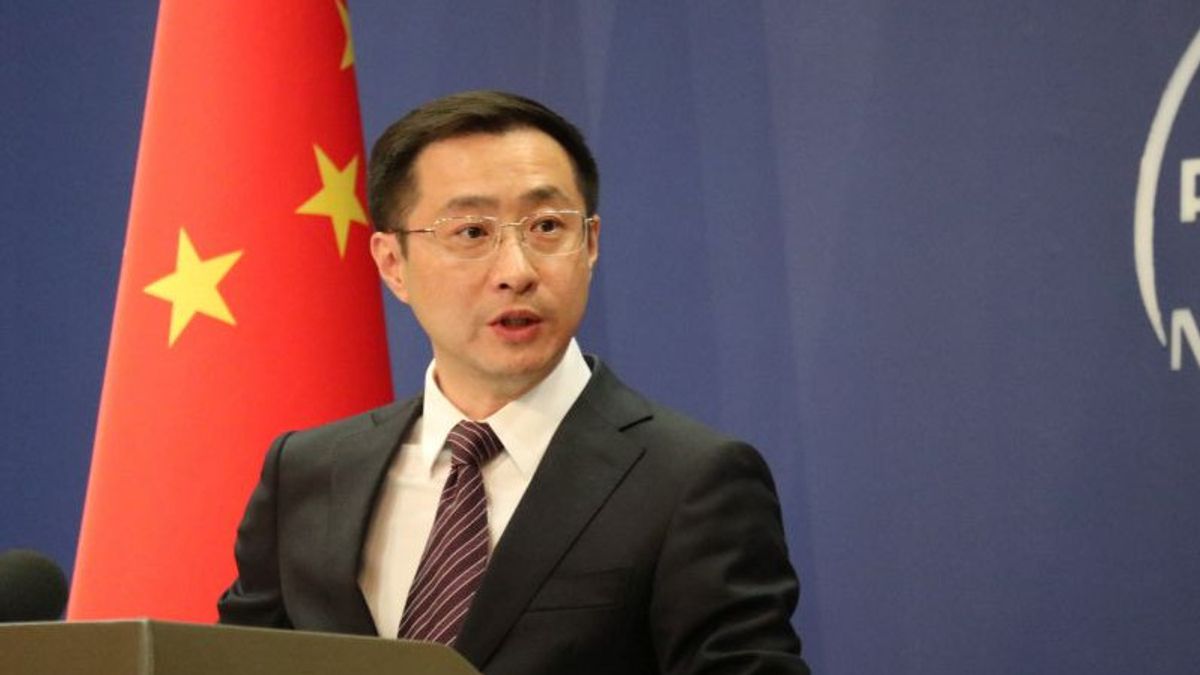


JAKARTA - The Chinese government called four defense ministerial ministers from the United States, Japan, Australia and the Philippines spreading false accusations about the "Chinese threat" in the South China Sea and the East China Sea.
"The US, together with Japan, Australia, and the Philippines, have bravely spread false accusations of 'Chinese threat' in 'Shangri-La Dialogue' and are trying to use the East China Sea and South China Sea issues to sow disputes and trigger confrontations between countries in the region," Chinese Foreign Ministry spokesman Lin Jian told a news conference in Beijing on Tuesday, June 3.
Deputy Prime Minister of Australia and Secretary of Defense Richard Marles, Japanese Defense Minister Nakaani Gen, Philippine National Defense Minister Gilberto Teodoro, Jr. and United States Secretary of Defense Pete Hegseth met on the sidelines of "Shangri-La Dialogue" in Singapore on Saturday (31/5).
In an official release, the four expressed serious concern about China's destabilization in the East China Sea and South China Sea and any unilateral attempt to change the "state quo" by force or coercion.
They reiterated serious concerns about China's dangerous behavior in the South China Sea towards the Philippines and other countries, and stressed the importance of resolving disputes peacefully.
"China deeply regrets and firmly opposes it, and has filed a serious protest," said Lin Jian.
Lin Jian said the politics of blocks and confrontations were products of the mentality of the Cold War so that they were no longer in accordance with the trends of the times and were not welcomed by countries in the region.
"Block politics and confrontation will not solve any problems, let alone intimidate China. We will not be afraid in defending China's territorial sovereignty and maritime rights and interests," added Lin Jian.
China, Lin Jian said, called on the US and its allies to stop slander and defamation, stop distorting facts and diverting errors to maritime issues and stop bringing together exclusive small groups.
"We also ask the US to stop disturbing the efforts of related parties to resolve problems through dialogue and consultation and maintain regional peace and stability," said Lin Jian.
SEE ALSO:

The meeting of the Defense Ministers from the US, Australia, Japan and the Philippines also underscores the importance of enforcing international law, freedom of navigation and aviation, particularly as reflected in the United Nations Convention on the Law of the Sea. Defense ministers call for peace and stability in the region.
They underlined the importance of ASEAN's main role and regional architecture led by ASEAN in ensuring security and stability in the Indo-Pacific region.
"In dealing with what we all describe as the unprecedented development of military capacity by China," said US Defense Secretary Pete Hegseth.
"We have seen the largest conventional military development in the world since the end of the Second World War carried out by China, and it affects the strategic landscape and strategic complexity for the region, for the world, for all of us," said Deputy Prime Minister of Australia and Defense Minister Richard Marles.
Meanwhile, Philippine Defense Minister Gilberto Teodoro said that through his defense with the US, Australia, and Japan, it would bring mutual prosperity to the people.
"Those who need the most prosperity are those who are the most victims of China's excess actions. We feel that this group is not an exclusive group but inclusive, transparent under international law," said Defense Minister Gilberto.
Furthermore, Japan's Defense Minister Nakaati revealed that China's activities in the East China Sea and South China Sea were more provocative than before.
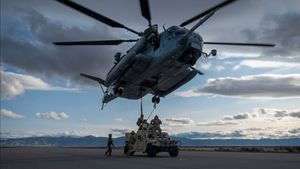
The four also agreed to support their defense infrastructure investment, namely jointly installing a Japanese-made air surveillance radar system at Wallace Air Base, the development and integration of a continuous air domain sensor by the US at the Basa Air Base Command and Control Fusion Center and Australia supports Philippine Air Force infrastructure in the South China Sea.
The English, Chinese, Japanese, Arabic, and French versions are automatically generated by the AI. So there may still be inaccuracies in translating, please always see Indonesian as our main language. (system supported by DigitalSiber.id)
Most Popular Tags
#Prabowo Subianto #donald trump #2026 World Cup #venezuela #konflik timur tengahPopular


